Arpeggios for Guitar: The Easiest Way to Get Unstuck on Guitar
If you’ve been stuck playing the same licks over and over, this one’s for you. Today we’re talking arpeggios.
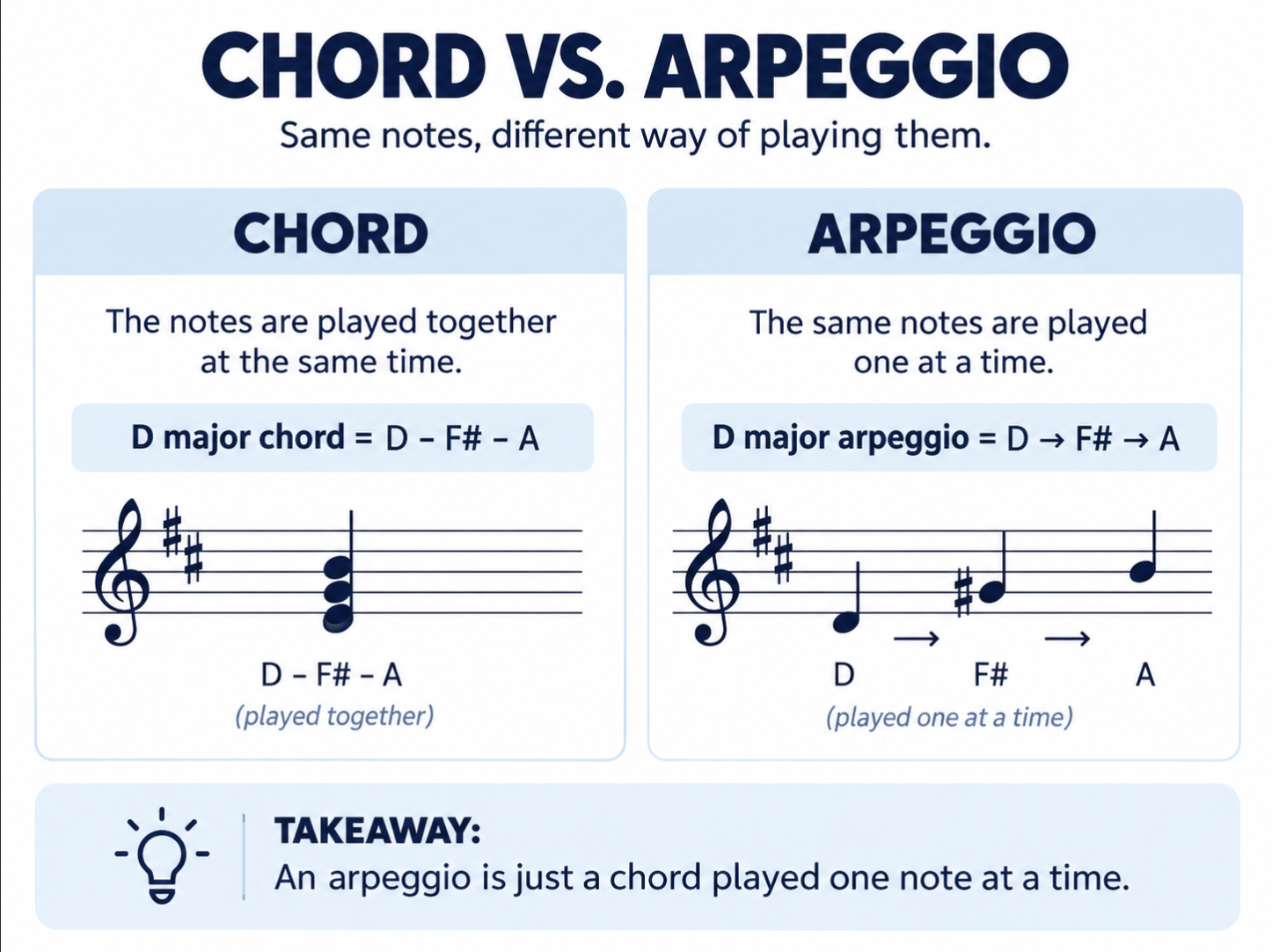
Aside from being a really cool word, an arpeggio is basically a chord. The difference is that instead of playing all the notes at the same time, you play each note one at a time.
Strum a D major chord and you hear all of it at once. Pick those same notes one after another and you’ve got an arpeggio. That’s it.
Why Should You Even Care About Arpeggios?
Arpeggios give you melodic harmony over chords. They’re the fastest way I know to find your chord tones, especially when you’re improvising or trying to write a melody.
They also work as a road map when you’re soloing. They keep you in check and show you where you are on the neck. If you get lost, you can always find your way back home.
And they’re great for pulling triads and inversions out of chords. We’ll get to that near the end.
The Guitar Newsletter That Doesn’t Suck
Free every week: licks to steal, gear talk, rock trivia with prizes, guitarist spotlights, and more.
A Quick Word on the CAGED System
If you haven’t looked into the CAGED system yet, do it. It’s one of the most useful ways to find arpeggios all over the neck.
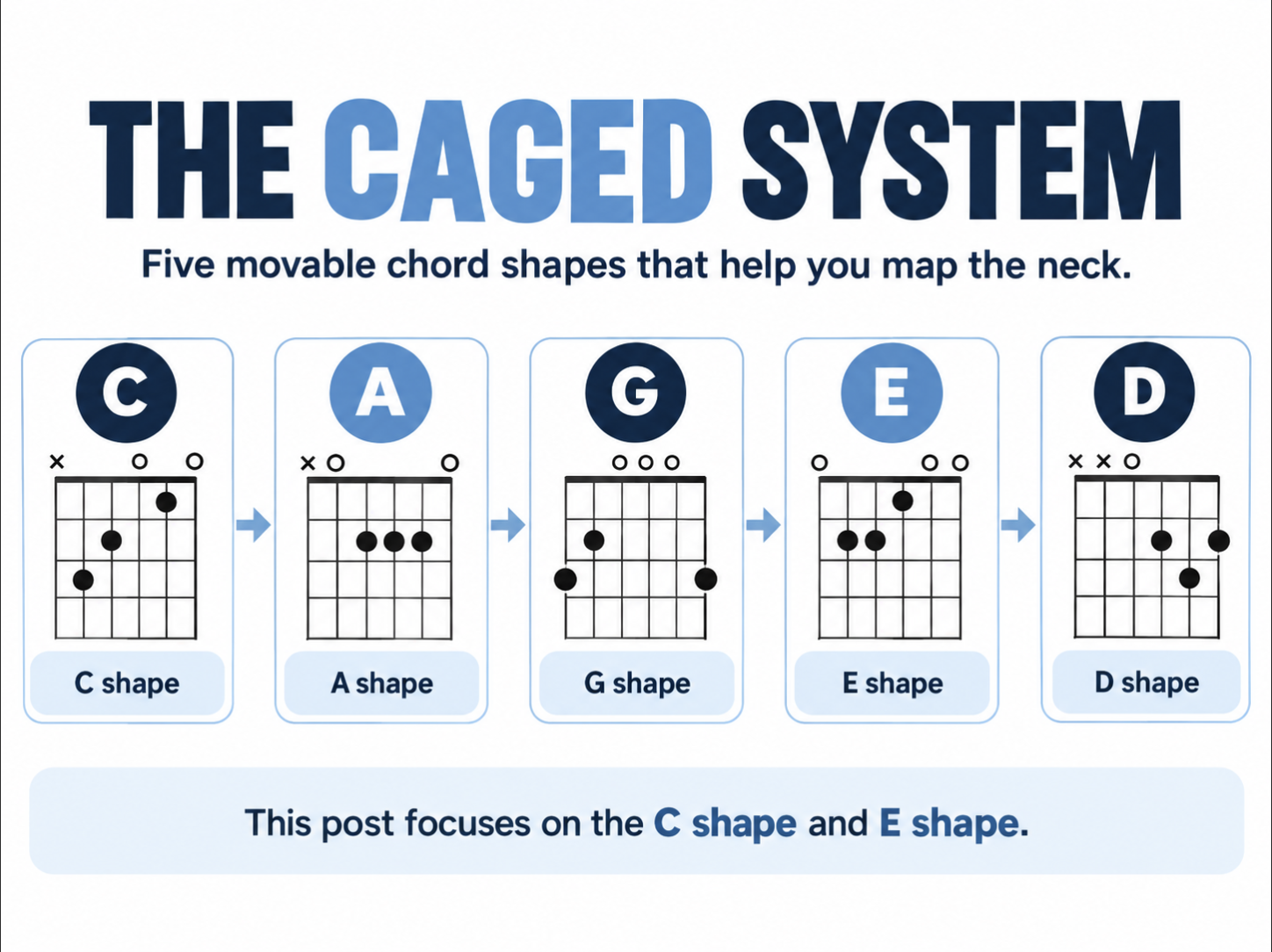
All it really means is taking the five open chord shapes (C, A, G, E, and D) and treating each one as a shape you can move anywhere on the neck to play any chord.
So if you play a C major chord in the C shape, then the A shape, the G shape, the E shape, and the D shape, you’ve played C major in all five positions up the neck.
In this post we’re working with two of those shapes: the C shape and the E shape.
The C-Shape Arpeggio (Major)
This is one of the classic arpeggio shapes, and it’s the one I’d start with.
Start with an open C chord and play it from the bottom up: C, E, G, C, E. That’s 1, 3, 5, 1, 3, lined up perfectly.
A lot of players (especially the sweep pickers) will add the 5th on top too. That gets you 1, 3, 5, 1, 3, 5, and it’s got a really nice sound and shape.
Here’s why this is such a good starting point:
- It’s comfortable, even as you move it up the neck.
- The notes are laid out cleanly. You never have to leave the shape to get 1, 3, 5, 1, 3, 5.
Moving It Up the Neck
Now let’s move that shape up a whole step. Your root note is now D on the A string.
The catch is that you don’t have the nut doing the work for you anymore. So you have to adjust your hand into the shape yourself.
If you were strumming this as a chord, you’d have to barre it. But since we’re arpeggiating, you don’t need to barre anything. Just walk through the notes: 1, 3, 5, 1, 3, 5.
This makes for a really nice sweep shape. Sweeping is tough on an acoustic, but everything stays consistent.
Move it up another whole step and you’re in E major. Leave off the lowest note and you still have 1, 3, 5, 1, 3, 5.
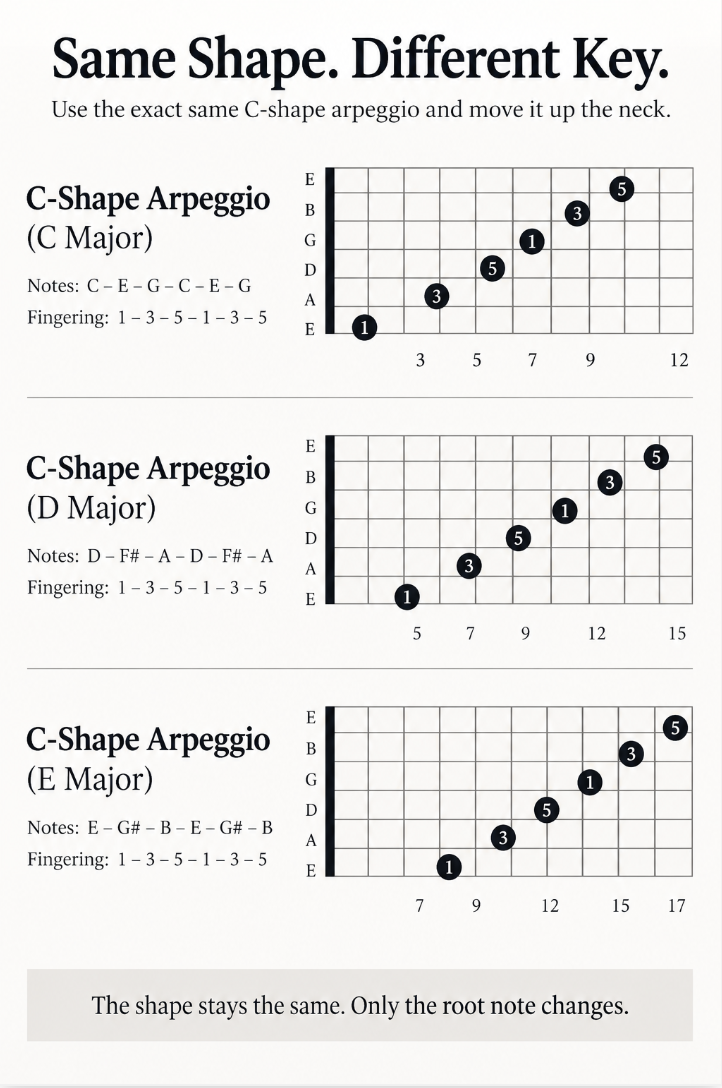
This is what I mean about the road map. Once I’m in this shape, I know exactly where my 1s, 3s, and 5s are. They’re all stacked right there.
The C-Shape Arpeggio (Minor)
If you caught my last live, you saw what happens when you try to play a C minor in open position. It doesn’t work.
You can drop the 3rd to a flat 3rd to get the minor sound, and you’ve still got your 5th and your root. So far you’ve got C, E flat, G, C. The problem is the open high E string. That’s a major 3rd sitting right on top, and if you accidentally hit it, it sounds TERRIBLE.
So skip open position. Move up to D, where you can get every note of the shape.
Remember our major C shape was 1, 3, 5. For minor, we take that 3rd and flatten it. In D, that means the F sharp comes down to F.
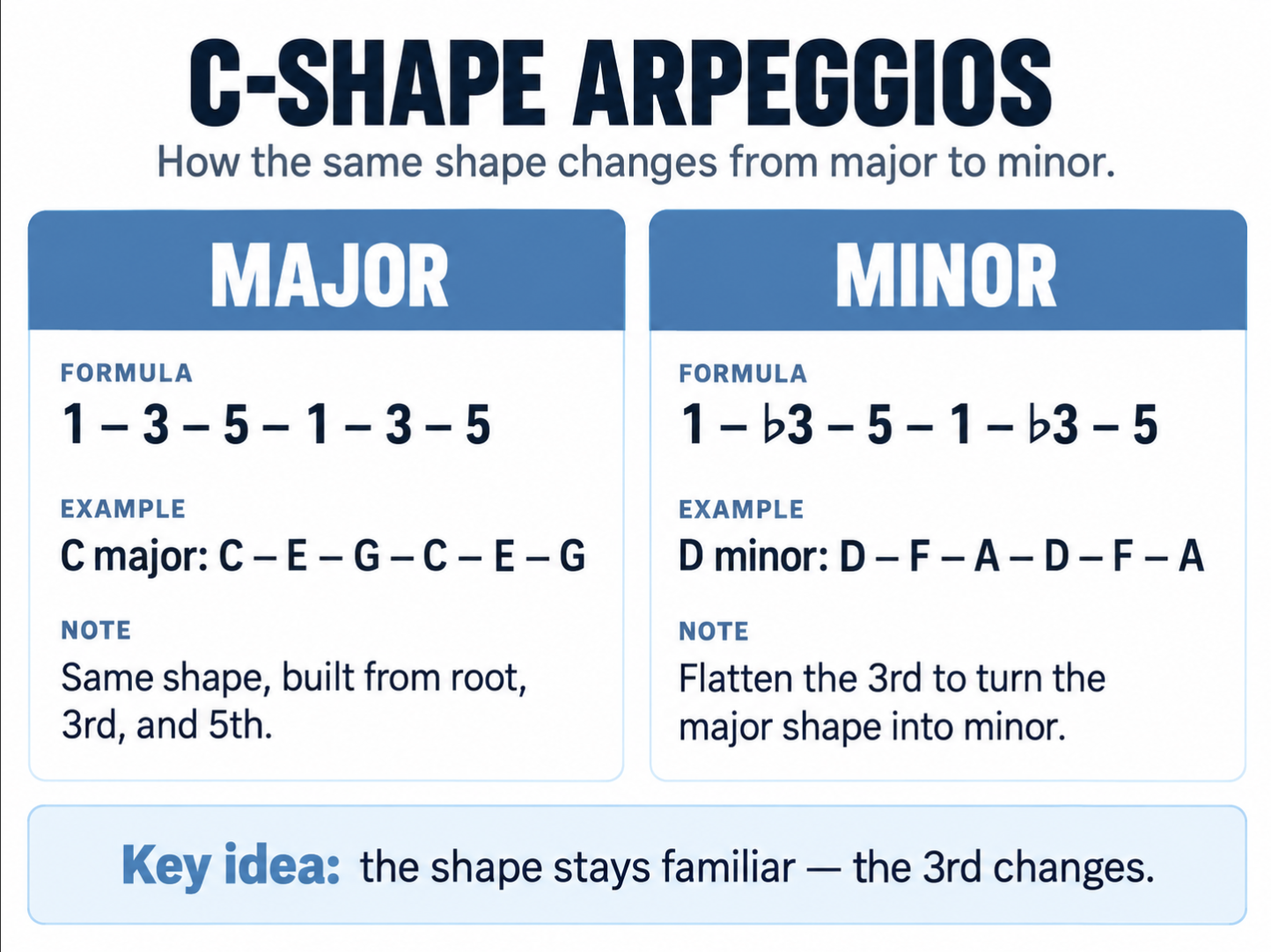
So now it’s D, F, A, then up to the next D, F, A.
Here’s the part I love. The top of this shape is the D minor chord shape you already know. The bottom is a nice clean minor triad.
Sweep pickers will add the 5th on top again, so you get:
1, flat 3, 5, 1, flat 3, 5, then come back down the opposite way.
Slide the whole thing up a half step and you’re in E minor. Really, really sweet.
With the C shape, you can cover pretty much every key. Unless you’re like me, playing an acoustic and running out of frets. Then you need another shape.
The E-Shape Arpeggio (Major)
Take a C major chord in the E shape (the barre chord built off the open E chord, rooted on the low E string). That’s your E-shaped arpeggio.
The full six-string version goes 1, 5, 1, 3, 5, 1.
I’m going to show this one in A so I don’t run out of frets as we move around.
Look at that pattern again and you’ll notice something. There’s no 3rd in the first octave. So to fill it in, go 1, then up two whole steps to the 3, then the 5. The root sits right on top of that 5. Then keep going: 3, 5, 1.
I’ll be upfront about this one. I’ve messed around with the full six-string version, including sweeping it, but I’ve never been great at it. The way it folds back onto itself makes it awkward, and I never put in the practice.
So here’s how I actually play it: 1, 3, 5 in the first octave, then 1, 3, 5 again in the second octave.
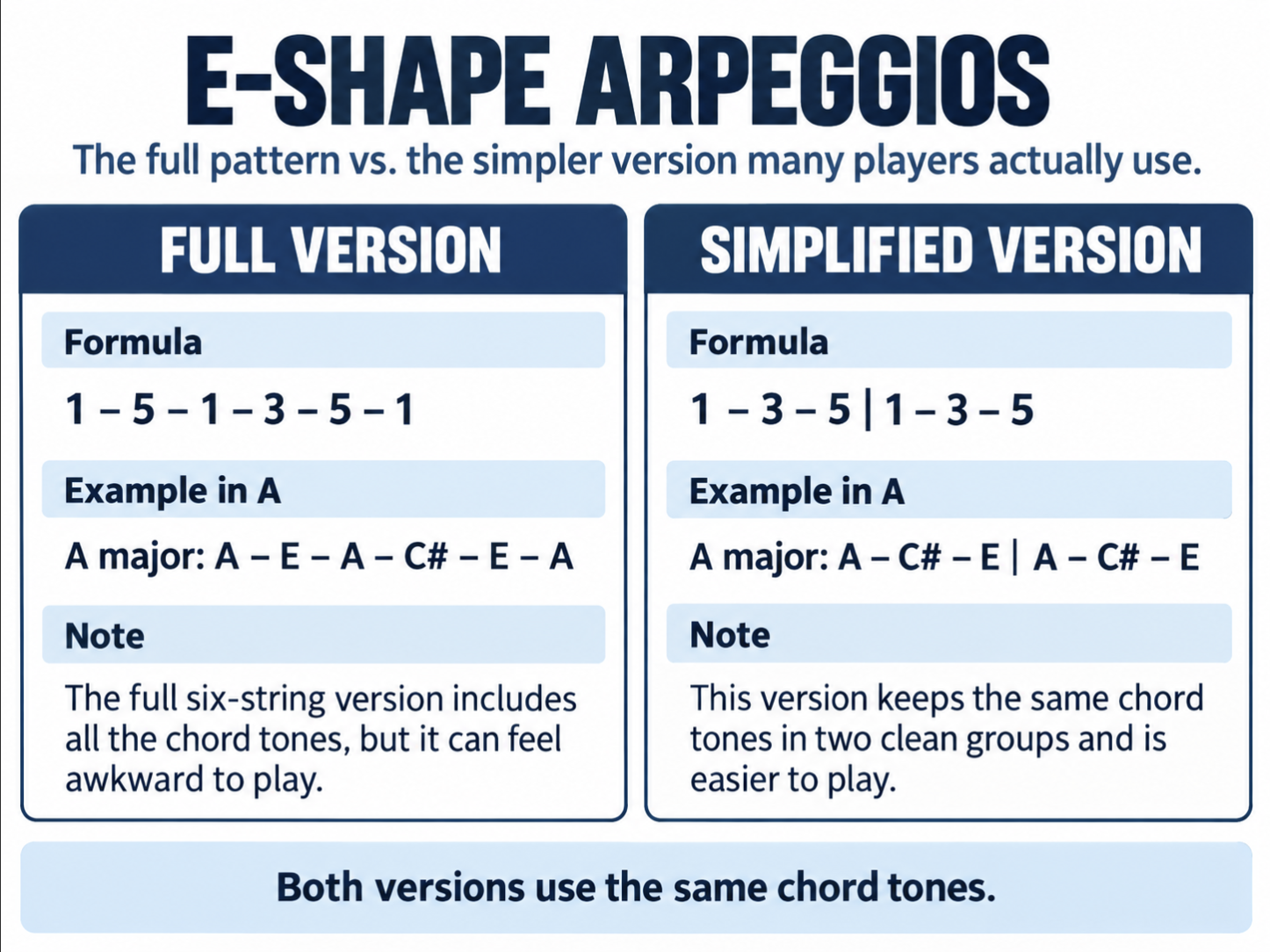
It’s easier to play and you get the same notes. You also skip that slide at the top that loves to come back and mess everything up.
Want it in B? Same exact shape. You’ve got B, D sharp, and F sharp.
The E-Shape Arpeggio (Minor)
To make the E shape minor, pull your notes from the natural minor scale.
Back in A, start from the major scale and make three changes:
- Flatten the 3rd
- Flatten the 6th
- Flatten the 7th
The root, 2nd, 4th, and 5th stay put. That’s your natural minor scale, and those are the notes we’re working from now.
For this shape, I play 1, flat 3, 5, then 1, flat 3, 5 again in the next octave.
It’s a little wonky at first. Once you practice it and get comfortable, it’s really not that bad. And it’s WAY easier than trying to play the full six-string shape up there.
A Word on Sweep Picking
I’ve never been a big sweep picking guy. It can sound cool, and if you’re into it, go for it.
It’s really hard on an acoustic, though. And if you do go down that road, keep a close eye on your picking hand and on keeping it in sync with your fretting hand. That’s the whole game.
Personally, I’ve always used arpeggios more as a vehicle. I pull notes out of them to get to the notes I really want to play.
That’s the beauty of these shapes. They’re built from chord tones, so when you’re improvising over a progression, they lead you right where you need to go. Or they help you find someplace new.
Using Arpeggios to Move Between Shapes
This is more of a concept, but I’ve always thought it was neat.
Say I’m in A major. The scale goes 1, 2, 3, 4, 5, 6, 7, back to the root.
I can play my arpeggio, 1, 3, 5, then think:
- From the 5 to the 6 is a whole step
- From the 6 to the 7 is another whole step
- From the 7 to the 1 is a half step
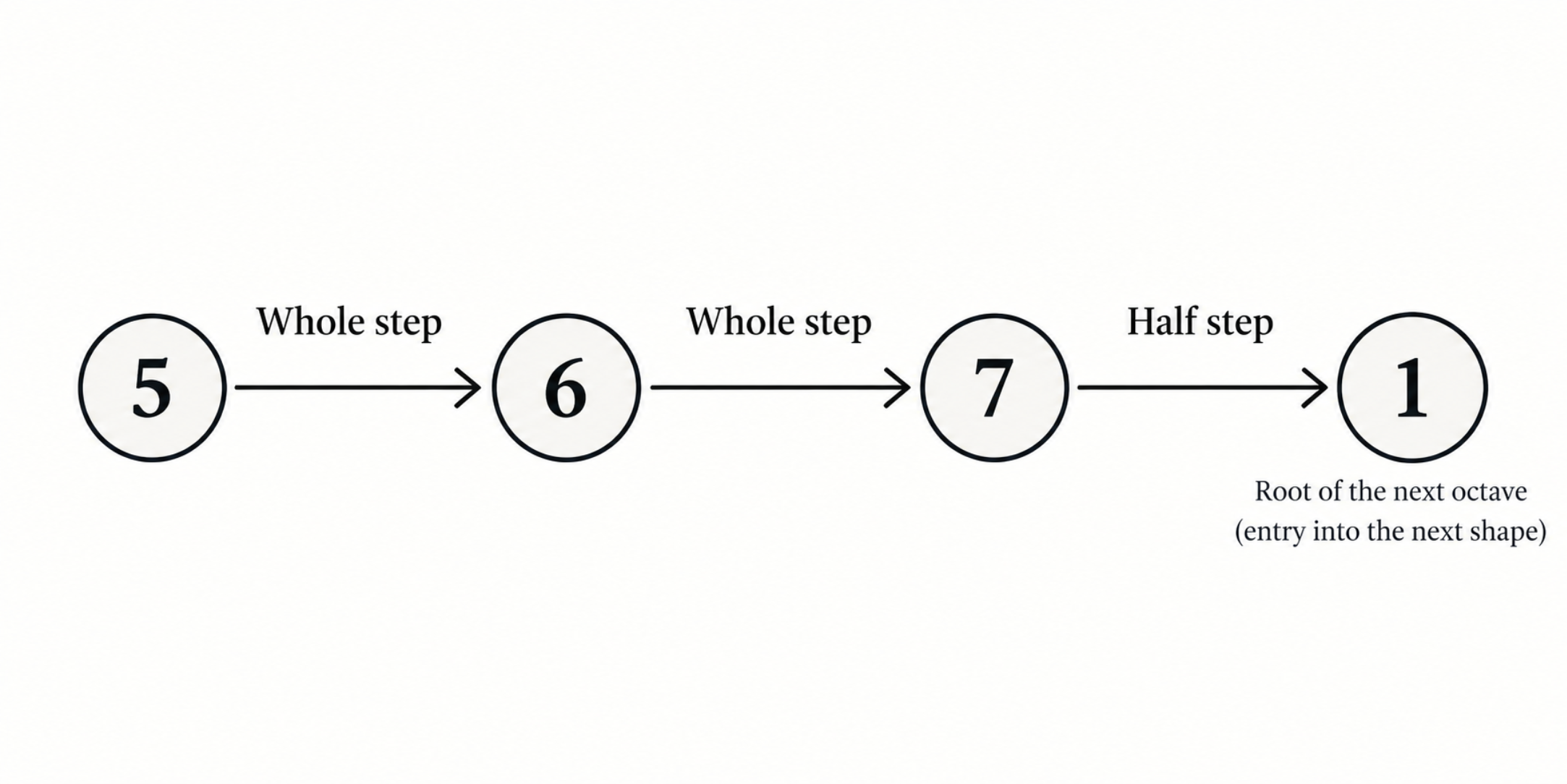
And now I’m at the root one octave up, which puts me in the next shape.
When you think about it that way, you can glide between your two shapes. It stops being “shape one” and “shape two” and turns into one connected neck.
Add Some Movement With 7ths
Here’s another one I love, especially in a minor key.
I’m a big fan of 7th chords. So instead of running straight up and down the arpeggio, I’ll give it more movement.
Something like: 1, flat 3, 5, flat 7, then back down 5, flat 3.
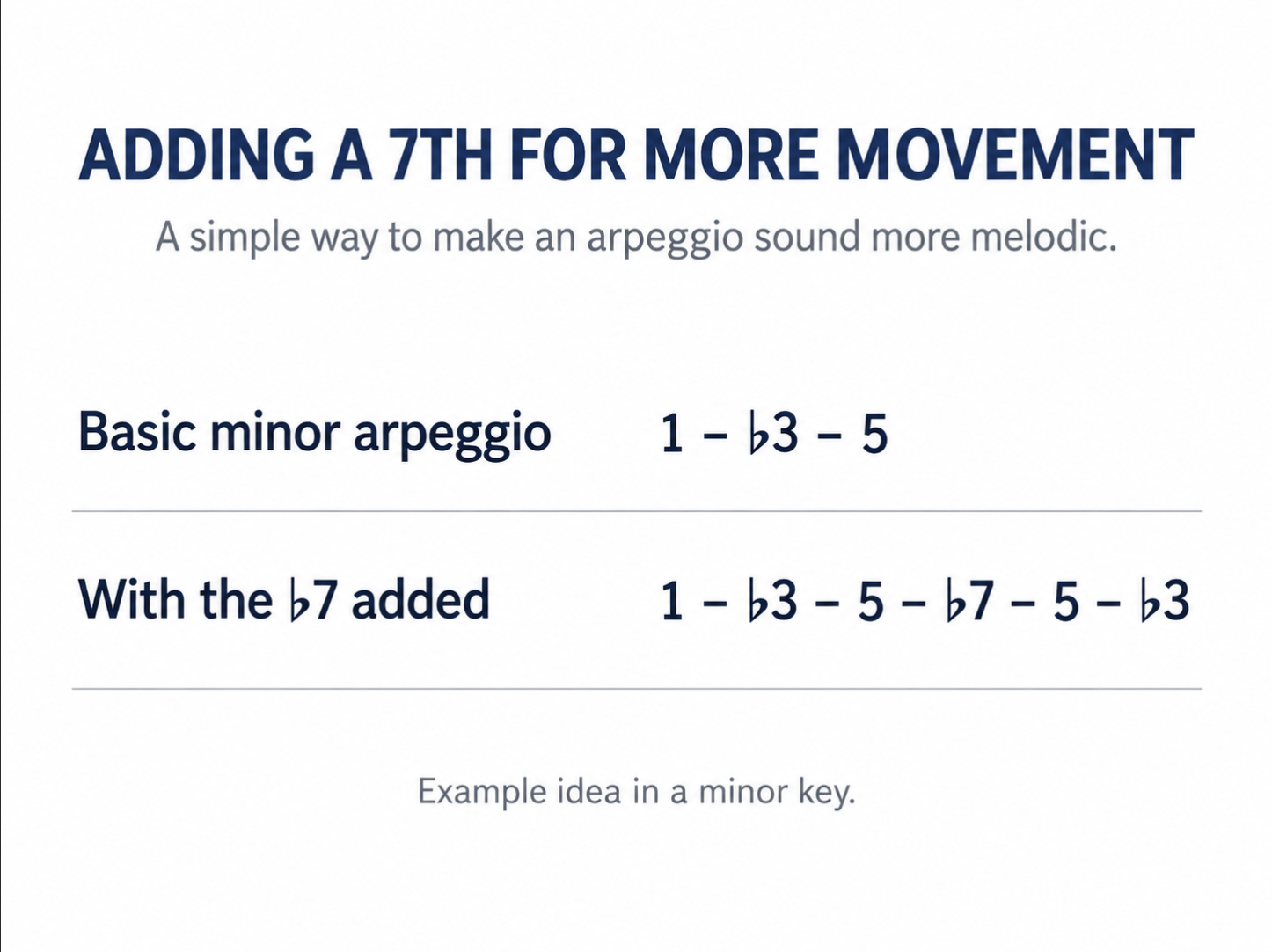
Hear how that flows? It’s got more movement and more melody. I especially love doing stuff like this in the Dorian mode. It just sounds a little more unique, at least to my ear.
Bonus: Triads and Inversions From One Shape
I’d love to do a full deep dive on this another time, but here’s a taste.
Take a G-shape arpeggio in the key of C. Out of that one shape, you can get:
- Root position: 1, 3, 5
- First inversion: 3, 1, 5
- Second inversion: 5, 1, 3
All from a single shape. That’s really handy.
Fun fact: that inversion shape is where a lot of that Jimi Hendrix sound comes from.
How to Practice Arpeggios
Start slow. Use a metronome and set it to 60 BPM.
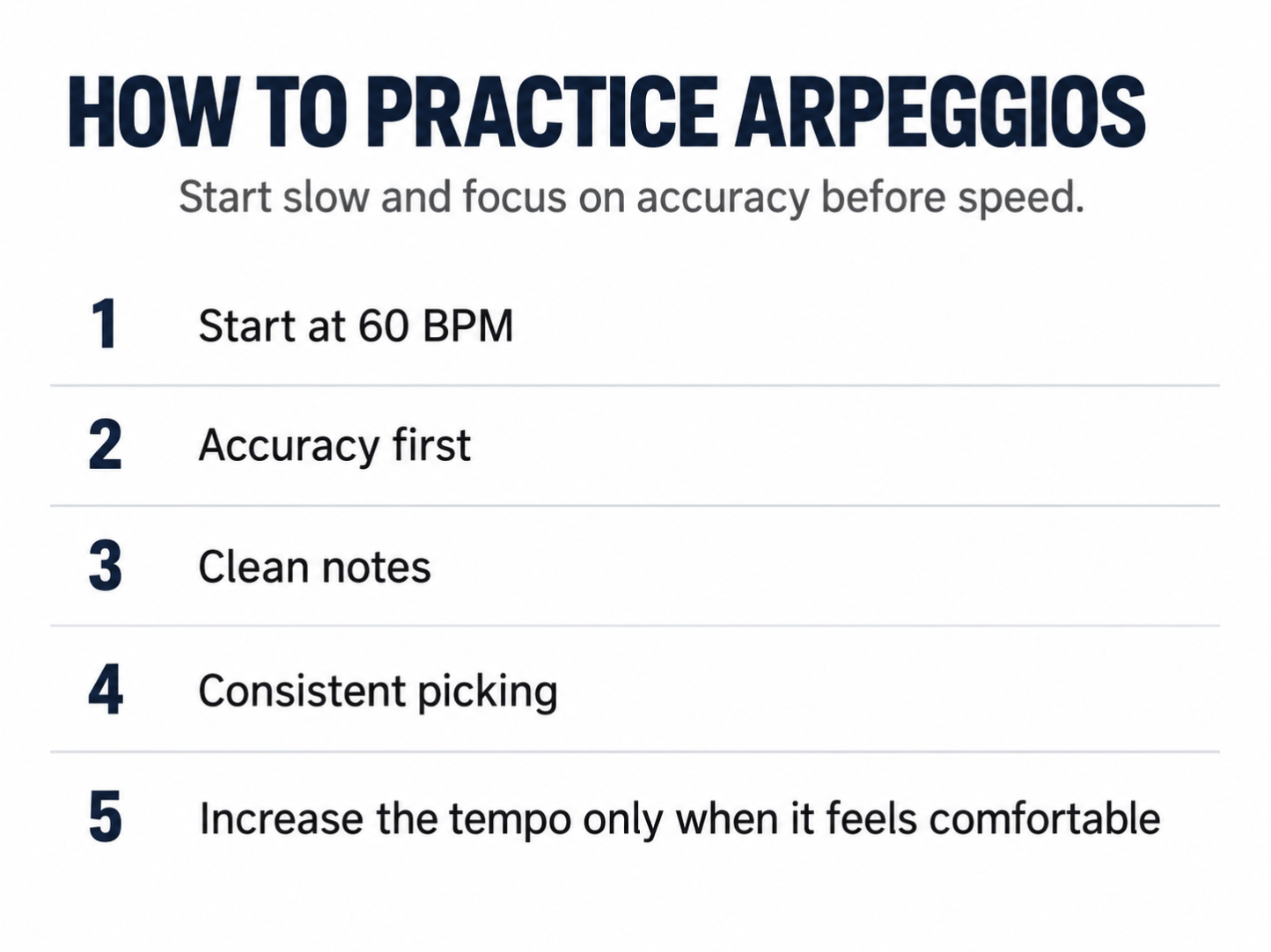
Yes, that’s dreadfully slow. That’s the point. Right now you’re going for accuracy, not speed. Play clean and play accurate. The speed will come once these shapes feel comfortable.
The Picking Hand Drill Nobody Does
If you want to get into the nitty-gritty, arpeggios are AWESOME for your picking hand. Most players neglect their picking hand.
Take that C-shape arpeggio. Any basic chord works, because this drill is all about your picking hand.
Now strict alternate pick through every note: down, up, down, up, down.
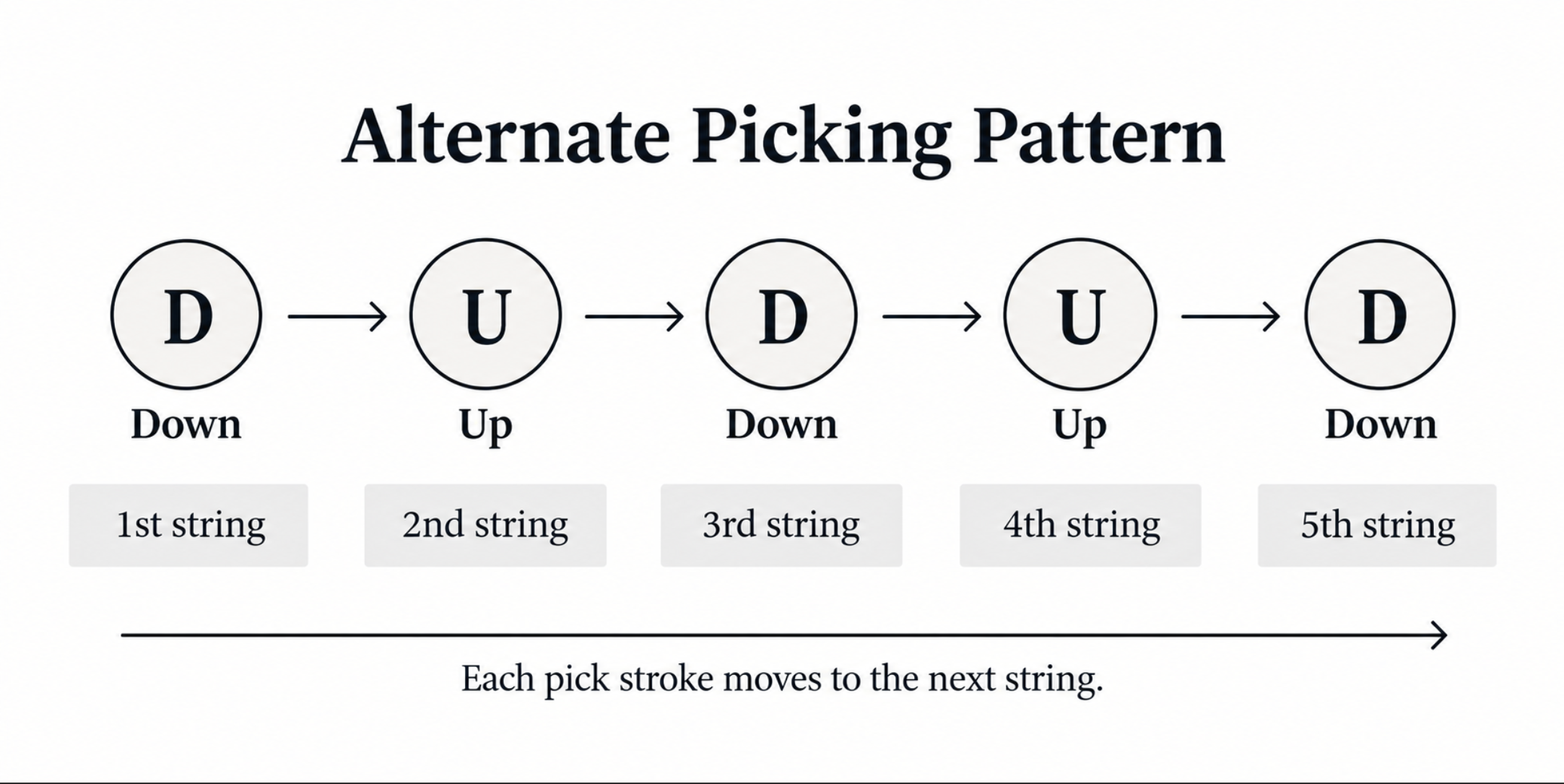
It’s a lot harder than it looks, I promise. Every time you play a downstroke, the next note has to be an upstroke, so you have to jump over the string to get it. Then you jump the next string for the downstroke. It’s constant flip-flopping.
If you want to dial in your picking hand, strict alternate picking through arpeggios is super sweet. Super DUPER sweet.
This Is Just the Beginning
We’ve only scratched the surface here. There are more shapes out there, and there’s so much more you can do:
- Adding 7ths
- Adding extended notes
- Mixing up the order of the notes
This isn’t the be-all and end-all of arpeggios. It’s meant to get your boots on the ground, get you moving, and give you a different way of looking at the chords you already know.
Try something you haven’t tried before. Or look at something familiar from a different angle.
The Guitar Newsletter That Doesn’t Suck
Free every week: licks to steal, gear talk, rock trivia with prizes, guitarist spotlights, and more.