How to Build Chords on Guitar: Easy Chord Construction Theory Every Player Should Know
Today, we’re going to talk all about building chords.
This is easy music theory. It’s the kind of stuff we should ALL know. And once it clicks, a lot of the chord shapes you’ve been playing for years are going to make sense.
What Even Is a Chord?
A chord is just two or more notes played at the same time.
That’s it. When you play notes together like that, they create harmony. And that’s basically what a chord is.
The notes in a major chord (like a nice C major) come from the major scale. The notes in a minor chord come from the minor scale.
So if you know your scales, you can build your chords.
How to Build a Major Chord
We’ll start with C. It’s a nice, clean scale with no sharps and no flats, which makes it way easier to follow along.
Start with the C major scale
Start on the A string, 3rd fret. That’s your C. Now walk up the scale:
- 1: C
- 2: D
- 3: E
- 4: F
- 5: G
- 6: A
- 7: B
- 1 (octave): C
The major chord formula: 1, 3, 5
A major chord is built from three notes of that scale:
- The 1 (root). This sets the stage for what key you’re in.
- The 3. This is the note that tells your ears whether the chord is major or minor.
- The 5. This adds the perfect harmony over the top and completes the chord.
So a C major chord is C, E, and G.
Check it against the chords you already know
Let’s make sure the theory lines up with the shapes you’re already playing.
Open position C chord: C, E, G, C, E. That’s 1-3-5-1-3. It’s just a stack of the same three notes.
A-shape barre chord (3rd fret): C, G, C, E, G. That’s 1-5-1-3-5. Same three notes, different order.
E-shape barre chord (8th fret): C, G, C, E, G, C. That’s 1-5-1-3-5-1. Same rules again.
Every major chord you play follows this. As long as you’ve got the 1, the 3, and the 5 from the major scale, you’ve got a major chord.
The Guitar Newsletter That Doesn’t Suck
Free every week: licks to steal, gear talk, rock trivia with prizes, guitarist spotlights, and more.
How to Build a Minor Chord
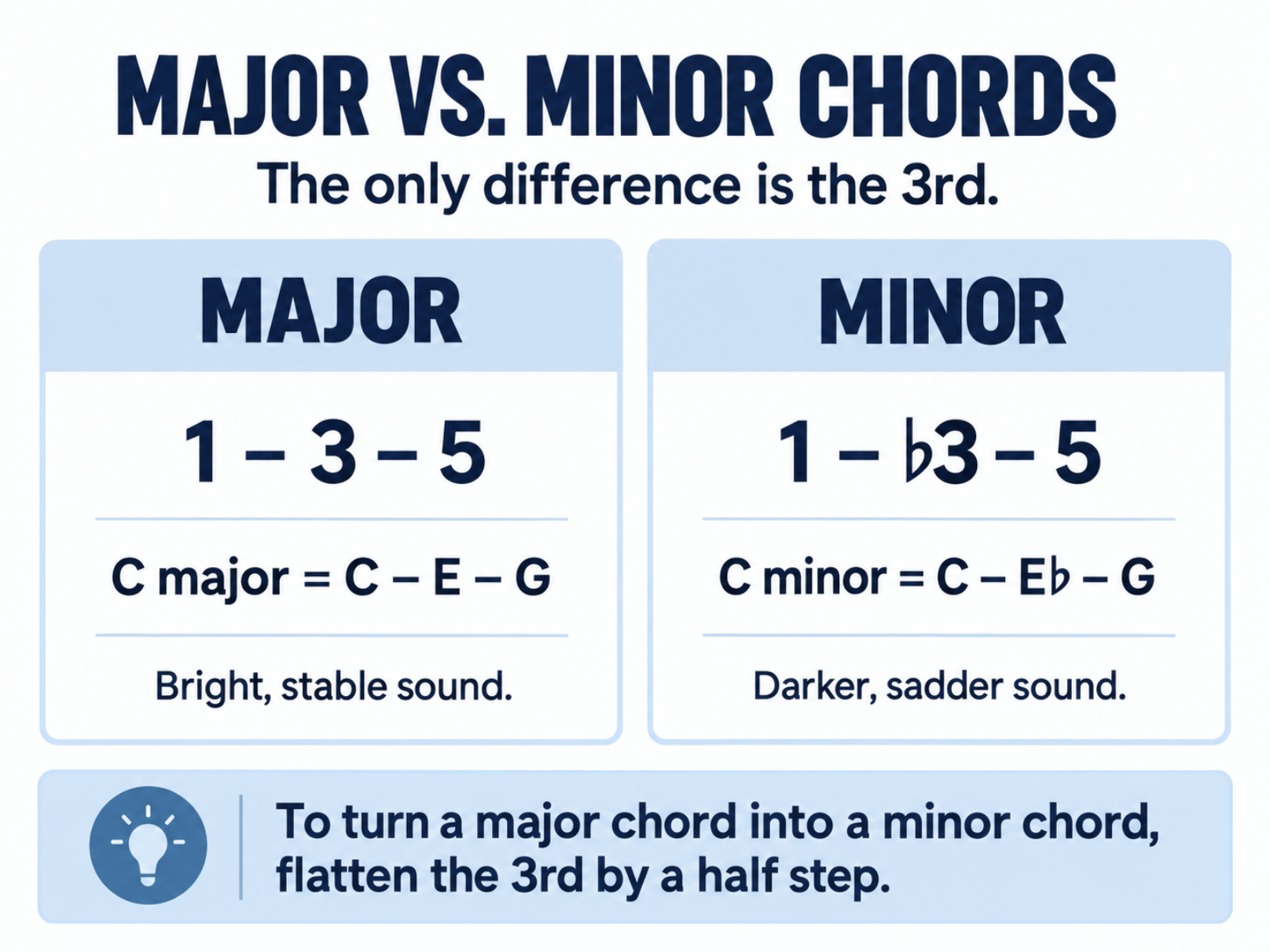
Minor chords follow the same idea. The only difference is we pull from the minor scale instead.
The C natural minor scale
- 1: C
- 2: D
- ♭3: E♭
- 4: F
- 5: G
- ♭6: A♭
- ♭7: B♭
- 1 (octave): C
The minor chord formula: 1, ♭3, 5
Same recipe as before. The 1 sets the key. The ♭3 (E♭) sets the minor sound in your ears. The 5 brings it all back together.
So C minor is C, E♭, and G.
Here’s the easy way to think about it.. the 1 and the 5 stay exactly the same. The ONLY thing you change to turn major into minor is the 3rd. Flatten it by a half step.
Open position C minor (and why nobody plays it)
Take your open C chord. The E on the 2nd fret of the D string gets flattened to E♭ on the 1st fret.
The other E is the open high E string. You can’t flatten an open string (unless you detune it), so just skip that string.
That leaves you with C, E♭, G, and the C on the B string. It IS a C minor.
It’s just not a very comfortable one. That’s why you almost never see anyone play it this way.
A-shape C minor
Your A-shape major was 1-5-1-3-5, and the 3rd (E) sits on the 5th fret of the B string.
Flatten it to the 4th fret. Now you’ve got 1-5-1-♭3-5.
That’s exactly why the A-shape minor barre chord looks the way it does.
E-shape C minor
Your E-shape major was 1-5-1-3-5-1, and the 3rd is under your middle finger on the G string.
You can’t slide that finger down, so just lift it off. The barre catches the ♭3 for you. Now you’ve got 1-5-1-♭3-5-1, and that’s a C minor.
That’s chord construction theory for basic major and minor chords. Now let’s do something with it.
How to Build 7th Chords
I know a lot of you have run into 7th chords in songs you’ve tried to learn. Let’s build some.
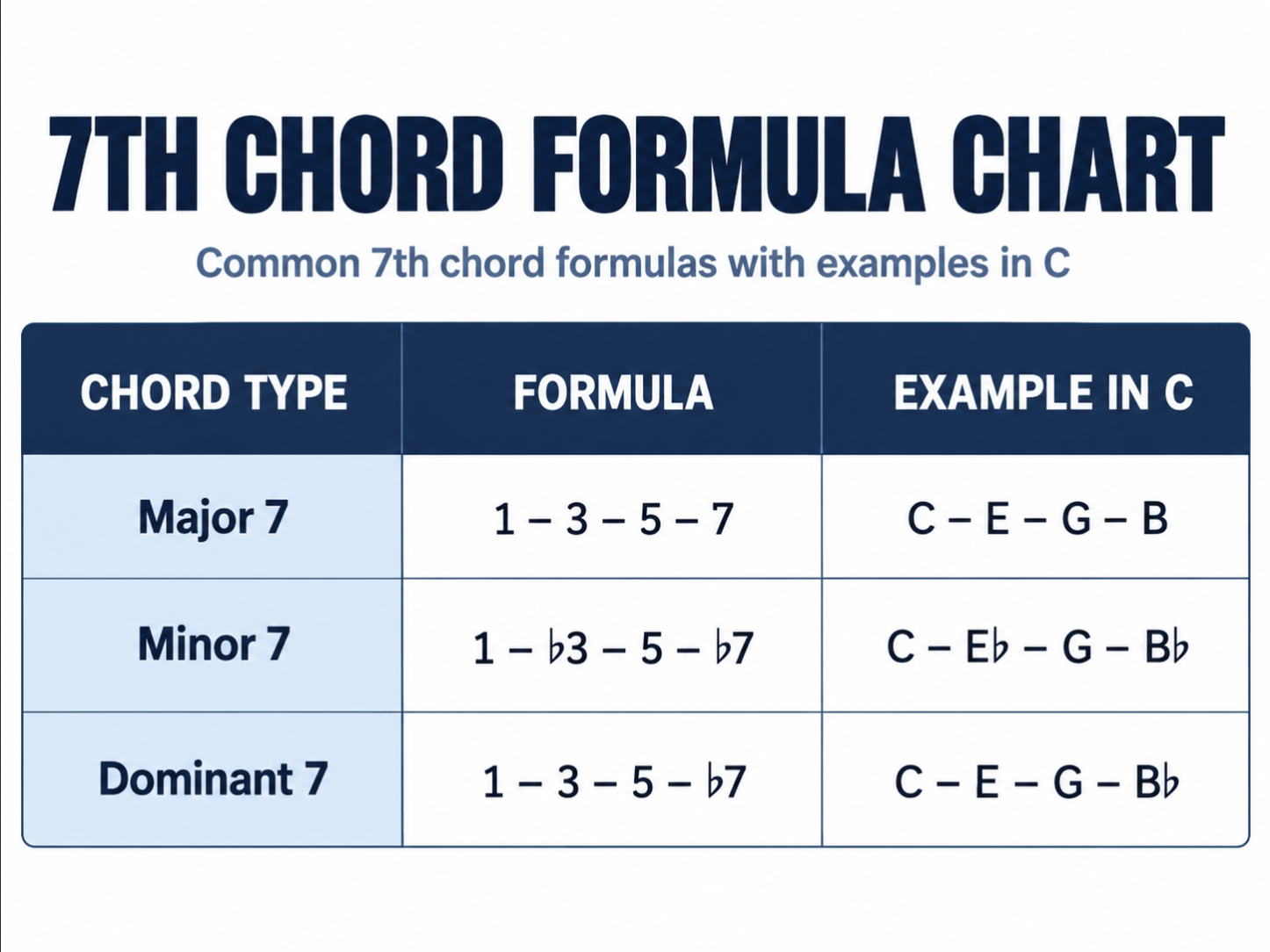
A 7th chord follows the same formula you already know, plus one extra note on top:
- 1
- 3 (or ♭3 for minor)
- 5
- 7 (or ♭7 for minor)
The one thing to watch: where the 7 sits
This is important.
In the major scale, the 7 is only a half step below the octave.
In the minor scale, the ♭7 is a whole step below the octave.
Keep that in mind. It’ll make total sense once we get into the shapes.
Major 7 Chords
Open position C major 7
Your open C chord already has the 1, 3, and 5. You’re 75% of the way there.
You just need the 7. And since the 7 is a half step below the octave, the most economical move is to take the octave C on the B string and drop it down a half step. That’s the open B string.
Lift your first finger. Done. That’s a C major 7 in open position, and it’s a really nice chord.
A-shape C major 7
The A shape is 1-5-1-3-5. Find the octave (the second 1, on the G string) and flatten it a half step.
Now the chord kind of looks like a backwards D chord. And that’s a C major 7.
E-shape C major 7
The E shape is 1-5-1-3-5-1. The octave you want is on the D string. Drop it a half step.
Unfortunately, that totally changes how you fret the chord. This one can feel awkward at first. Get used to it anyway, because it’s a REALLY useful shape.
Minor 7 Chords
Remember, minor 7 chords use a ♭7, which sits a whole step below the octave.
Open position C minor 7
Skip it.
You technically can do it, but it’s like playing Twister with your fingers. It’s not practical.
A-shape C minor 7
Start with your A-shape C minor (the one where you flattened the 3rd on the B string).
Now find the octave on the G string and drop it a whole step. That lands right on your barre.
So all you have to do is lift your pinky. That’s a C minor 7. Really, really nice chord.
E-shape C minor 7
Start with your E-shape C minor (the one where you lifted your middle finger).
Now find the octave under your pinky on the D string and drop it a whole step too. It lands on the barre.
At this point the chord is basically just a plain barre with one extra note sticking out. And that’s a C minor 7.
You can do this in any key
That’s how you build 7th chords. Pick your key, use the major or minor scale to figure out what notes you’ve got, and start stacking them.
This is also why a lot of the chord shapes you know look the way they do. And it’s a big part of why the guitar is tuned the way it is. Tune it any other way and you’d be doing some seriously wonky finger stretches to make these chords happen.
What Are Suspended Chords?
If you’ve ever seen chords like Dsus2 or Dsus4 and wondered what’s going on, here’s the deal.
We’ll stick with C to keep things consistent.
A suspended chord replaces the 3rd with either the 2 or the 4.
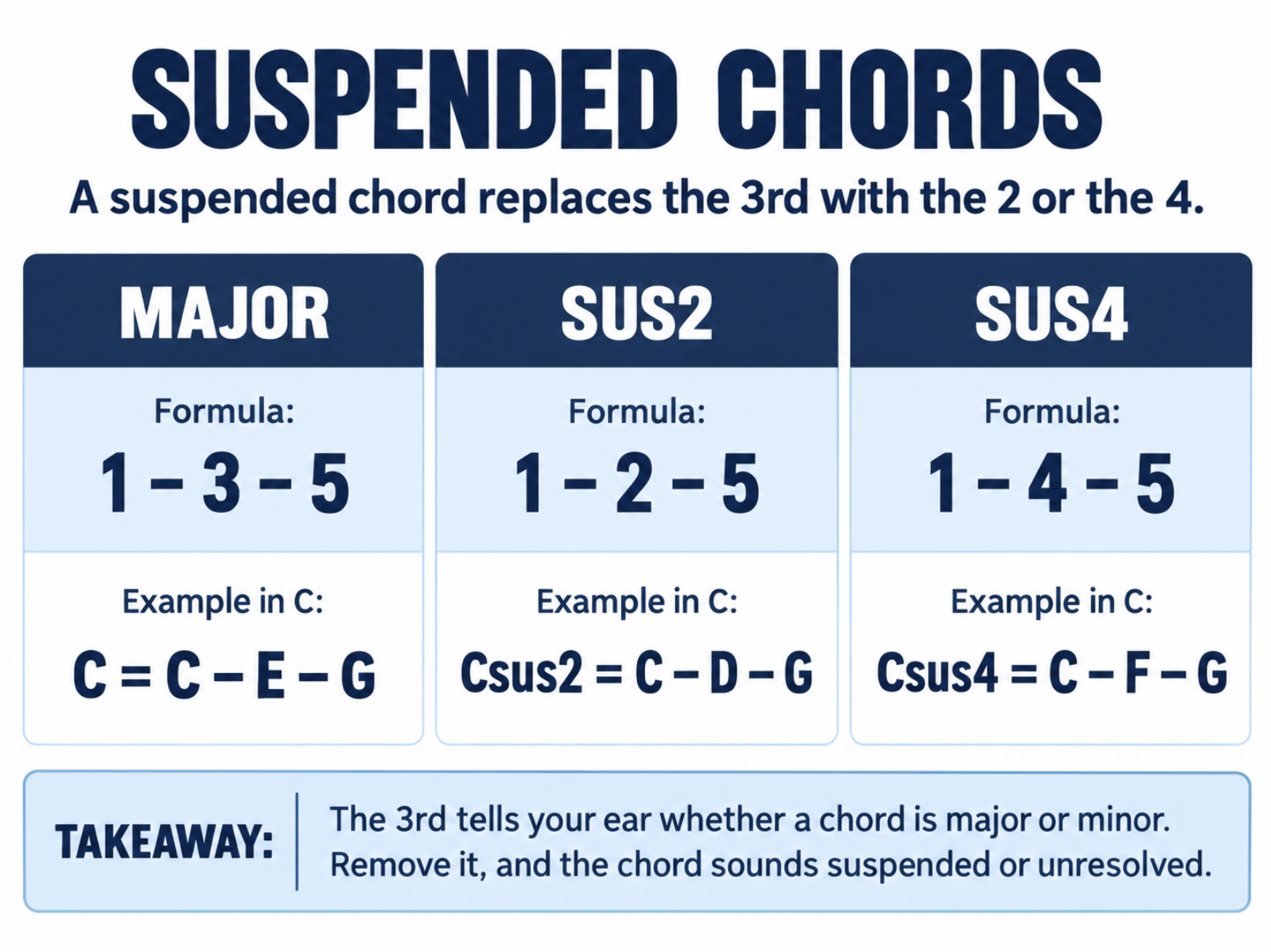
Since the 3rd is the note that tells your ear major or minor, taking it out leaves the chord hanging. There’s no resolution. That’s why it’s called “suspended.”
Csus2
Replace the 3 with the 2. So instead of C-E-G, you’ve got C-D-G.
On the guitar, take the E on the D string (2nd fret) and drop it down a whole step to the open D.
Now play the Csus2, then go back to the regular C. Hear that big resolve?
Csus4
Replace the 3 with the 4. The 4th in C is F, so you’ve got C-F-G.
Take that same E on the D string and move it UP a half step to the F on the 3rd fret. That’s a Csus4. Then resolve it back to the C.
The shortcut
When you see a sus chord, find the 3rd of the chord.
- Sus2: move the 3rd down to the 2.
- Sus4: move the 3rd up to the 4.
And realistically, if you’re playing a sus chord, you’re probably about to resolve right back to that major 3rd. That’s what they’re for. They make the resolve hit harder.
What Are 9th Chords?
Here’s the question that trips people up.. the scale only has seven notes. So what the heck is a 9?
When you reach the octave, instead of calling it “1” again, keep counting. The octave becomes 8. The next note up becomes 9.
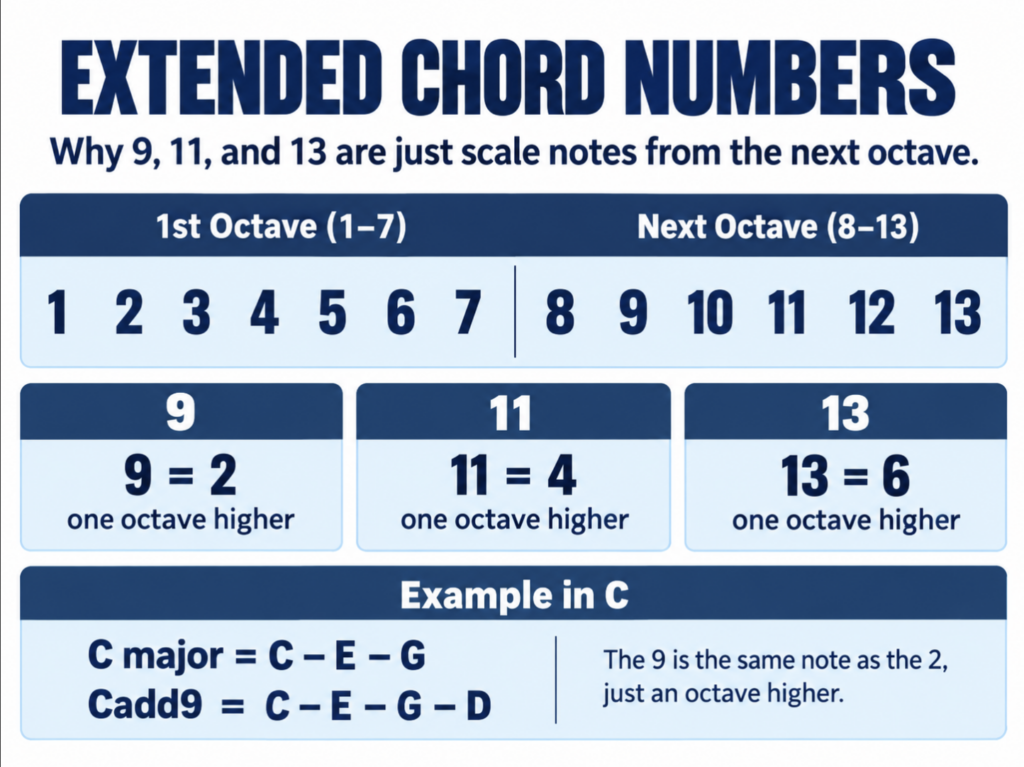
So the 9 is just the 2, one octave higher. In C, that’s a D.
Cadd9
You’ve seen Cadd9 in a TON of songs. It’s just a C chord with that higher 2 added on top.
In your open C chord, your first finger is on the octave C on the B string. Move it up a whole step to the 3rd fret. That’s a D. That’s your 9.
A lot of players also grab the G on the 3rd fret of the high E string. That’s totally fine. It’s just another 5th.
So now you’ve got C-E-G-D-G. That’s a Cadd9.
What about add11 and add13?
Same idea. Just keep counting past the octave:
- 9 = the 2, an octave up
- 11 = the 4, an octave up
- 13 = the 6, an octave up
It’s a little weird to wrap your head around at first. But anytime you see those wacky numbers, all it means is you’re adding a note from the next octave.
Keep Leveling Up
If you’ve got questions about any of this, you can join our guitar community here.
The Guitar Newsletter That Doesn’t Suck
Free every week: licks to steal, gear talk, rock trivia with prizes, guitarist spotlights, and more.