How to Play Sweet Home Alabama on Guitar, Step by Step
Today we’re taking a look at Sweet Home Alabama off Lynyrd Skynyrd’s 1974 album Second Helping.
Here’s the thing about this song.. everybody thinks they already know it. Three chords, round and round, done. And you can absolutely fake it at a campfire that way.
But the reason it still sounds like a bar band covering it when most people play it is that the whole song lives in the little stuff. The muted bass note. The sloppy slide. The hammer-ons nobody bothers to learn.
So we’re going to break down the sections and talk about how to piece it all together. We won’t go into every single nuance, but we’ll cover most of it.
Before you start
Tune to standard, E A D G B E. No capo, no drop tuning, nothing weird.
He typically plays an electric on this. I think it sounds great on an acoustic too if that’s more your style, and I’ll point out the one spot where the acoustic makes you cheat a little.
Difficulty-wise, this sits right in beginner-to-intermediate territory. If you can play a G, a C and a D and you’ve done a few hammer-ons, you can get through this. The bridge is the part that’ll take you a week.
The three chords you need
For this entire song you need three chords.
- A regular D
- A C add 9
- A regular G
That G is the one people sometimes call the rock G, because we include the ring finger in there as well.
Look at those top two strings. On all three chords, your ring and pinky just sit there on the 3rd fret and never move. That’s the whole trick to playing this song smoothly, and it’s why the progression feels so easy once it clicks.
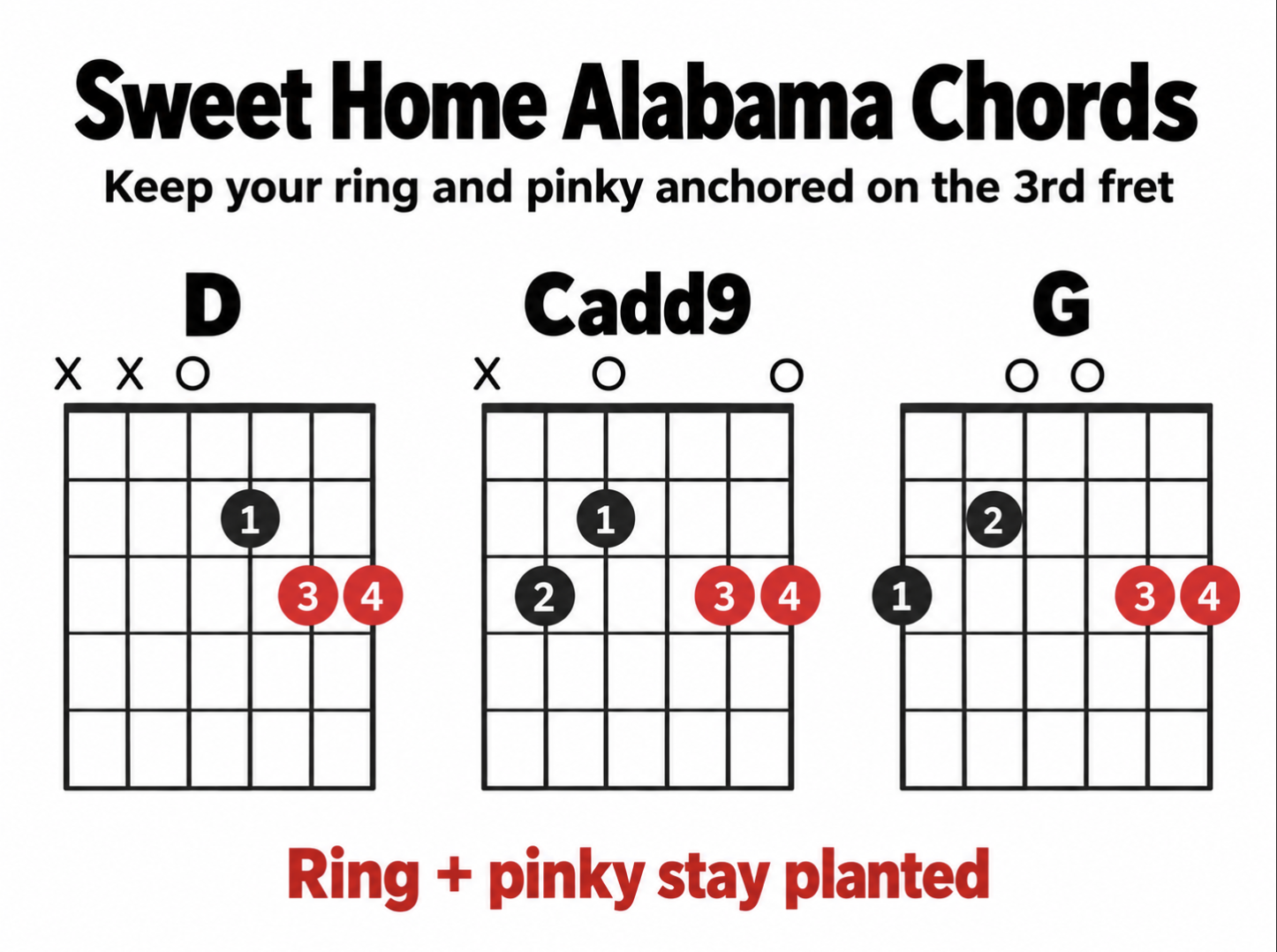
That’s your whole harmonic vocabulary for the song. Everything else is decoration.
The intro
Start with that D chord. Begin on the open D string, then pick through the B and G strings. Then move into the C add 9, then the G.
Now here’s the thing to take note of, and it’s the single biggest one in this lesson.
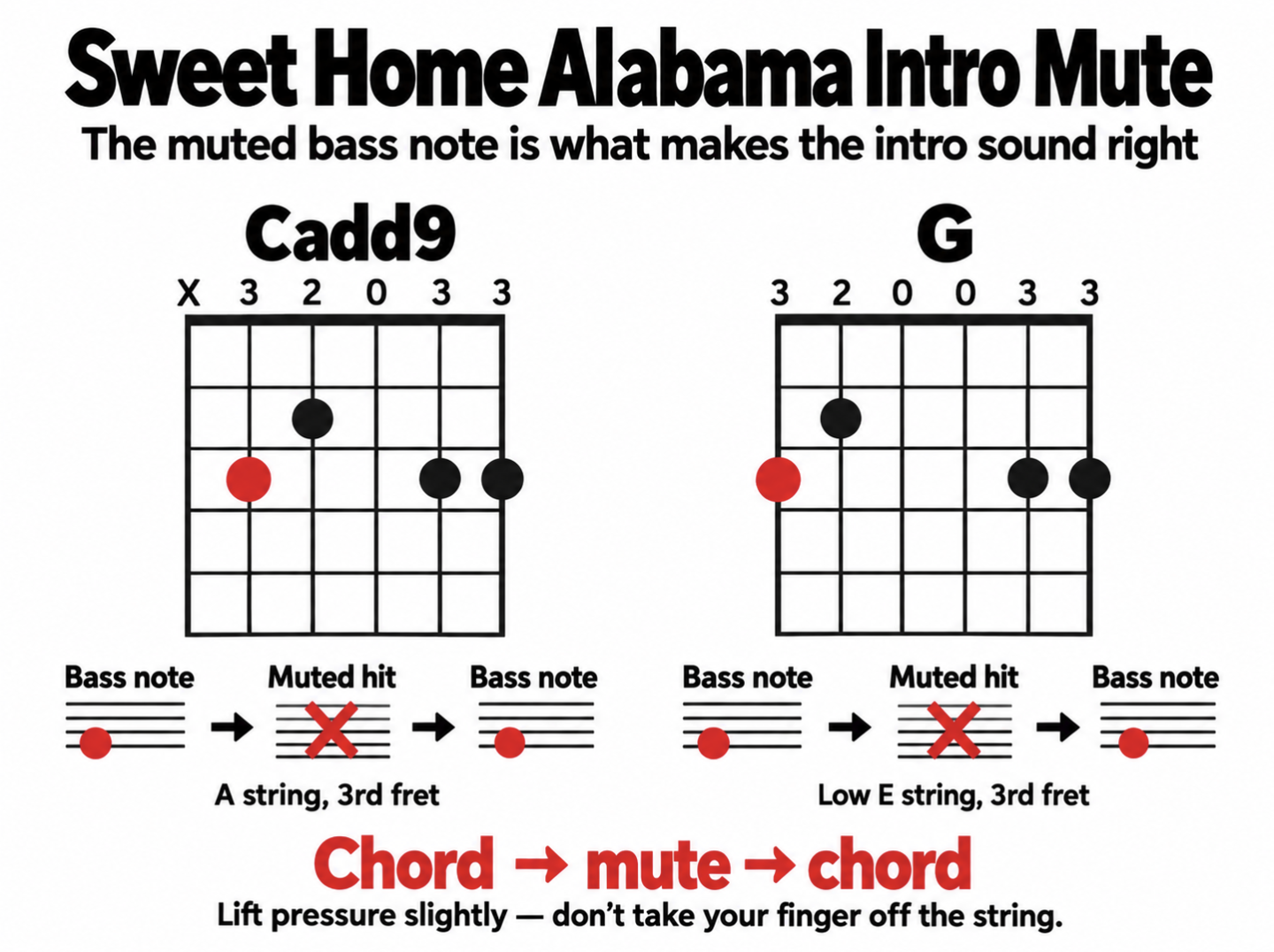
On the C add 9, he mutes that low bass note. So you play the 3rd fret of the A string, lift your finger up slightly, grab that muted note, and play it again.
He does the same thing on the G chord.
That mute is most of what makes this intro sound like the record instead of like somebody strumming three chords. It’s percussive. It fills the gap where a drummer would put a ghost note. Skip it and the intro goes flat, and you won’t be able to work out why.
Practice just that: chord, mute, chord. Get it loose before you worry about the rest.
The hammer-ons and pull-offs
To finish off the phrase there’s a little section of hammer-ons and pull-offs. This is all on your A, D and G strings.
- Hammer on to the 2nd fret of the A from open
- Same on the D string, open, hammer on to the 2nd, pull off
- Back down to the A string from the 2nd fret, pull off
- Then on the G string, 2nd fret, pull off
Keep these light. The temptation is to dig in and make every note even and loud, and that’s not what it sounds like on the record. It’s a ripple, not a statement.
The second intro riff
This next riff is all on the G string.
Start on the 2nd fret of the G string. Play the 2nd fret, pull off, then pick the string. Do the same thing on the 4th fret.
Then we get to the bit where your guitar choice matters.
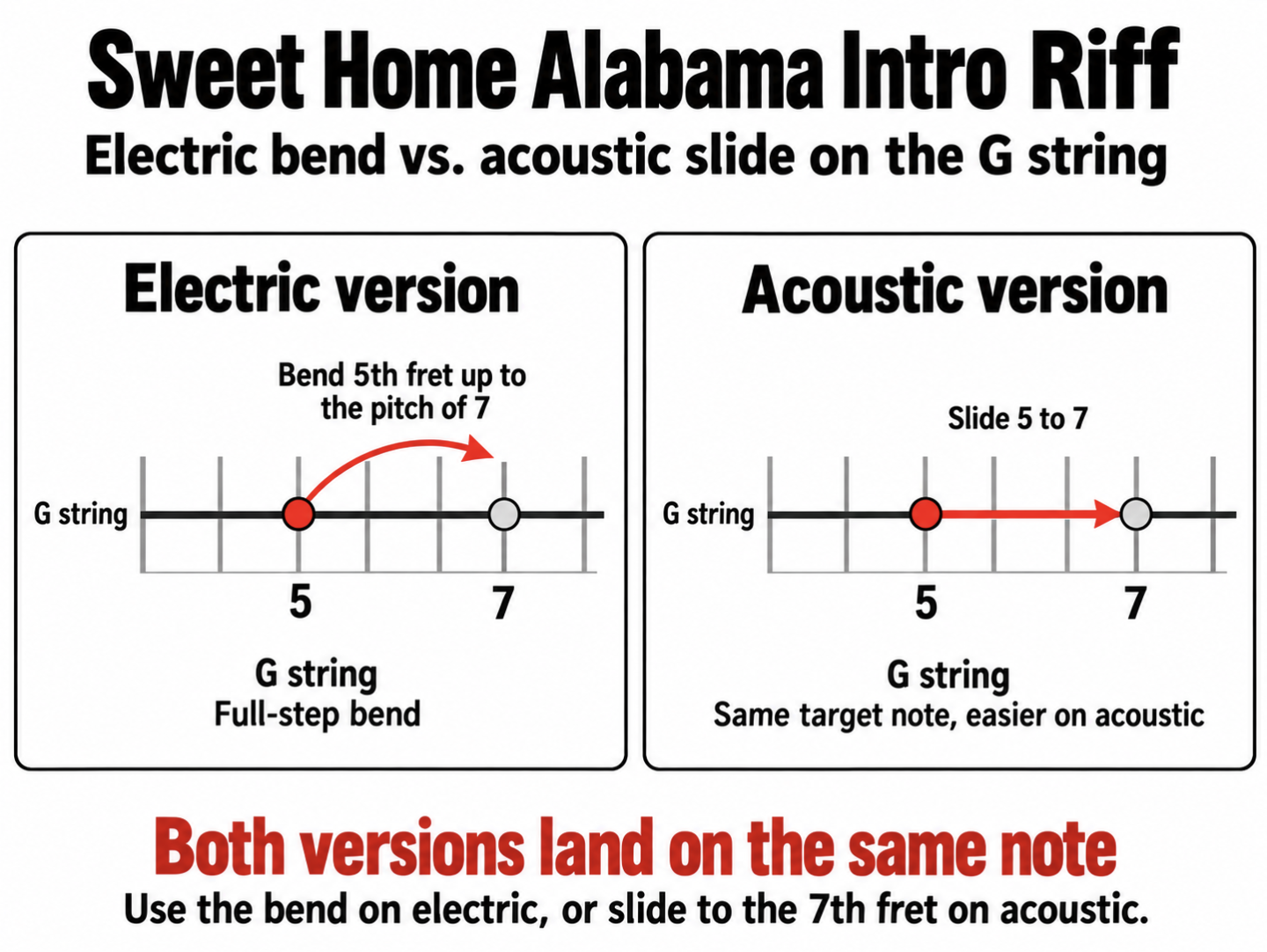
On the album he’s playing an electric, so he plays the 5th fret and bends it up to where it sounds like the 7th.
On an acoustic that’s really difficult to do, and honestly I’m always a little worried I’m going to snap the string. So instead I play the 5th fret and slide up into the 7th.
Nobody’s going to arrest you for the slide. It gets you to the same note, and on an acoustic it actually sounds more natural than a strangled full-step bend.
The last lick of the intro
This one is much easier than the other two.
Play the open A string, hammer on to the 2nd fret, then play your open D and G strings.
Sometimes on the end cap he’ll even throw in an extra hammer-on on that 2nd fret of the low A string.
That’s your whole intro. Three pieces, and the third one’s free.
The bridge, the best part of the song
In my opinion this is the most fun part of the song to play.
Start on your A string. Play the 7th fret, the 8th fret, the 9th fret. Then use your index finger to bar the 7th fret of the D and G strings and play that twice. That’s what we call a double stop.
Then play the 9th fret and haphazardly slide down, play the 5th fret to the 7th fret. Then do that double stop on the 5th fret of the D and G strings.
Then the 7th fret on the A string, haphazardly slide down again, and do the end cap by adding the 3rd fret of the low E string to finish the phrase.
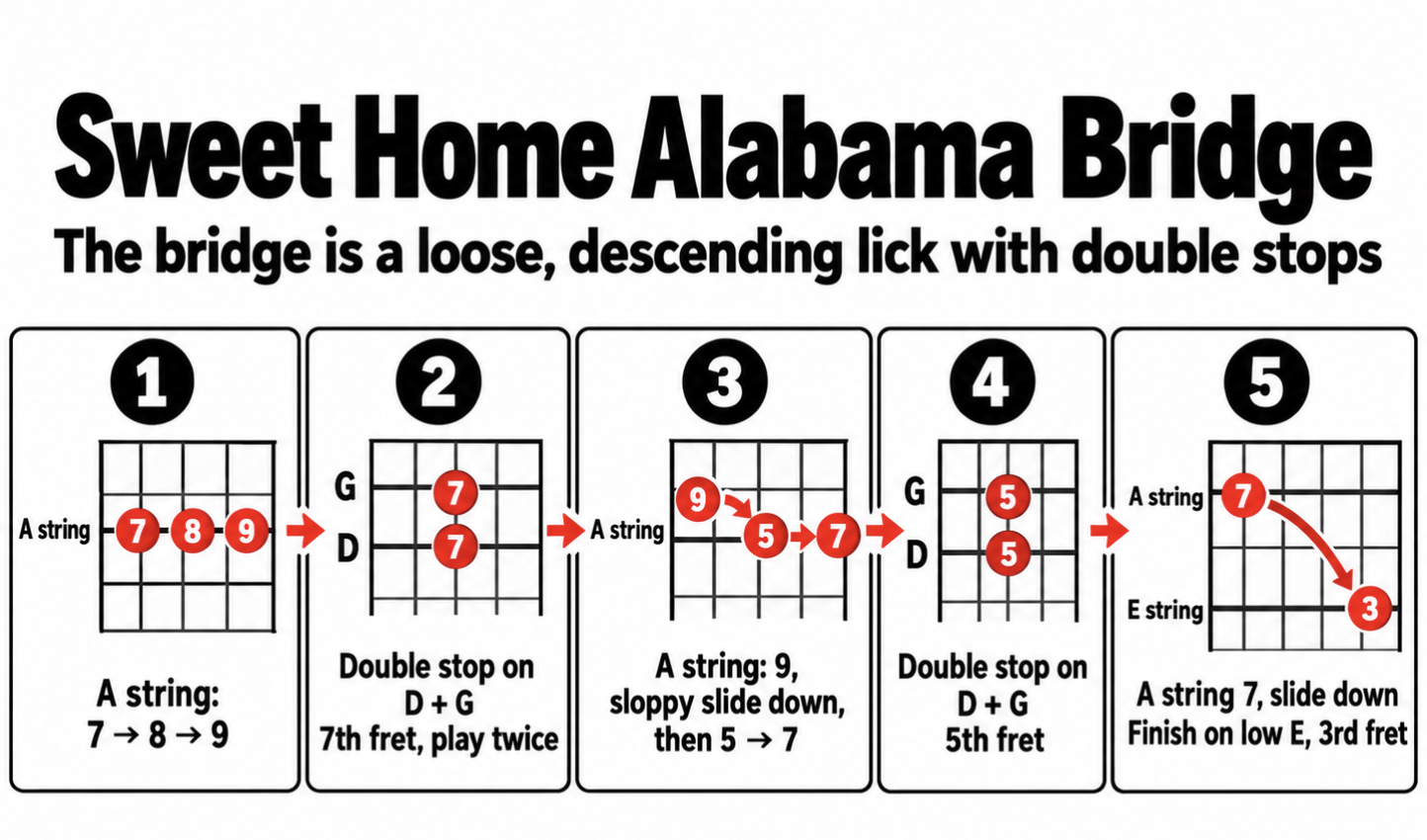
I keep saying haphazardly and I mean it. That sloppy slide is on purpose. It’s supposed to sound loose, like somebody falling down the neck and landing on their feet. If you play it clean and measured it sounds like an exercise.
The chorus
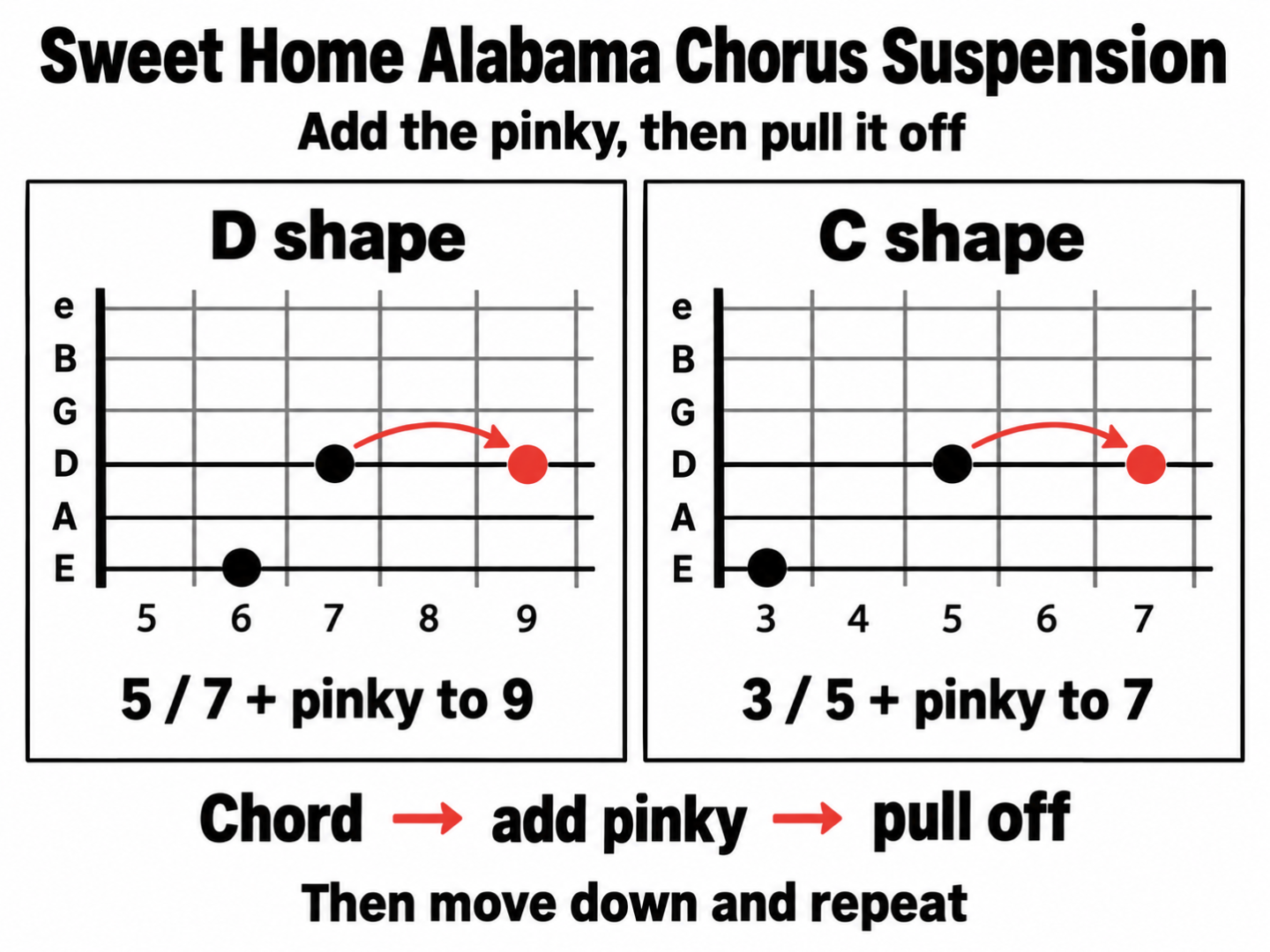
The chorus is just power chords with suspensions added onto them.
The first one is a D power chord. Index on the 5th fret of your low E string, ring finger on the 7th fret of the D string. The suspension is your pinky on the D string up at the 9th fret.
Then slide that whole position down a whole step. Index on the 3rd fret, ring finger on the 5th fret of the D string. That hammer-on is your pinky on the 7th fret of the D string.
Then move down to the 3rd fret of the low E and the 5th fret of the A.
The rhythm goes like this: a double on the D, add the suspension, pull off with the pinky, then move to the C. On the last line of the chorus, heading into the solo, you slide into an F, then a C.
That pinky suspension is the hook of the whole chorus. It’s the same idea as a sus4 resolving back home, and once your ear catches it you’ll hear it in about forty other Southern rock songs.
The solo, and why it’s in G
For the solo we go back into what you could call the verse.
The solo section is in G major pentatonic. That’s all you need to know to start improvising over it.
Now, a lot of people get tripped up here, because the song starts on a D and they assume they should be soloing in D. Look at where the progression actually lands, though. D to C to G, over and over, and it keeps coming home to that G. The G is the tonic. The D just happens to be the chord it starts on.
So G major pentatonic it is. If you want the cheater version, G major pentatonic is the same notes as E minor pentatonic, which most of you already have under your fingers. Play your E minor box at the 12th fret and start resolving on G instead of E, and you’re there.
A word on tone
You don’t need much for this one.
On an electric, a clean-ish amp with a little bit of breakup gets you there. This is not a high gain song. If you’re scooped and saturated, all those hammer-ons and the muted bass note turn into mush, and mush is the opposite of what this song is.
Bridge pickup for the bite on the bridge section, neck or middle for the intro if you want it rounder.
On an acoustic, just play it. It suits the song better than people expect.
Common mistakes
A few things I see constantly with this one.
- Skipping the mute on the C add 9. Covered above. It’s the whole intro
- Playing the bridge slides too cleanly. Loose is the point
- Moving the ring and pinky between chords. They stay on the 3rd fret. If they’re moving, you’re working too hard
- Soloing in D. Resolve to G
- Rushing the intro. This song sits back. It’s not in a hurry and neither are you
The song structure
Here’s the full map:
- Intro
- Verse one
- Bridge
- Verse two
- Chorus
- Solo one
- Verse three
- Chorus
- Solo two
- Bridge
- Verse
- Chorus
- Outro
What to practice first
Don’t try to learn it front to back in one sitting. Do it in this order:
1. The three chords, with the ring and pinky anchored
2. The C add 9 mute, on its own, until it’s automatic
3. The intro picking pattern
4. The hammer-on lick
5. The G-string riff
6. The chorus with the pinky suspension
7. The bridge, slowly, last
Piece it all together and you’re playing Sweet Home Alabama by Lynyrd Skynyrd.
Give it a go this week, and if you’ve got questions, come find us in the community.