The Circle of Fifths on Guitar: Scales, Chord Progressions, and Instant Transposition
This post is all about the circle of fifths.
I’ve seen this topic confuse a lot of people in the past, so hopefully we can break it down into a little more manageable pieces and get you actually using it in your playing.
The circle of fifths is a complicated topic because there are a million different things you could use it for, but it’s all based on a really simple mathematical formula. Once you’ve got it down, you can use it in a lot of your playing for multiple reasons. Different people use it for different things. I’ll show you what I like to use it for.
Before you go any further, pull up Google and do a quick circle of fifths search. Having a picture of it in front of you will help.
First, a quick home base
In western music we have 12 tones. That’s the chromatic scale.
If I start on my low E string and count up, there’s 1, 2, 3, 4, 5, 6, 7, 8, 9, 10, 11, 12, and then we’re back where we started. Twelve notes.
The circle of fifths is just moving through those notes at a distance of five. Right now we’re going to throw out the half steps, and I’ll show you why in a second.
The Guitar Newsletter That Doesn’t Suck
Free every week: licks to steal, gear talk, rock trivia with prizes, guitarist spotlights, and more.
What the circle is actually telling you
Starting at the very top, we have C. At the very bottom, F# or Gb, however you prefer it.
As you move to the right, each increment adds one sharp to that scale.
C has nothing. It’s a perfect scale, no sharps, no flats. G has one. D has two. A has three. E has four. B has five. F# has six. And C# down at the bottom has all seven.
As you move to the left from C to F, you’re adding flats instead. One flat, two flats, three flats, four, and so on and so forth, contextually.
That alone is one solid use for the circle. Look at a key, know instantly how many sharps or flats live in it.
Now let’s put it on the guitar
Here’s where it gets fun, because the way the guitar is tuned makes a really interesting pattern emerge. You don’t even necessarily need the image once you see it.
An instrument like a piano is a little more laid out, a little more complicated. The guitar is a perfect instrument for this.
Start with C on the third fret of the A string.
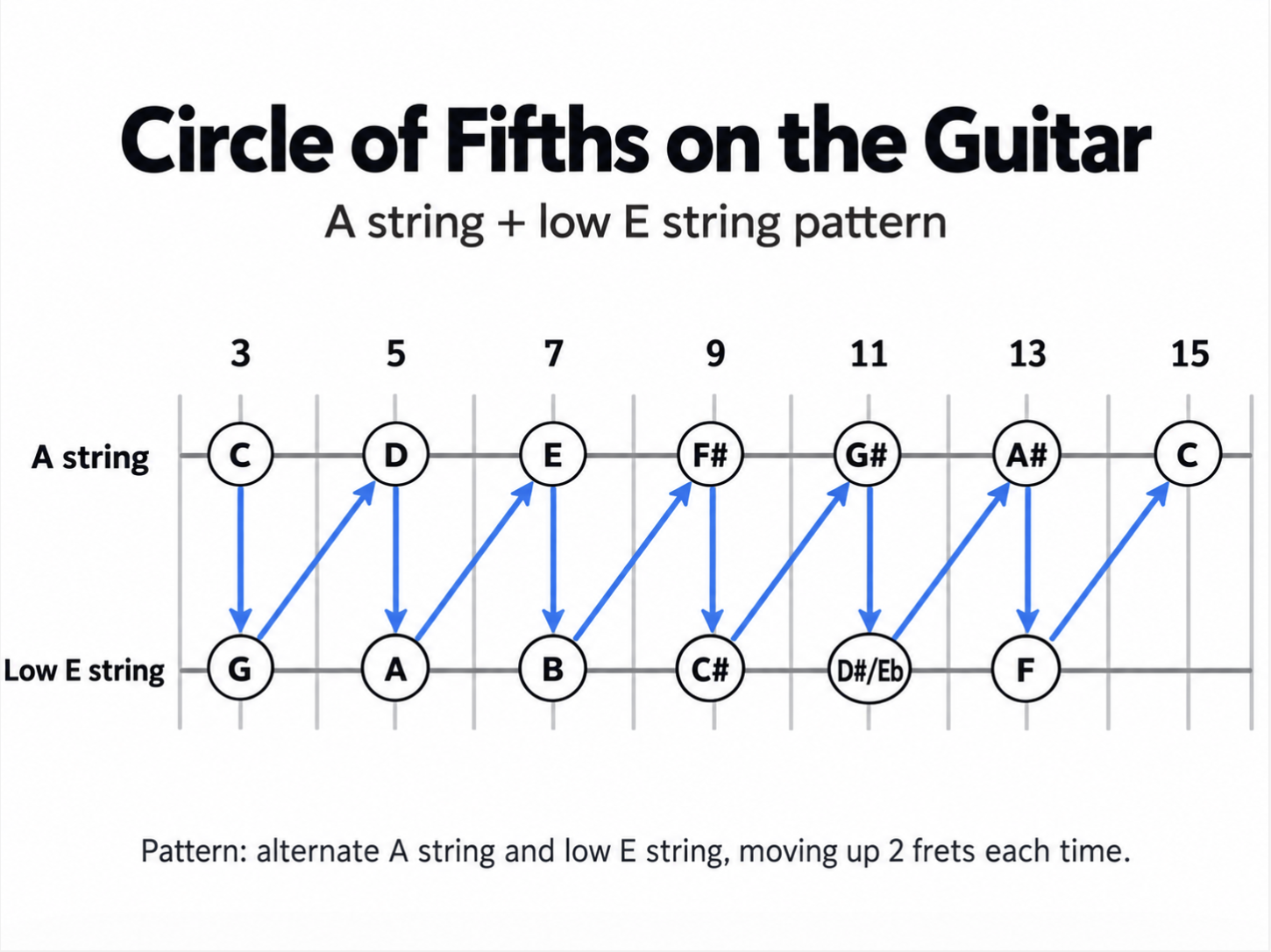
The next fifth is on the third fret of the E string. That’s G.
Move up two frets, back to the A string, and you have D. Then A is right below it on the fifth fret of the E string.
Move up two frets to the A string and you have E. Go down below him and you’ve got B.
You can already see the pattern emerge. It starts on your dots and follows your dots, two frets at a time, A string then E string, all the way up:
- C (A string, 3rd fret), G (E string, 3rd fret)
- D (A string, 5th), A (E string, 5th)
- E (A string, 7th), B (E string, 7th)
- F# (A string, 9th), C# (E string, 9th)
- G# (A string, 11th), D#/Eb (E string, 11th)
- A# (A string, 13th), F (E string, 13th)
- And back to C
Two frets up, two frets up, two frets up, and you land back on C.
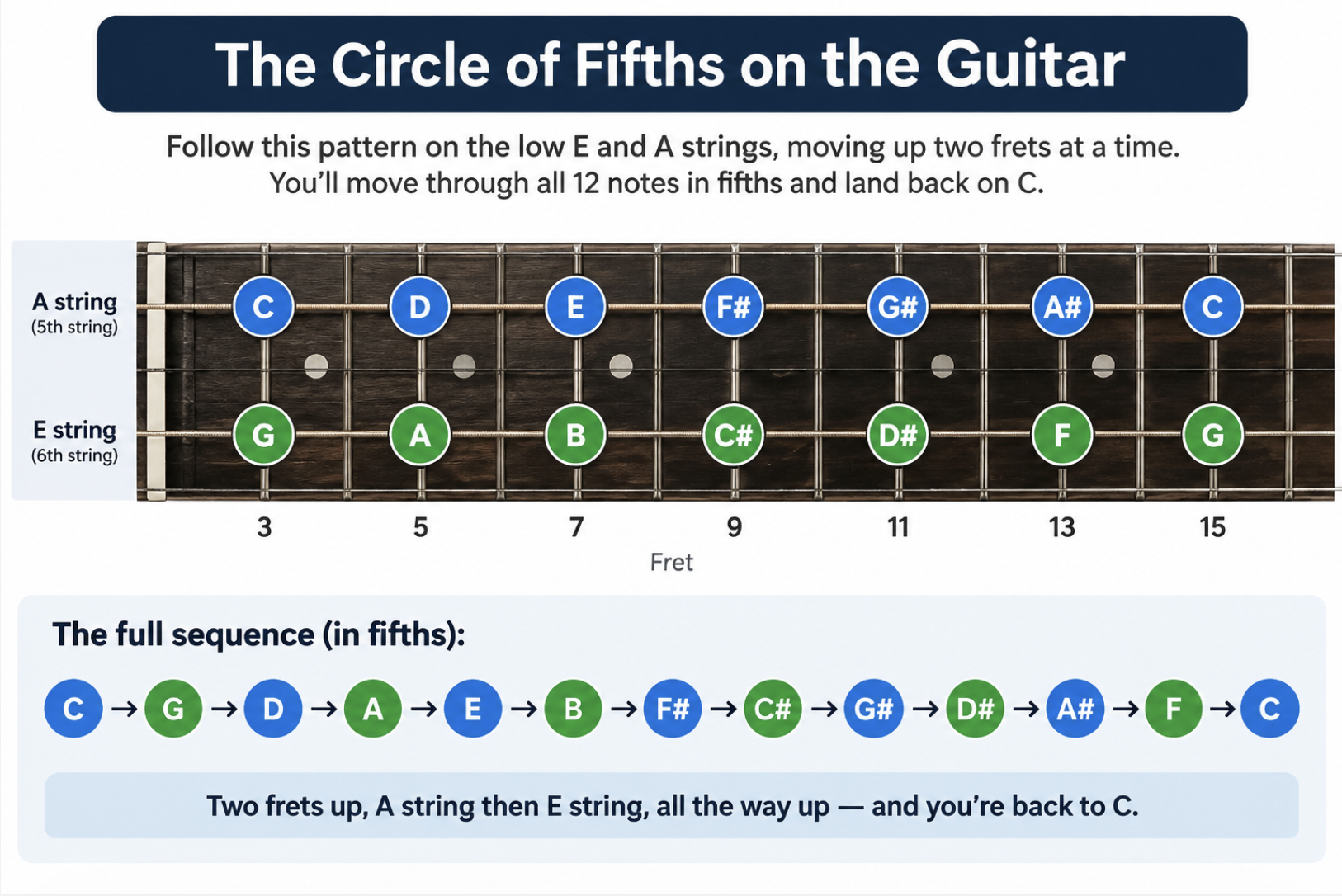
What just happened there is you moved in intervals of fifths through every single chromatic note on the guitar. Really, really neat idea.
It sounds especially cool if you do it with barre chords. Use major chords for all of these and just walk it up the neck. That’s every note in the chromatic scale, moved in fifths.
Fifths one way, fourths the other
Another really interesting takeaway. This direction moves you in fifths. Go the opposite way and you’re traveling in fourths.
It’s the same relationship you use every time you tune the guitar off that fifth fret. The B string is the wonky one where you’ve got to move, but on the whole that’s the idea.
The relative minors are built right in
If you remember the video we did a week or two ago on relative scales, this connects directly.
Most circle of fifths charts will also show you the relative minor in relation to your key.
C major’s relative minor is A minor. G’s is E minor. D’s is B minor. A’s is F# minor.
Really cool example to use with what we talked about in that lesson. If you’re playing F# minor pentatonic, you can also get an A major pentatonic by starting three frets up. Same notes, different home base.
Every chord in the key, in one little shape
This is my favorite use.
Take the key you’re playing in and look at the three notes across the top of the circle, plus the three relative minors sitting underneath them.
Say C is the key. Go to the left and that’s your 4 (F), because that direction travels in fourths. Go to the right and that’s your 5 (G). Coincidentally enough, the relative minors underneath work out perfectly too. That’s your minor 2, your minor 3, and your minor 6.
Which means that little cluster is every chord in C major.
Let’s do them in order, and you’ll see what I’m talking about. C, D, E, F, G, A. Remember that the 2 and the 3 are minors, the 4 and the 5 are majors, and the 6 is a minor:
- 1: C major
- 2: D minor
- 3: E minor
- 4: F major
- 5: G major
- 6: A minor
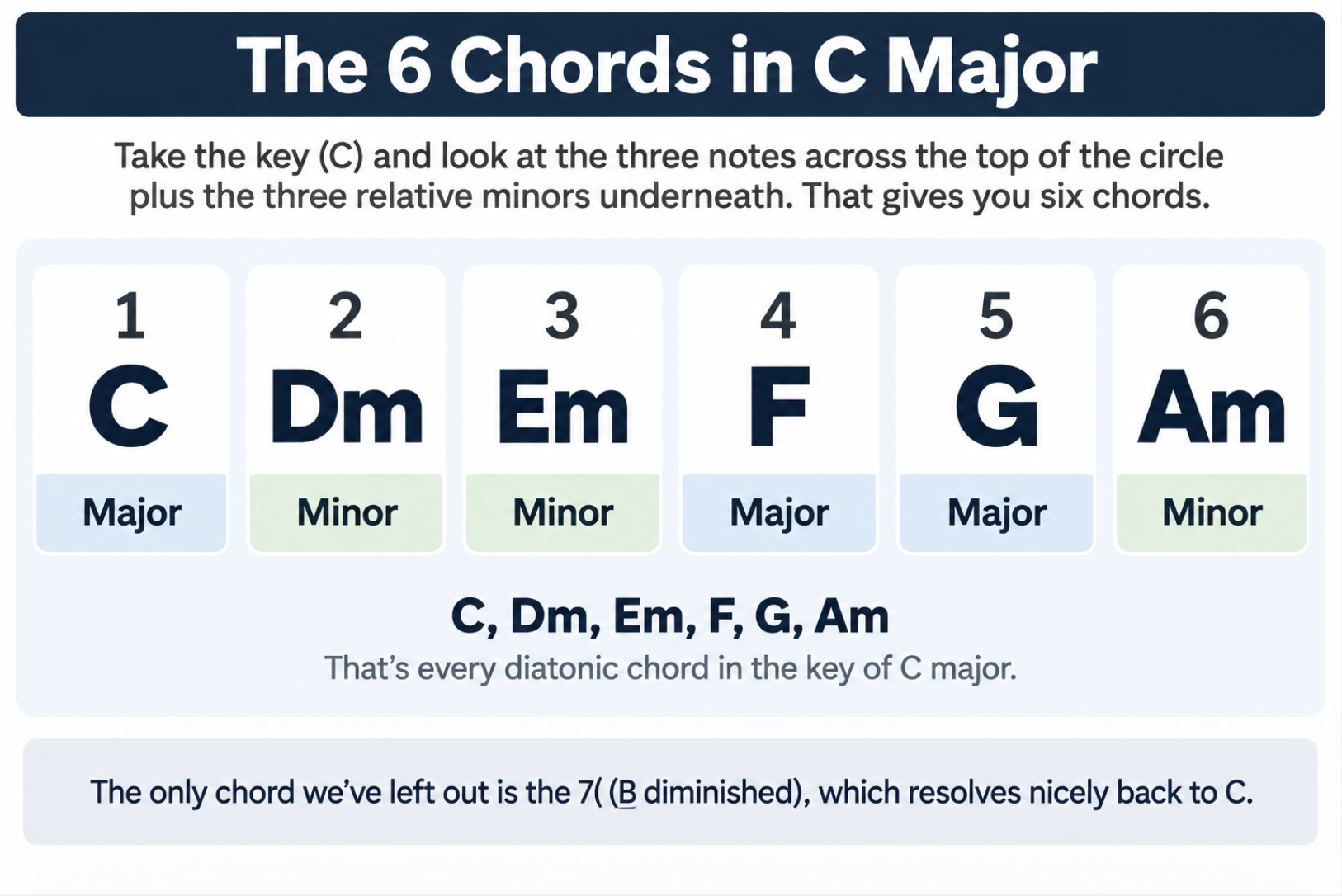
The only thing we’ve left out is the 7, and that’s because in the diatonic major the 7 is diminished. It’s a weird one to look at on paper, but it resolves very nicely back to C.
Every single chord in the key of C, from one little shape.
And here’s a bonus. If you travel in fifths starting from C and just play them as majors.. C, G, D, A, E.. that’s a chord progression right there. That’s Hey Joe by Jimi Hendrix.
Now slide that same shape somewhere else. Put A at the center and you get D as your 4, E as your 5, B minor as your 2, C# minor as your 3, and F# minor as your 6. Every single chord in A major.
This all works off diatonics. Minor keys and modes work off a slightly different principle, and I don’t want to dive that deep here because this is already a very deep topic. You can take this very, very far.
Transposing on the fly (put the capo down)
Here’s another one I use constantly.
If you play in a band, a church group, or even just with some friends, eventually somebody says “hey, there’s a song I want to play, but I don’t like it in this key.”
We’re all guilty of reaching for a capo to bring it up and going “well, it’s this now.” You don’t even need to do that.
Take a very simple chord progression so you’ll see what I’m talking about. La Bamba by Ritchie Valens. The progression is C, F, G. Super easy.
C, F, G is a 1, 4, 5. You can see it right there in your little shape.
Say I don’t want to play it in C. Say I want it in D. I go to D on the circle, grab the one on either side, and now it’s D, G, A. Same song.
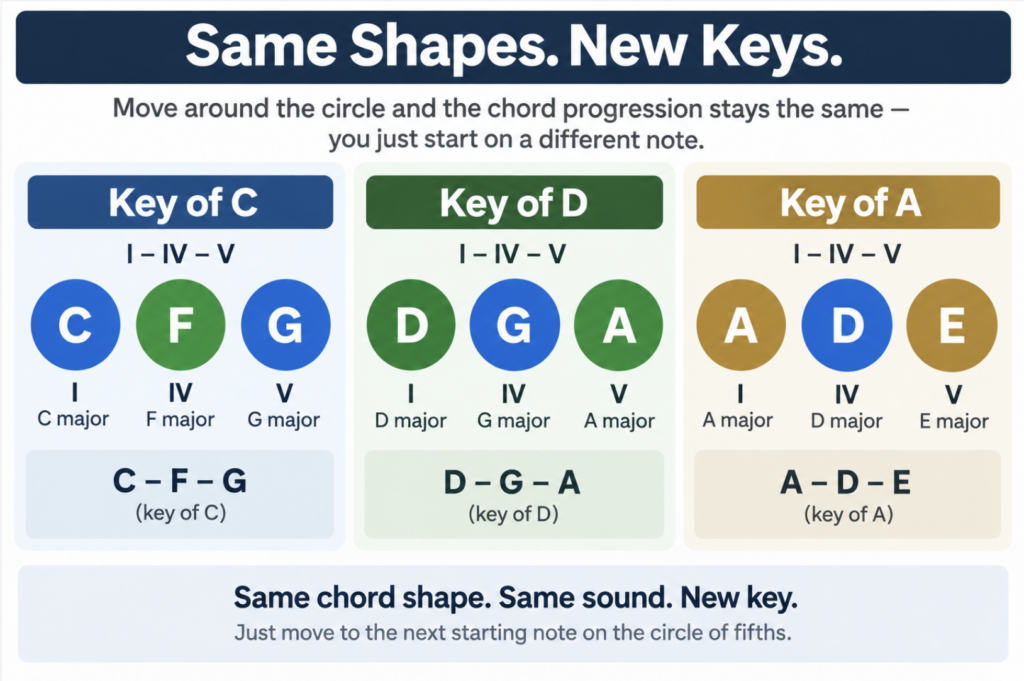
Want it in A? A, D, E.
You instantly transpose whatever song into whatever key you need. You just need that little shape. 1, 4, 5 across the top and 2, 3, 6 underneath.
Wrapping up
There’s definitely a lot to take away from the circle of fifths, and a lot of different use cases. You can use it to identify scales. You can use it for chord progressions. You can use it for identifying relative minors. You can use it for transposition.
And this is still just touching the tip of the iceberg when it comes to what the circle of fifths actually is.
I don’t want this to be a confusing topic. I want it to be an illuminating one. Wow, there’s so much I can do with this. I wonder what else I can do with this.
Hopefully that steers you in the right direction and sets your wings free.
Keep practicing out there. And remember, don’t compare yourself to anybody. Comparison is the thief of joy. We all move at our own pace, it’s our own journey. Guitar playing is one of those very private, personal experiences, and it’s a pleasure joining you on it.
The Guitar Newsletter That Doesn’t Suck
Free every week: licks to steal, gear talk, rock trivia with prizes, guitarist spotlights, and more.