15 Guitar Mistakes Every Beginner Makes (And How to Avoid Them)
Man, those first few months with a guitar are brutal, ain’t they?
Your hands probably hurt and it’s not like you sound great (yet) anyway. There comes a time where you feel like you might want to quit, but I promise things get SO much better.
That’s not to say that guitar is easy. I get frustrated on a daily basis when I’m practicing. But it’s worth every second you put into it.
When I first started, I didn’t really have a mentor or someone who could tell me that I probably wasn’t doing anything catastrophically wrong. I was just falling into the same traps that most guitarists fall into.
And once you spot the patterns, they’re relatively easy to fix.
So here are the 15 biggest mistakes I see beginners make, including at least one you’re probably doing right now, and how to fix them.
15. The Death Grip on the Neck
This one hits close to home because I spent my first six months strangling my guitar. I was teaching my wife a few chords the other day and I noticed her doing the same thing. It’s very common.

When I first started, I thought that was just how you were supposed to hold a guitar. I thought that more pressure meant cleaner notes. But that’s not true at all.
It turns out, when you squeeze the life out of your strings, you’re pulling them sharp. Not to mention, your hand cramps up in about thirty seconds, and everything sounds choked.
Try This Instead
Fret any note and then slowly ease up on the pressure until it starts to buzz. Now add just a tiny bit more pressure back until it sounds clean, and that’s it!
It might feel weird at first. I remember thinking, “How is this note going to sound good if I’m barely touching it?” But it works and it’s how you’re supposed to play.
Run through a scale or even play some open chords with this lighter touch. Keep your thumb relaxed on the back of the neck. And whenever you catch yourself tensing up, just pause, notice it, and reset.
Once you get used to playing with a lighter touch, you’ll never go back because your notes will sound so much better and your hand won’t cramp up like it used to.
14. Ignoring Rhythm Practice
The fastest way to expose yourself as a bedroom guitarist is by playing with other people, especially drummers.
I learned this the hard way when I ended up at my first jam session. I’d been practicing scales for months so I felt pretty confident, and I had some decent licks down.
Then the drummer counted us in and I was completely lost within eight bars.
And that’s because playing along to a metronome isn’t the same as playing with other humans. Something I had to learn the hard way.
Rhythm practice isn’t the most fun; nobody is posting Instagram videos of themselves counting along to a click track. I get it.
But if you can’t keep time, nothing else matters. You could be the next Hendrix, but if you speed up and slow down randomly, you’re going to sound like an amateur.
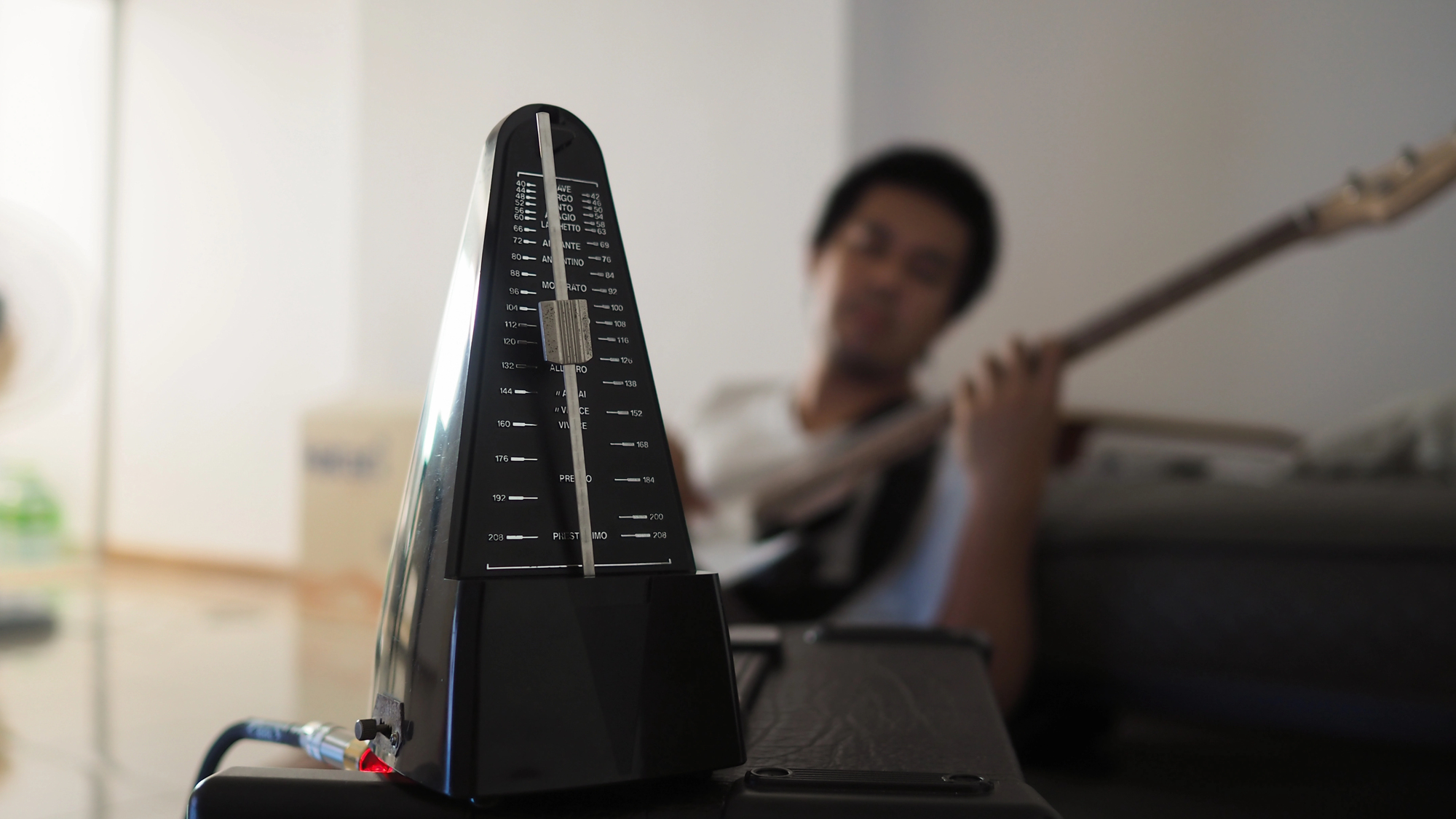
In order to fix this, take two chords, set a metronome, and play for ten minutes.
NOTE: Use our free online metronome tool here!
Start at 60 BPM, even if it feels super slow. Your job is to lock in so that the click disappears under your strumming.
Most people quit after thirty seconds because it’s boring, but you shouldn’t be most people. Most people aren’t good at guitar.
Once you nail this, try a drum track instead of a click. From there, move to full backing tracks. Solid timing will get you further than fancy licks ever will.
13. Only Playing in One Scale Box
The infamous 5th fret pentatonic box.
If you’ve been playing for more than six months, you probably know this shape like the back of your hand; the A minor pentatonic, or as some like to call it, the holy grail of beginner lead playing.

But the problem is after a while, every solo you play starts sounding the same. You’re hitting all the right notes, but it’s getting boring.
Signs You Might Be Stuck
- Every bend is on the same two strings
- Your licks all have that familiar “shape” to them
- Someone calls out a key change and you get lost
I spent about a year living in that box and convinced myself I was improvising. But really, I was just rearranging the same five notes in slightly different orders.
What most people don’t know is that that box you’ve been living in connects to other identical shapes across the neck. Find that A note at the 5th fret of your low E string. Now find it again at the 7th fret of the D string. And again at the 10th fret of the B string. Play your familiar pentatonic pattern starting from each of these spots.
Do this and now you’ve got three times as much fretboard to work with. Start connecting these shapes; play a lick in one box, then jump to another, and your solos will start being much more dynamic (and less boring).
12. Avoiding Barre Chords (Forever)
Oh the F chord.. might as well be the F word, am I right? It’s the finger-twisting nightmare that makes you wonder why you ever thought learning guitar was a good idea in the first place.
I remember the first time I saw it in a chord chart; I didn’t think it would be that hard.
Three weeks later, I was still getting nothing but buzz and muted strings, and my index finger felt like it was going to snap in half. I started looking up “easy F chord alternatives” and telling myself that maybe I didn’t really need barre chords to be a good guitar player.

But I was lying to myself and avoiding a huge problem. You do need barre chords. End of story there.
Barre chords are your ticket off the first three frets. Without them, you’re stuck playing the same handful of open chords in the same keys forever.
Try playing a song in B flat and everything feels like a brick wall. The same thing happens when the chords start climbing up the neck.. you’re stuck and wishing the song would just stay in C forever.
Barre chords suck at first. But I recommend starting with just two strings. Get comfortable barring across the high E and B strings. Then add the G string. Build up slowly instead of trying to muscle through all six strings on day one.
It took me months to get a clean F chord.. literally months. But the day it finally worked, I could play in any key and move chord progressions around the neck.
The players who push through this phase get to play the good music.
11. Treating Triads Like “Advanced Stuff”
What’s a triad you might ask..? If you think it’s just some complicated jazz thing you’re wrong, so let me explain.
NOTE: I have a video tutorial on Triads 101 below. Feel free to check it out if you’re more of a visual learner.
The truth is, you’ve been playing triads this whole time. If you’ve ever strummed just the thin strings of a G chord, that’s a G major triad.
You think you need to strum all six strings of every chord, but half the time you just need three carefully chosen notes. That’s how you get a clean, punchy sound that you hear in professional recordings.
To try this, take a chord you already know and zoom in on just three notes: the root, third, and fifth. That’s the triad.
For example:
- In an open G, the notes on strings 2–3–4 (B-D-G), which is a first inversion triad.
- In an open C, the same string group (C-E-G), a root position triad.
It’s kind of funny when you realize you’ve been playing this stuff all along, and it also seems way less intimidating.
10. Thinking Arpeggios Are Only for Shredders
“Arpeggio” sounds like something only neo-classical metal guitarists do at inhuman speeds.
But you’ve probably been playing arpeggios for months without realizing it. You know when you fingerpick through a chord instead of just strumming the whole thing? That’s an arpeggio. It’s pretty much any time you play chord notes separately instead of together.
NOTE: I also have a video lesson for this if you’re interest. Check it out below:
Arpeggio is just a fancy Italian word for “play the chord notes one at a time instead of all at once.”
This is important because when you’re soloing over a chord progression, arpeggios show you which notes will sound good, instead of just hoping something works.
To try this, grab a C major chord. Now instead of strumming it, pluck each string individually. C-E-G-C-E. You played an arpeggio. Try it with other chords you already know, too.
9. Wasting Time on Useless Warm-Ups
Almost every guitarist has spent hours running the classic 1-2-3-4 exercise. It can feel productive, but then you go to play a real song, and none of that work seems relevant.
That’s because most of those “beginner warm-ups” don’t transfer into music. You’ll rarely, if ever, use a strict chromatic run in a riff or solo. So why spend your limited practice time drilling something that doesn’t make your playing sound better?
Now I’m not saying you shouldn’t warm up. Quite the opposite, in fact.
Here’s a Youtube video I created to show you a better warm up than the 1-2-3-4 exercise:
A better approach is to warm up with material that connects directly to music. For example, take a pentatonic scale and play it slowly, but focus on clean tone and relaxed movement. You can add slides, bends, and dynamics as you go.
Or pick a simple lick you already know and loop it as your warm-up. You’ll be getting your fingers moving and improving something you’ll use in a real song.
Warm-ups don’t need to be long either. We’re talkin’ five minutes of thoughtful playing and that will do more for you than half an hour of busywork. The goal is to get your hands ready while reinforcing good habits.
If your warm-up sounds like music, you’re on the right track, but if it sounds like a robot exercise, you’re probably wasting your time 🤷♂️
8. Playing Chords and Scales Without Understanding Them
I used to think I was making progress because I could play through all five pentatonic boxes and rattle off an open C chord. But if you’d asked me what notes I was playing… HA! Yeah, no clue.

That worked for a while, but eventually it felt like I was just moving shapes around without knowing why. For me, every new scale pattern was just another thing to memorize.
What finally helped was breaking it down into simple formulas.
A major chord is just 1-3-5. A minor chord is 1-b3-5. Once I started looking at scales and asking, “Okay, which notes make up the chord here?”, the fretboard made sense.
It’s not instantaneous of course, BUT shapes stop being random.
7. Skipping Ear Training
I personally leaned on tabs way too long. You might feel the same way, at least at some point down the road.
Essentially, every song I learned came from some sketchy text file with numbers stacked on top of each other. And when YouTube tutorials became popular, that was even easier. All I had to do was copy what the guy on screen was doing.
For a while it felt like I was cheating the system.
Then one day a buddy looked at me mid-jam and said, “Just follow the chords, you’ll hear it.” Ha no way, I couldn’t. My hands knew shapes, but my ears were clueless.
Ear training doesn’t have to mean sitting at a piano singing intervals like you’re in choir. Instead, use our free Ear Training Tool here (bookmark it to come back to it regularly), and use it for a few minutes a day.
Another thing you can do is use two-chord songs to practice ear training.
Start with riffs you already know like Smoke on the Water, Seven Nation Army, Sunshine of Your Love, etc. You already know these (probably) so let your ear lead the way and your fingers will catch up.
I’m not saying toss every tab in the trash because they are useful. But the minute your ear sharpens up, you’re no longer chained to tabs, and that’s when jamming feels really good.
6. Never Learning to Change Keys
If someone says “Let’s take it up to A instead of C” and you freeze, that’s a sign you’re stuck in shapes.
What To Learn
- Circle of Fifths (use our free tool here): A map of how keys connect.
- Numbers, not letters. A 1-4-5 in C (C-F-G) becomes A-D-E in A.
- Repetition. Take one progression you know and practice it in three or four keys until it feels automatic.
Once you get this down, you don’t need your capo anymore.
5. Only Practicing What’s Comfortable
I used to have this practice routine that was basically just playing the same five songs over and over (because of course, I sounded good playing them). My ego got a boost, and I felt like I was practicing.

Meanwhile, my barre chords still buzzed, and my pinky was a decorative finger that did almost nothing.
But hey, I could nail Wonderwall for the hundredth time. HA!
The truth is if it sounds good when you practice it, you’re probably not improving much. Guitar growth happens in that uncomfortable zone where everything sounds like garbage and your brain hurts from trying so hard.
I know… Why torture yourself with chord changes that sound choppy when you could be shredding that one lick that sounds incredible? Well because that’s how you stay mediocre forever.
To try something different, spend just 20% of your practice time on whatever feels hardest right now. If you’re struggling to use your pinky, force yourself to play scales that require it. If your chord changes sound sloppy, slow them down and do them over and over.
It’s going to sound terrible at first and you’ll want to quit and go back to your comfort zone, but don’t. Push through the ugly phase!
Growth lives in the suck. Embrace the suck, my friends!
4. Ignoring Dynamics and Tone
Have you ever noticed how some guitarists can play three chords and make it sound amazing, while others shred through complicated solos that feel.. empty?
It all comes down to how they’re playing it.
I figured this out the hard way when I recorded myself for the first time. I thought I sounded pretty decent in my bedroom, but when I listened back, everything was monotone.

It turns out I’d been so focused on hitting the right notes that I completely ignored HOW I was hitting them.
Your fingers control way more than just which frets to press. How hard you pick a string changes the tone, sustain, and character of the note.
When you play light, the notes open up. But when you lean harder, they start to ring. When you rest your palm on the strings, it sounds chunky and percussive.
Most beginners treat their pick like an on/off switch, but it’s more like a volume knob. You can play soft, you can dig in, and everything in between.
To start noticing this, start paying attention to your right hand. Try playing the same riff with different picking intensities.
You’ll be shocked how much more interesting everything sounds when you start thinking about the feel of it all.
3. Forgetting to Play With Other People
Playing with others teaches you so many things. A few that come to mind are;
- How to listen while you’re playing
- When someone’s about to change dynamics
- When to stop and let someone else shine
- That your “perfect” timing isn’t perfect at all

It’s scary because there’s nowhere to hide. You might never notice the slight rush through your chord changes, but the bass player DOES notice! Even those little shortcuts you take that you’ve been getting away with, those are completely exposed, too.
But even terrible jam sessions make you better. I’ve learned more from five minutes of awkward, off-tempo noodling with another person than hours of great bedroom practice.
2. Comparing Yourself to the Wrong Players
Here’s something I don’t think guitarists hear enough: stop watching guitar virtuosos on YouTube.
Seriously, that 12-year-old playing “Through the Fire and Flames” has been practicing eight hours a day since she was five.
You’re comparing your behind-the-scenes to everyone else’s highlight reel, and it’s crap.
Here’s what I think matters more:
- Can you play something today that you couldn’t play last month?
- Can you switch between two chords without an awkward pause?
- Did a riff finally click after weeks of practice?
Those are your real victories, not whether you can keep up with someone who’s been grinding for decades.
Progress isn’t a competition, it’s just about being better than you were yesterday.
1. Playing Without a Plan
What are you working on today?
If you can’t answer that question in five seconds, you’re probably wasting your practice time.
Most guitarists don’t know how to approach practice .

The fix is simple: Pick one specific, measurable goal. Not “get better at guitar” because that’s useless. Something like “play this song without stopping” or “nail this chord change cleanly” or “hit 120 BPM on this picking pattern.”
Work on your measurable goal until it clicks, and then pick the next thing.
Before you even touch the guitar, you should know what you’re working on. If you can’t answer that, don’t just noodle around, stop and figure it out first. It’s no different than hitting the gym without knowing if you’re supposed to be working legs or arms.
A Final Note
I want to be clear.. we all pick up bad habits. I’ve been guilty of at least half of these at some point. Some of them I still struggle with (especially that last one)! The trick is catching yourself before you waste so much time going in circles.
You don’t need to fix everything at once, just pick whichever one was the most relevant to your playing and work on that first.