How to Figure Out Any Note on the Fretboard (and Use Relative Minors to Double Your Pentatonic)
Everybody tells you to memorize the fretboard. All 12 notes, all 6 strings, go.
That’s a lot of things to remember right off the rip. And memorization absolutely does help in the long run, but there’s a better place to start.. learning how to figure out what a note is. Once you can work it out in a couple of seconds, the memorization happens on its own without you sitting there with flashcards.
So that’s part one today. Part two is relative minors, which is the thing that lets you take one scale shape you already know and get twice the mileage out of it.
Part 1: Steal the Layout From a Piano
I brought a little show and tell for this one. My MIDI controller.
The reason I drag a keyboard into a guitar lesson is that a piano is beautifully laid out and a guitar.. is not. Plain and simple. On a piano you can SEE the gaps. On a guitar every fret looks exactly like every other fret.
A piano typically starts on C. That first note is C. There’s a black key sitting in between C and the next one, and that black key is C sharp. Then we move to the next letter of the alphabet, D, and D has a sharp too.
Then we hit E. And here’s where it gets interesting, because E does NOT have a black key sitting after it. E goes straight to F.
Keep going: F, F sharp, G, G sharp, A, A sharp, and then B. B is the other one with no black key. B goes straight back to C.
So the whole thing boils down to one rule you need to carry over to the guitar:
E and B don’t have sharps. Everything else does.
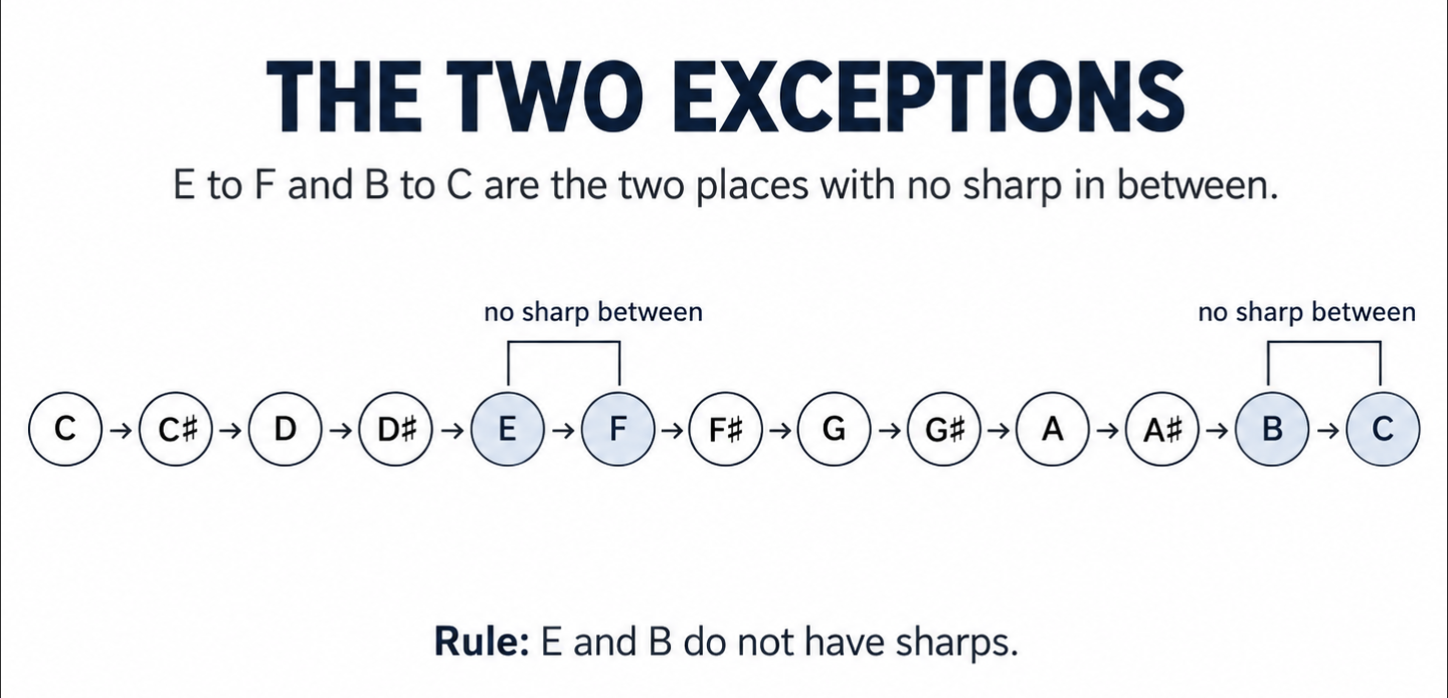
That’s it. That’s the piano lesson. Memorize those two letters and you can figure out the rest of the neck.
Walking Up a String
Quick refresher for anybody brand new. Your strings, from the fattest to the thinnest, are E, A, D, G, B, E. Low to high.
Let’s start on the A string, because A is a normal note that does have a sharp.
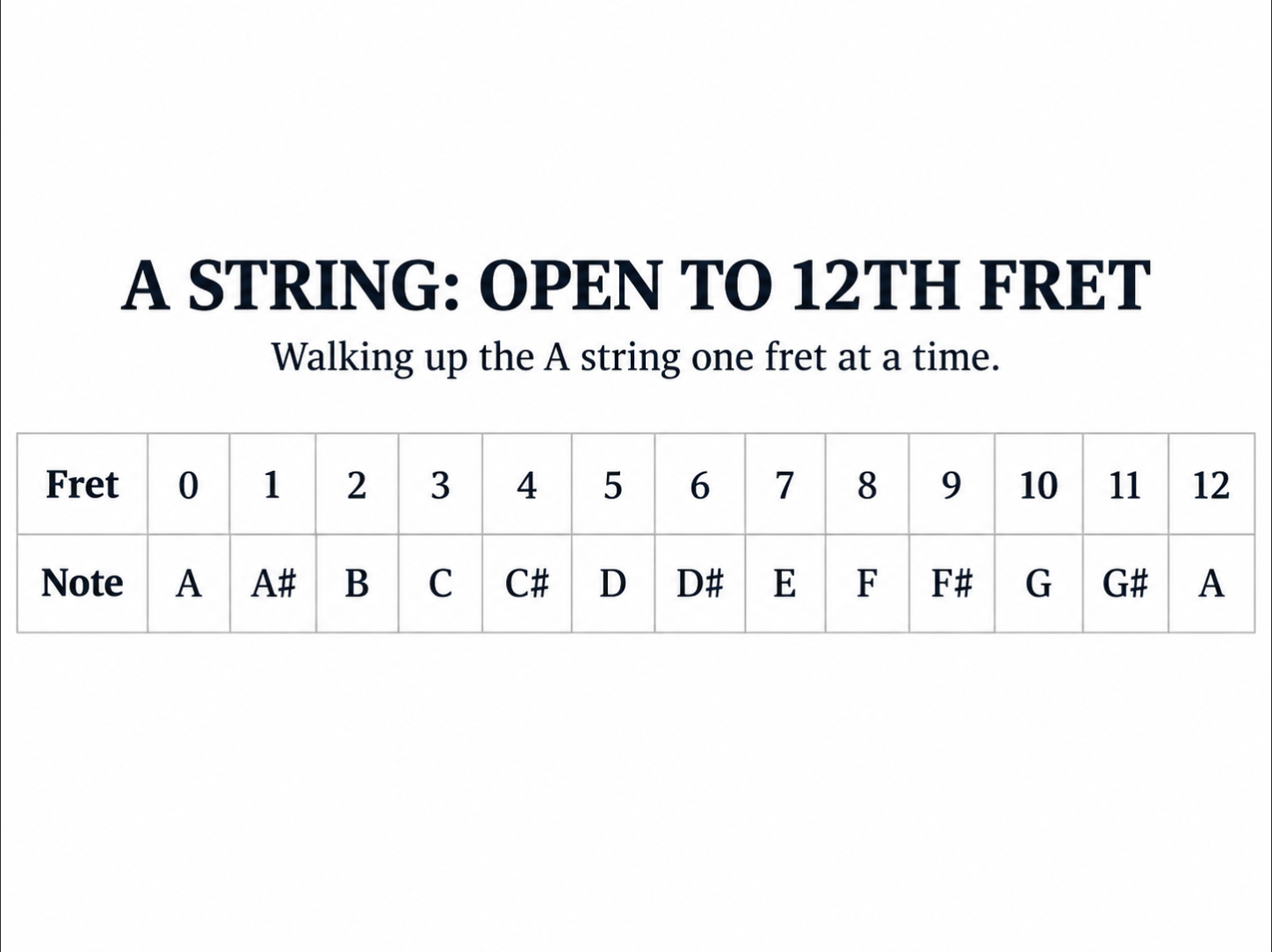
- Open is A
- 1st fret: A sharp
- 2nd fret: B (next letter of the alphabet)
- 3rd fret: C (B is one of our rebels, no sharp, so we jump straight to C)
- 4th fret: C sharp
- 5th fret: D
- 6th fret: D sharp
- 7th fret: E
- 8th fret: F (E, our other rebel, no sharp)
- 9th fret: F sharp
- 10th fret: G
- 11th fret: G sharp
- 12th fret: A
Notice I’m moving one fret at a time. Those are half steps. You’re not leaping around the neck, you’re just walking up the alphabet and remembering which two letters skip their sharp.
And look where we landed. The 12th fret, where the double dots are, is A again. That’s your octave, and it’s true on every string. Whatever your open string is, the 12th fret is that same note. E, A, D, G, B, E.
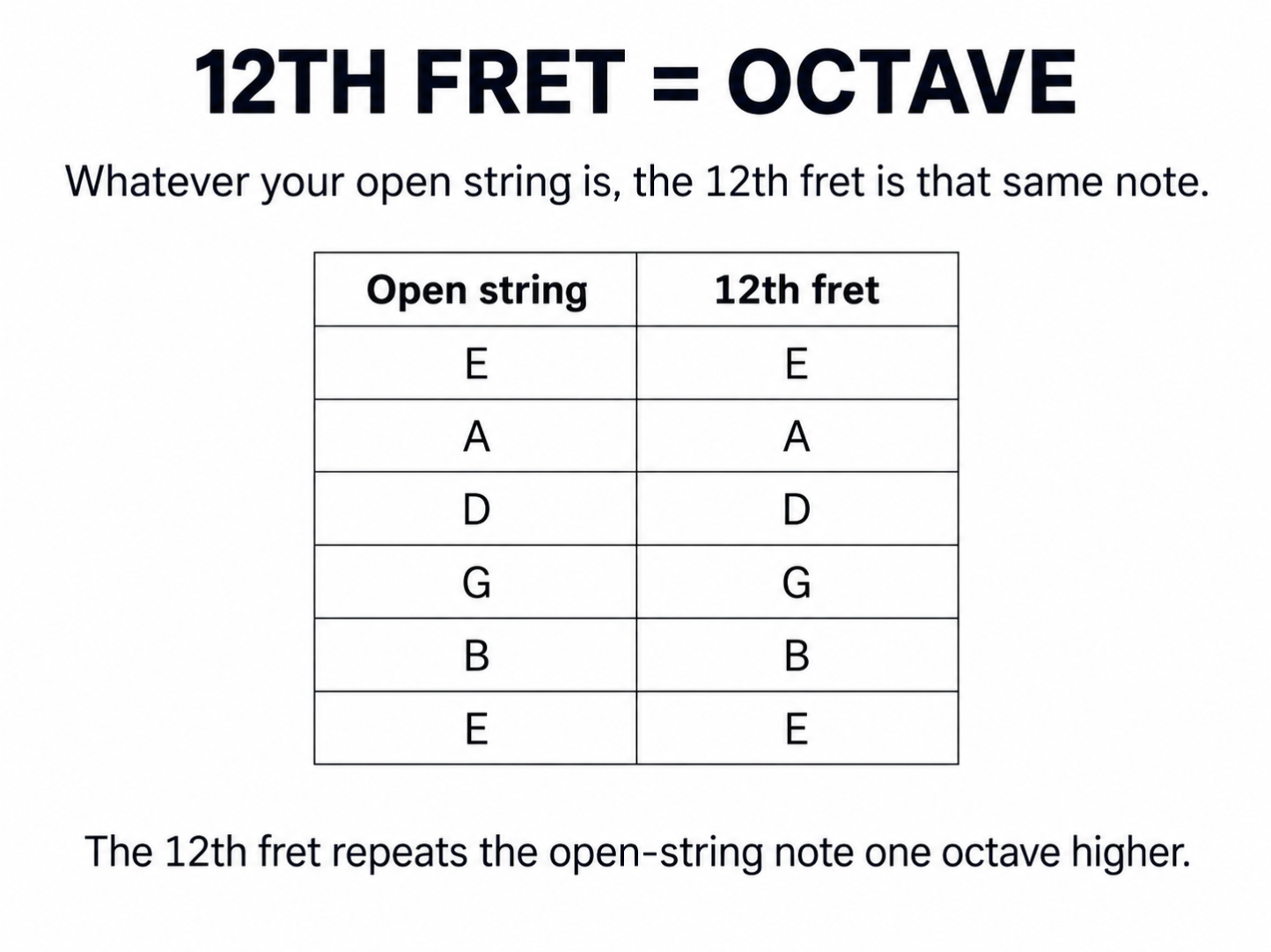
That’s also why your high E and low E are the same note. Your skinny E string is just the octave of the fat one, two octaves up.
The Guitar Newsletter That Doesn’t Suck
Free every week: licks to steal, gear talk, rock trivia with prizes, guitarist spotlights, and more.
One More, On the Low E
Let’s do it on the big fat E string to make sure it stuck.
Quick aside: I call it my low string. Some people call it the top string because it’s physically on top. I think of it as the low string because it literally plays the lowest note on the guitar. However you want to refer to it, it’s the fat one.
- Open is E
- 1st fret: F (E doesn’t have a sharp, remember)
- 2nd fret: F sharp
- 3rd fret: G
- 4th fret: G sharp
- 5th fret: A (we start the alphabet over)
- 6th fret: A sharp
- 7th fret: B
- 8th fret: C (B doesn’t have a sharp either)
- 9th fret: C sharp
- 10th fret: D
- 11th fret: D sharp
- 12th fret: E
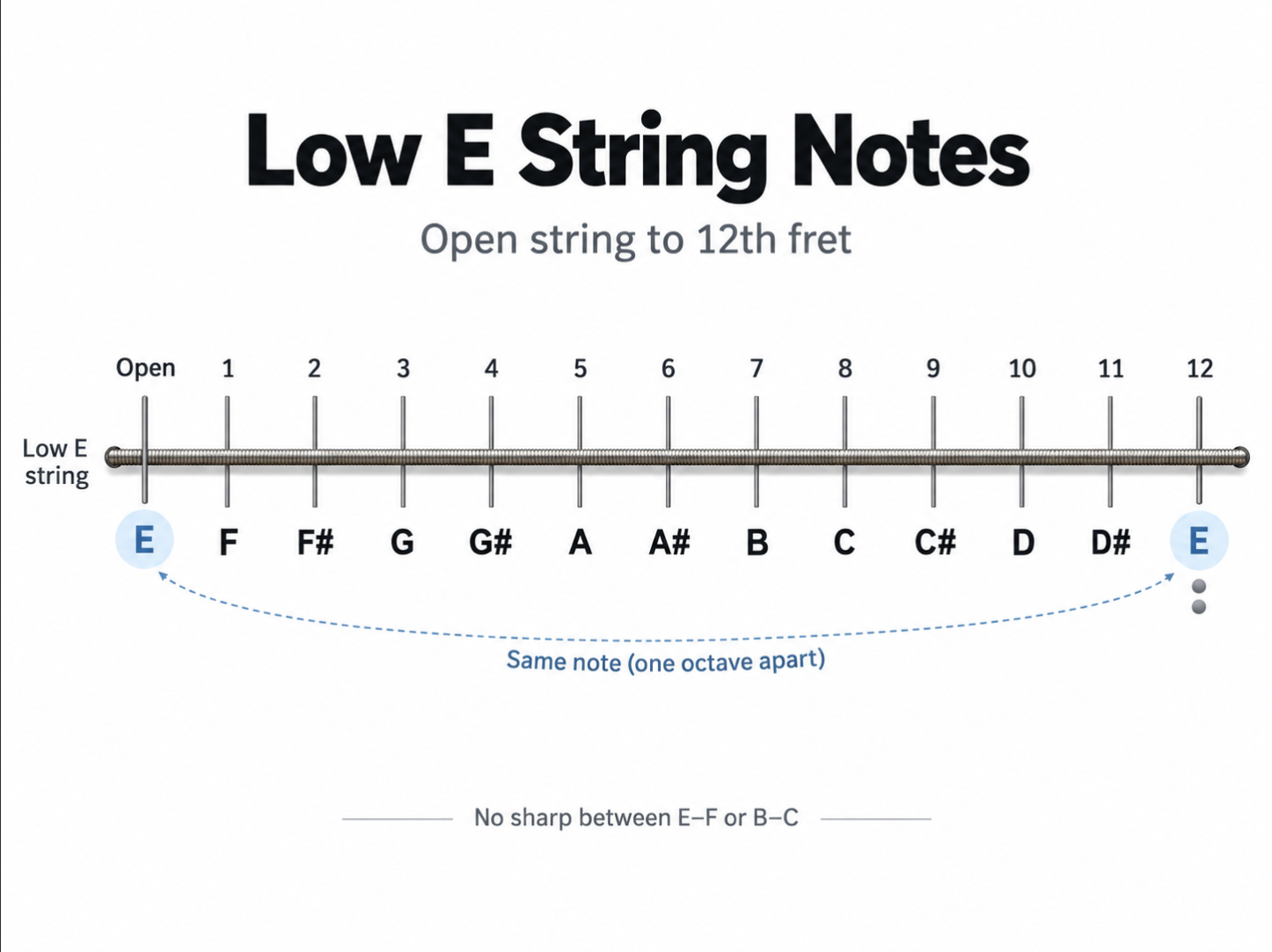
Same walk. Same two rebels. Same octave at the double dots.
Your Homework This Week
There are a million fretboard diagrams online and they’re fine. But looking at a picture is not the same as finding the note yourself.
So here’s the drill. Pick a note and go find it on every single string.
Say we pick E. Open low E string. 7th fret of the A string. 2nd fret of the D string. 9th fret of the G string. 5th fret of the B string. Open high E.
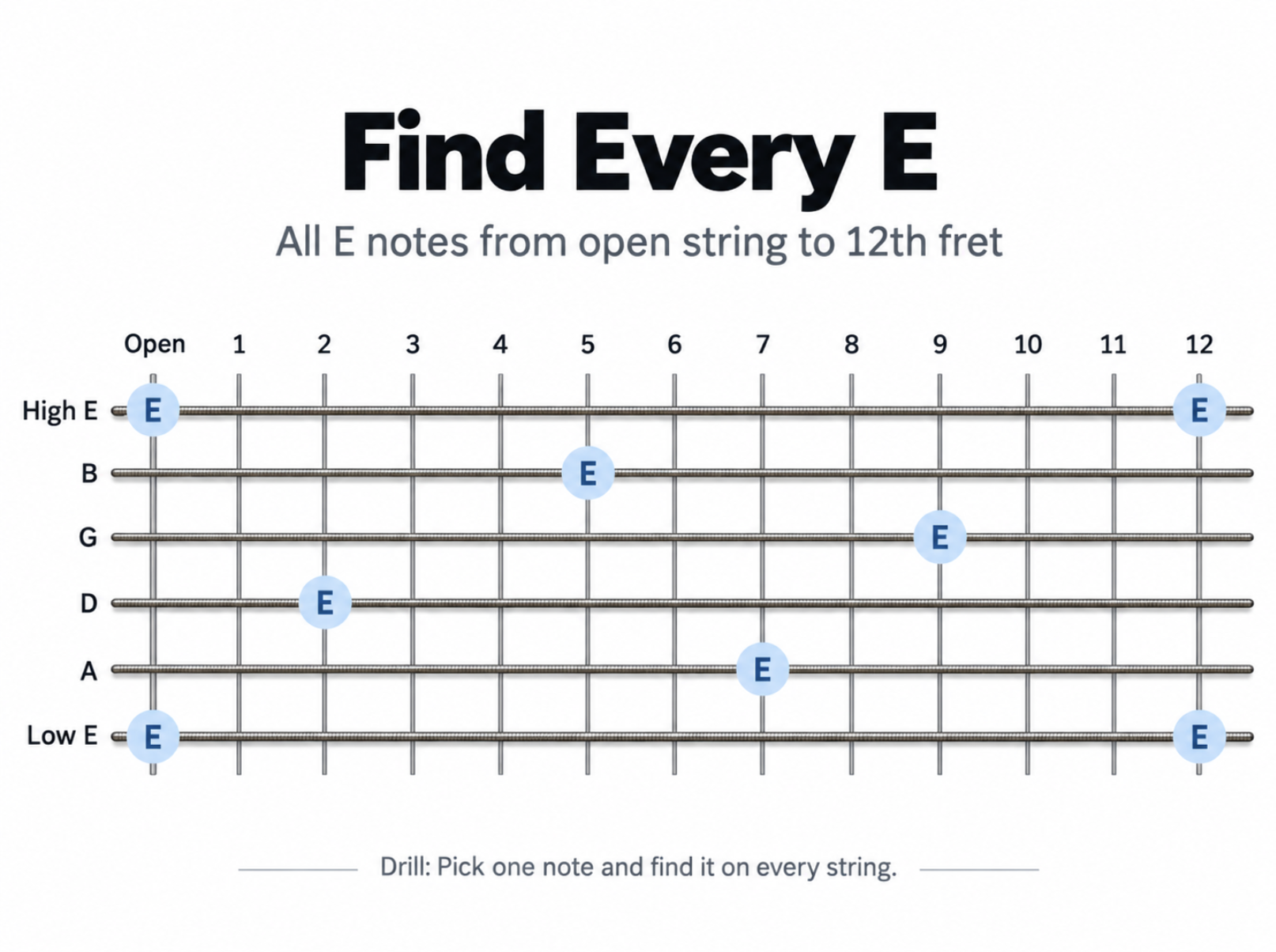
That’s every E on that side of the neck, and you found it by walking the alphabet instead of memorizing a chart. Do that with a different note every day for a week. It’s a handy thing to be able to do quickly, and it becomes absolutely essential the second you start getting into the more advanced stuff.
Which, conveniently..
Part 2: Relative Minors, and What the Heck That Even Means
If you’ve poked around the circle of fifths at all, you’ve seen C and A minor sitting together at the top. That’s not a coincidence. Those two are relative scales. They’re related. They’re cousins.
Here’s what that actually means. Let’s spell them out.
C major: C, D, E, F, G, A, B, C A minor: A, B, C, D, E, F, G, A
Look at those. Not a single sharp, not a single flat, in either one. They are the exact same notes. The only thing that changed is where you started.
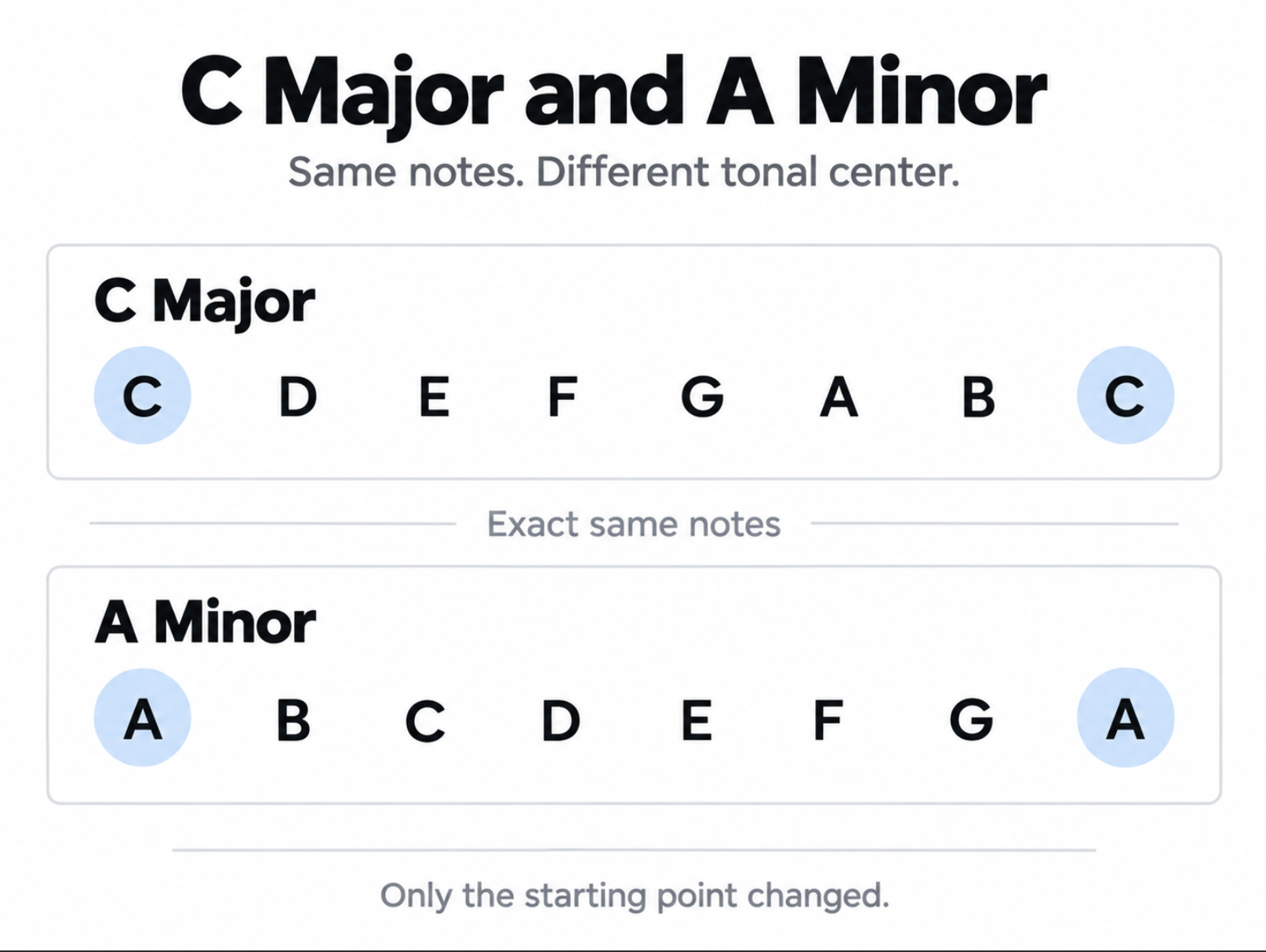
Which means if you played A minor over a C major progression, it would work. Same notes.
The one thing you have to actually think about is your tonal center. If you want it to sound like C, hit that C early and land on it, because whatever you plant first is what sticks in the listener’s ear. Start hammering on the A instead and now you’ve got a minor sound. Same notes, completely different feeling.
Here’s Why This Is Useful: You Already Know the Shape
Same notes means same shapes. That’s the whole payoff.
Most intermediate players have learned the minor pentatonic box at some point. It’s usually the first scale anybody shows you. In A, starting at the 5th fret of the low E string:
- Low E: 5th fret (index), 8th fret (pinky)
- A: 5th, 7th
- D: 5th, 7th
- G: 5th, 7th
- B: 5th, 8th
- High E: 5th, 8th
That’s A minor pentatonic. And for a lot of you the reaction is “well, duh, Ben.”
But here’s where I’m going with it. That shape works splendidly when the song is in A minor. Now let’s say the song is in C major.
You don’t need a new shape. You don’t need to move your hand. C major and A minor are relative, so that same box is already a C major pentatonic. You just have to start and resolve on the C instead of the A. The C is right there in the box, three frets up from where you started, on the 8th fret of your low E string.
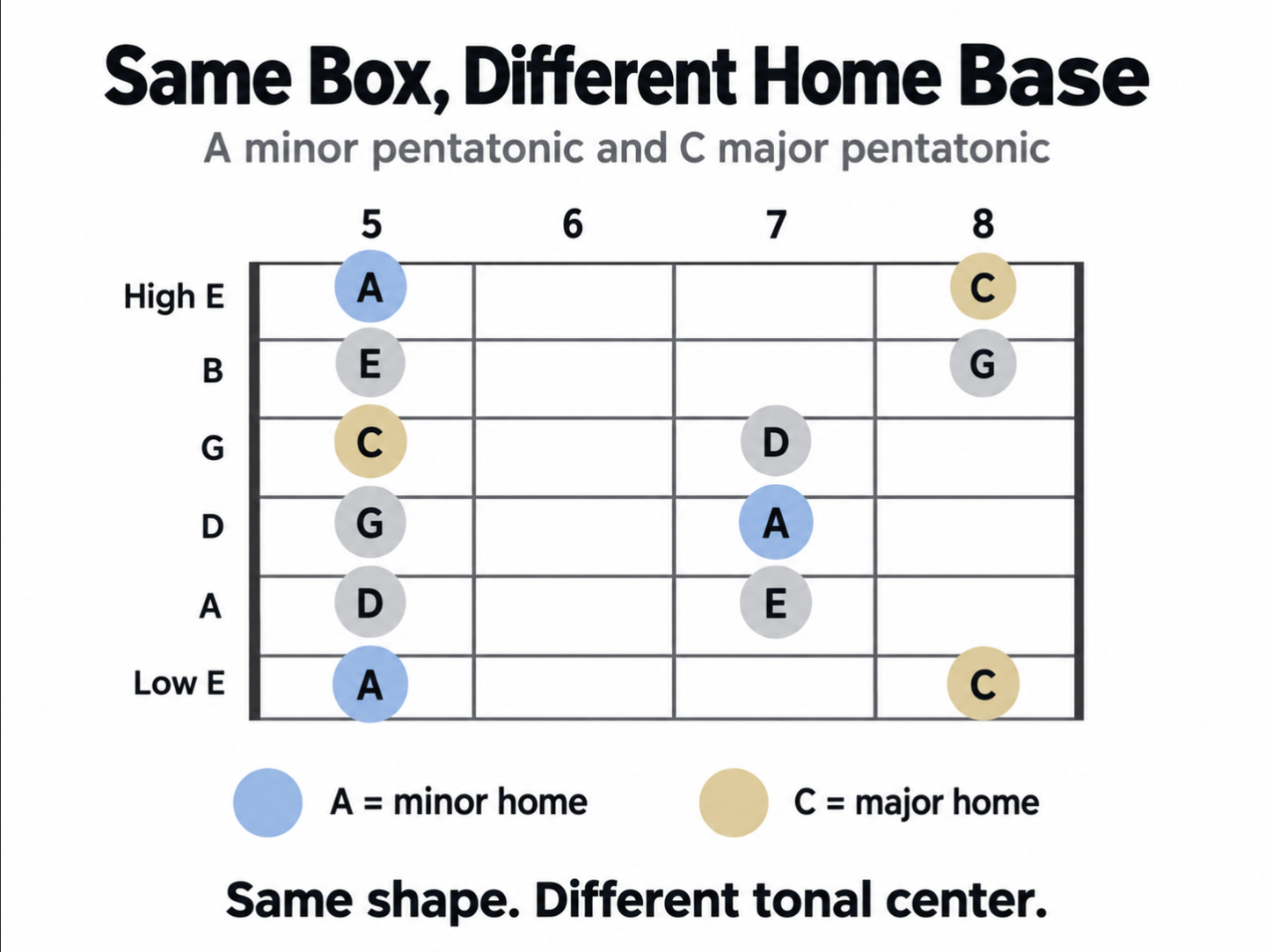
Same fingers. Same frets. Different home base. Suddenly the box sounds bright and major instead of dark and bluesy.
How to Find the Relative Minor
A relative minor comes from the 6th degree of the major scale. Whatever the 6th note of your major scale is, that’s your relative minor.
There are two ways to get there and I use both.
Count up. Run the major scale and number it as you go. C is 1, D is 2, E is 3, F is 4, G is 5, A is 6. There’s your relative minor. A minor.
Walk backwards. This is the faster one, and it’s the one I actually use. In a major scale, the 7th is a half step below the root, and the 6th is a whole step below the 7th. So from C, drop a half step to B (that’s your 7), then a whole step to A (that’s your 6). Done in about a second, and you never had to run the whole scale.
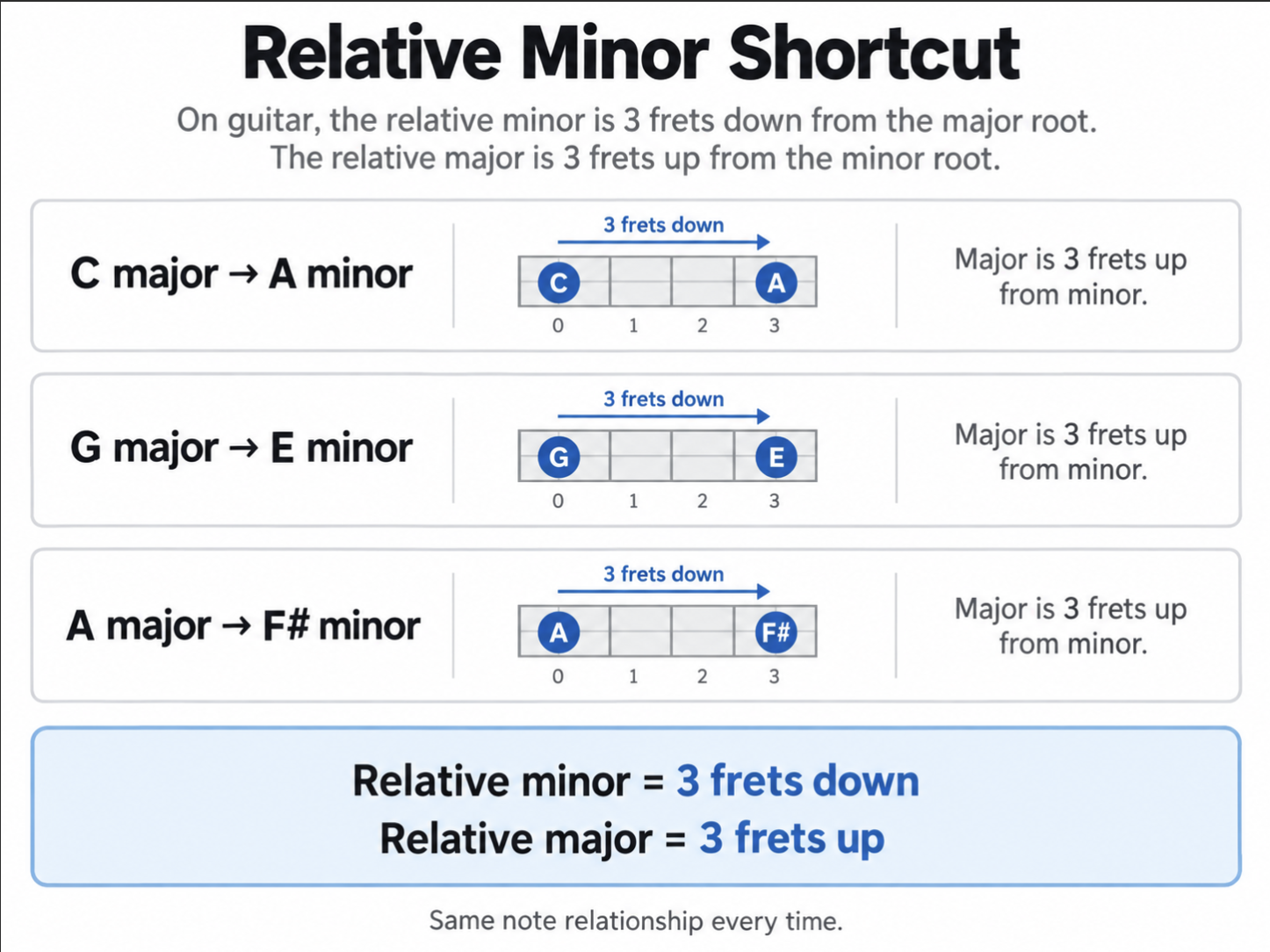
Technically it works in reverse too. C is the relative major of A minor, just like A minor is the relative minor of C.
Let’s Do It in Another Key
Common one. G major.
Count it up: G is 1, A is 2, B is 3, C is 4, D is 5, E is 6. Relative minor is E minor.
Or work backwards from G: half step down is F sharp (the 7), whole step down from there is E (the 6). Same answer, faster.
So if I’m playing over E minor, I’d do what we all do and reach for the E minor pentatonic box. And if I’m playing over G major, I use the exact same box and just get that G in my head and under my fingers as the tonal center. G sits three frets up from the E, same as C sat three frets up from A.
That’s not a coincidence either. The relative major is always three frets up from the minor. Once you see it, you can’t unsee it.
Want A major? Find A, walk backwards. G sharp is the 7. F sharp is the 6. So F sharp minor pentatonic is the shape I want, and I start it on the A.
Go Use It
Keep working the minor pentatonic. That shape has paid the bills for about sixty years of rock music and it isn’t going anywhere.
But start adding the major side into your playing this week. Take a box you already own, move your tonal center three frets up, and listen to how different it sounds. I think you’ll especially like this particular position, because it’s very much that Jimi Hendrix sort of flavor once you start leaning on the major notes.
And keep doing the fretboard drill while you’re at it. Pick a note, find it on all six strings. Two minutes a day. You’ll thank me the next time somebody calls out a key you’ve never played in.
If you’ve got questions, join our guitar community here!
The Guitar Newsletter That Doesn’t Suck
Free every week: licks to steal, gear talk, rock trivia with prizes, guitarist spotlights, and more.