How to Play Come As You Are by Nirvana: Full Guitar Lesson
This is Come As You Are, off 1991’s Nevermind by Nirvana.
If you’re going to learn one Nirvana song, this is the one I’d start with. The riff is four notes on two strings, the chorus is two chords, and the solo is the vocal melody. Kurt was not trying to impress anybody, and that’s exactly why it’s such a good song to have under your fingers.
It also teaches you something most beginner songs don’t, which we’ll get to in the bridge.
Before you start
Quick note before we start. I’m playing in standard tuning, E A D G B E, just like most of the rest of us are tuned to.
If you want to play along with the record, Kurt tunes all of his strings down a whole step, so he’s in D standard.
Everything below works either way, you’ll just be a whole step higher than the record.
My advice is to learn it in standard first. Get the shapes in your hands, then if you want to play along with the album, drop the whole guitar a step and nothing you learned changes, because every shape stays exactly where it was.
The intro and verse riff
The intro and verse use just your low E and A strings, and only a few frets.
You need the 1st and 2nd frets of your low E string, and the open A string. That’s it.
Here’s the order, slowly:
- Open E string
- 1st fret, low E
- 2nd fret, low E
- Open A
- 2nd fret, low E
- Open A
- 2nd fret, low E
Do that whole thing twice, then walk it back down: 1st fret, open.
Then go to the 2nd fret of the A string, open E string, 2nd fret of the A, open E.
And that is the entirety of the lick.
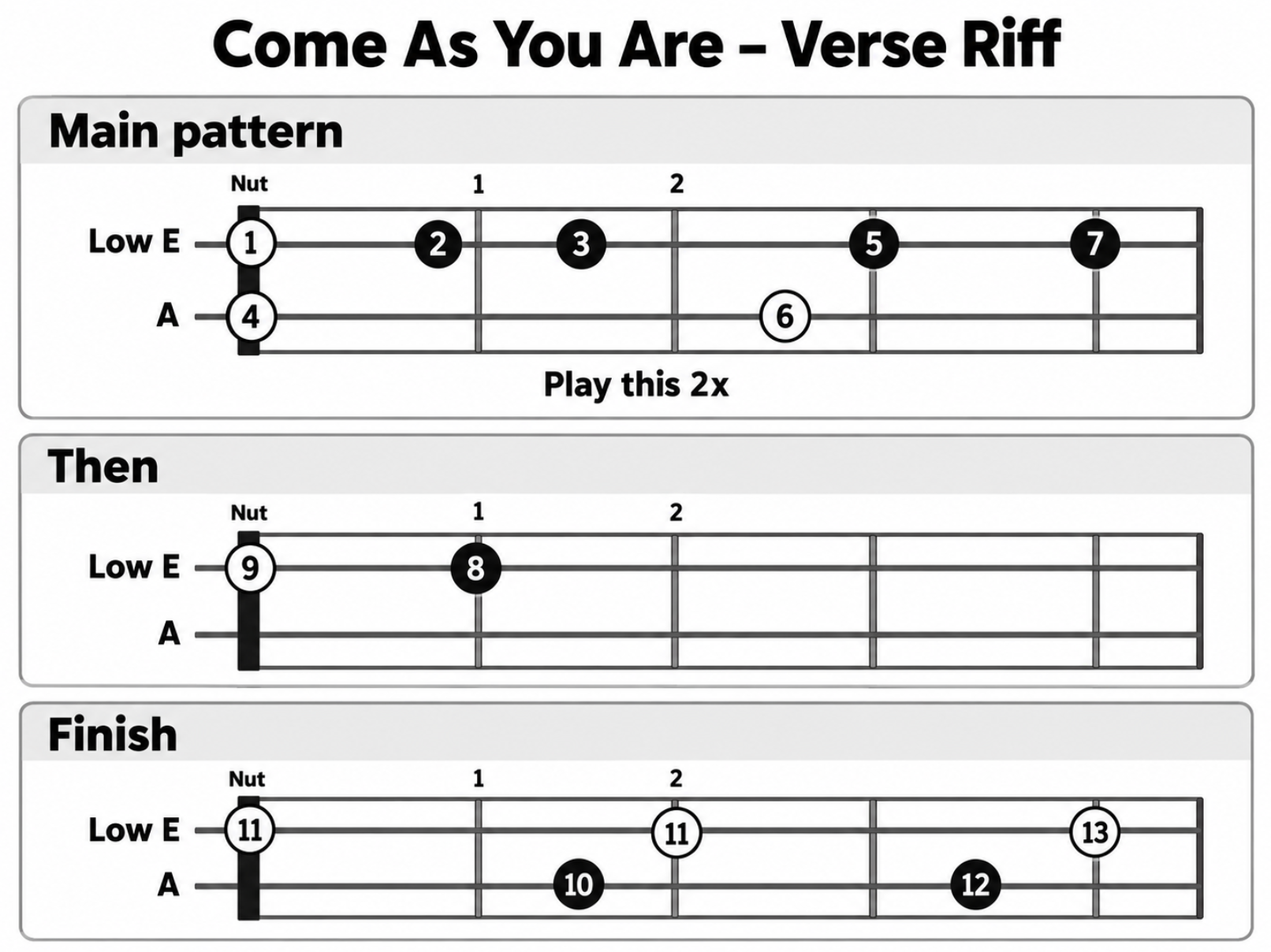
He plays that riff four times for the intro and eight times for the verse.
The thing to get right here is the feel, not the notes. The notes are easy. What makes it sound like the record is that it never speeds up and never digs in. It just rolls. If you find yourself getting louder as you go, back off.
Why that riff sounds so uneasy
Worth a second on this, because it explains the whole mood of the song.
Look at the first three notes. Open E, 1st fret, 2nd fret. Each one is a half step from the last. That’s a chromatic creep, and chromatic movement is the sound of something not sitting still. Your ear can’t file it into a key yet.
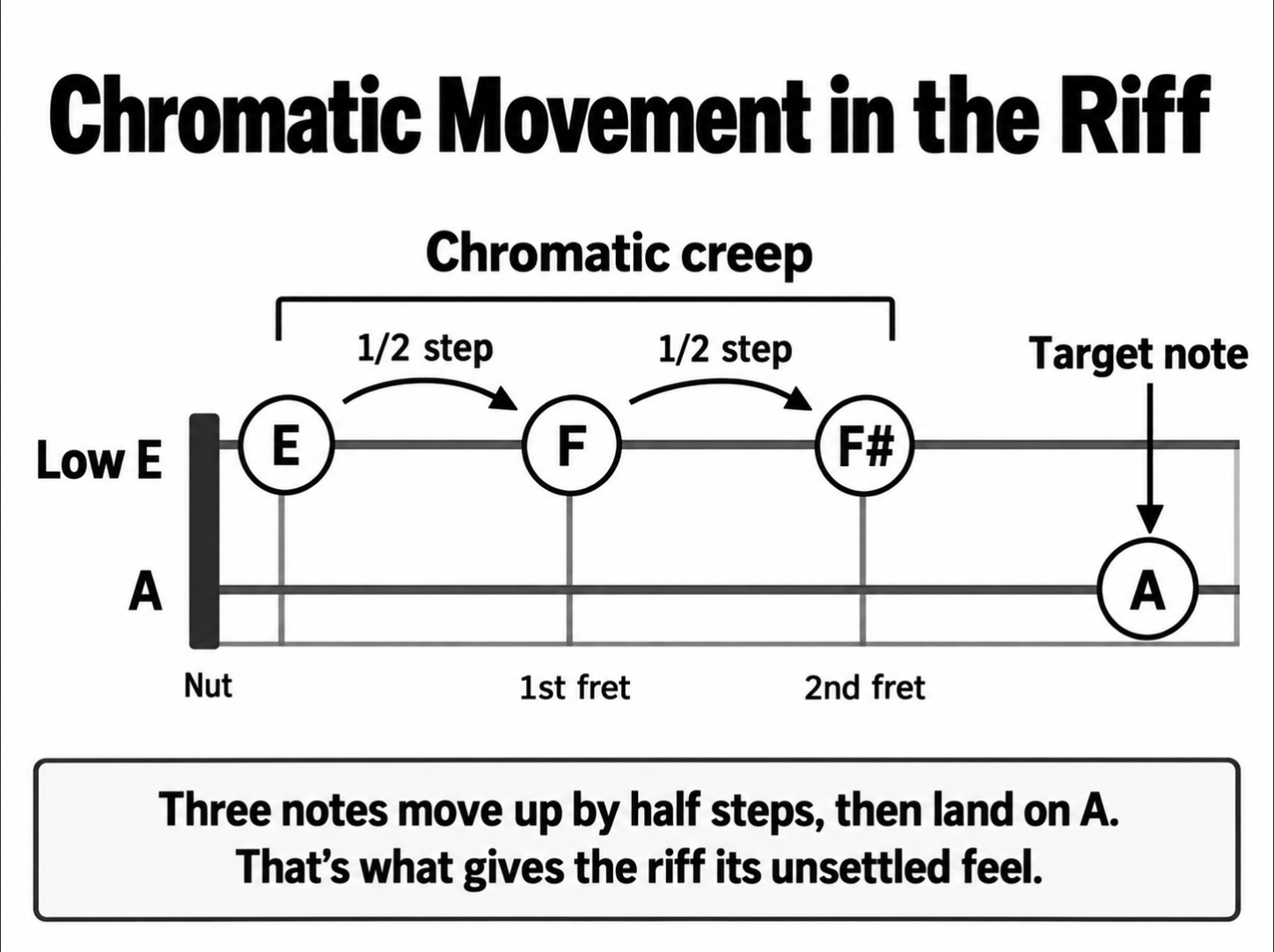
Then the open A arrives underneath and gives it a floor.
That’s the trick. Three notes that don’t belong to anything, landing on one that does, over and over. It’s unsettled and hypnotic at the same time, and it’s four notes.
You’ll find that same idea all over the place once you’ve heard it. A chromatic run into a target note is one of the cheapest ways to make a simple line sound like it means something.
Getting the tone
The chorus-pedal question comes up every time with this song, so let’s deal with it.
That watery, slightly seasick sound on the record is a chorus pedal. Kurt was famously using an Electro-Harmonix Small Clone, and it’s most of the character of the intro. Without it, the riff is still the riff, it’s just dry.
If you’ve got any chorus pedal, set it subtle. Slow rate, moderate depth. You’re after a gentle wobble, not a swirl.
If you don’t have one, don’t worry about it. Play it clean with your neck pickup and a touch of reverb and it sounds fine. Plenty of people have played this song on an acoustic at a campfire and nobody complained.
For the bridge and chorus, a bit of dirt. Not a wall of gain, just enough that the chords push.
Into the bridge
On that last time around, you land on an E major chord for a count of four. Then we move into the bridge.
The bridge is an F# power chord, or really a bar chord, but with a twist. The third is shifted up a half step.
Now, Kurt is a little bit of a sloppy player, so you can be a little sloppy with this too. But we do want that extra note to ring out. That’s what makes the chord sound like the record.
This is the part I mentioned earlier that teaches you something. That raised note turns an ordinary bar chord into something unsettled that wants to move. It’s a sus4, and it’s why the bridge sounds tense under the vocal instead of just loud.
Play that chord three times, again a little sloppy, then let the open strings ring.
Then move down to just an A chord and play it five times.
The strumming is:
Down, down up, down up, down up, down, and around again.
The song map
After the bridge, we slide back into the verse riff and play it four times. On the fourth time, back into the bridge.
For the bridge, play through that sequence four times.
Once you’ve done the bridge and the verses twice each, so intro, verse, bridge, verse, bridge, we move into the chorus.
The chorus
The chorus is super simple, it’s just two chords.
The B chord: bar the 2nd fret with your index, ring finger on the D, G and B strings at the 4th fret.
The D chord: index on the 2nd fret of the G string, middle finger on the 2nd fret of the high E, ring finger on the 3rd fret of the B. Make sure you don’t play the low E string.
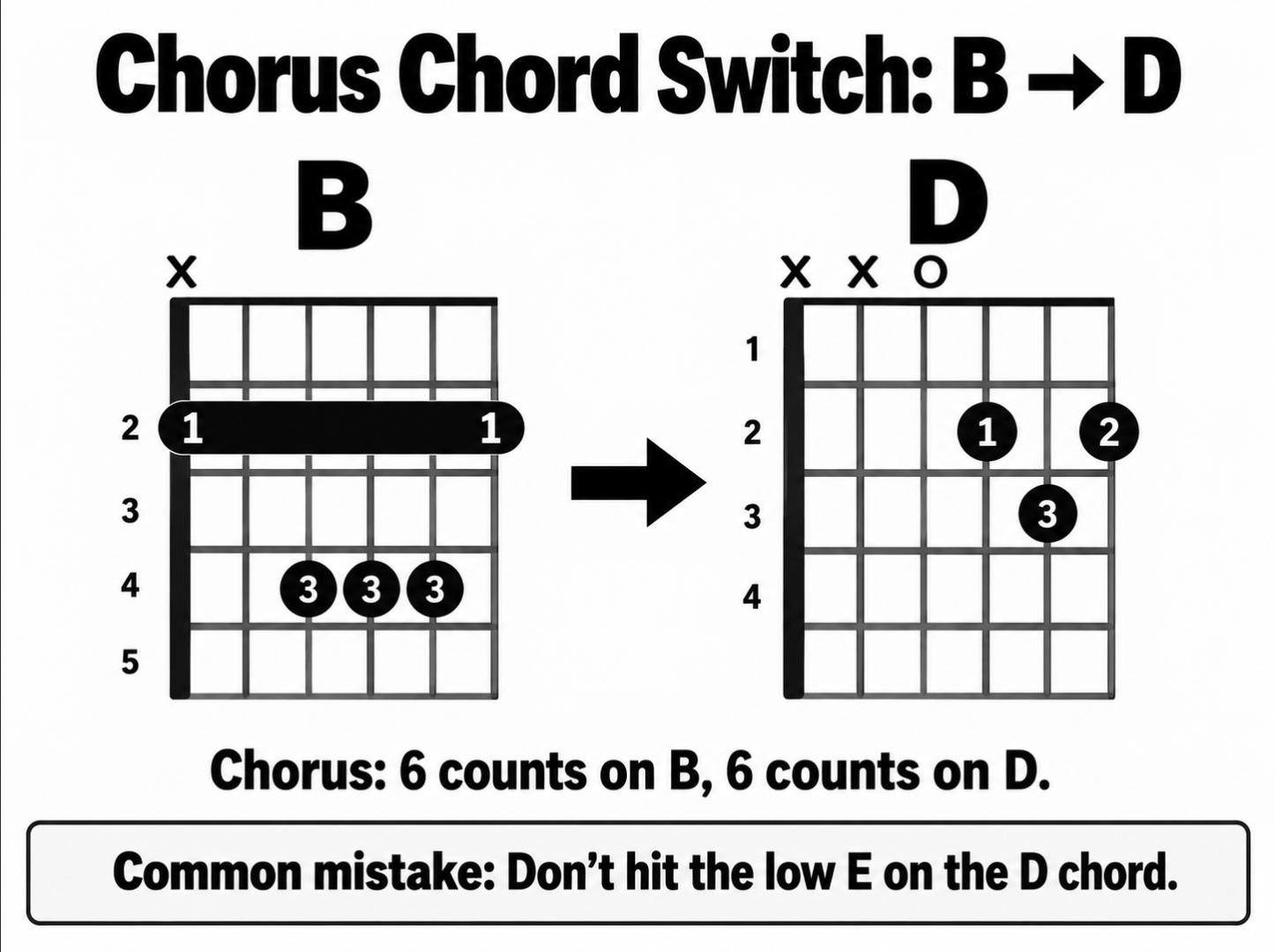
Six counts on the B, six on the D, back and forth. Play the chorus four times total.
Then it goes back into the verse, which leads us into the solo.
The solo, and why it’s easy
Kurt really liked to double up what the vocals were doing in his solos. It makes them really memorable, but also kind of simple, which is great for us.
The verse riff is going on in the background during the solo, and the whole solo is on the G string.
Start at the 4th fret, up to the 7th, up to the 9th. Do that twice.
On the third time around, go 4th fret, 7th, 9th, 11th, then back down to the 9th and the 7th.
Then it starts over.
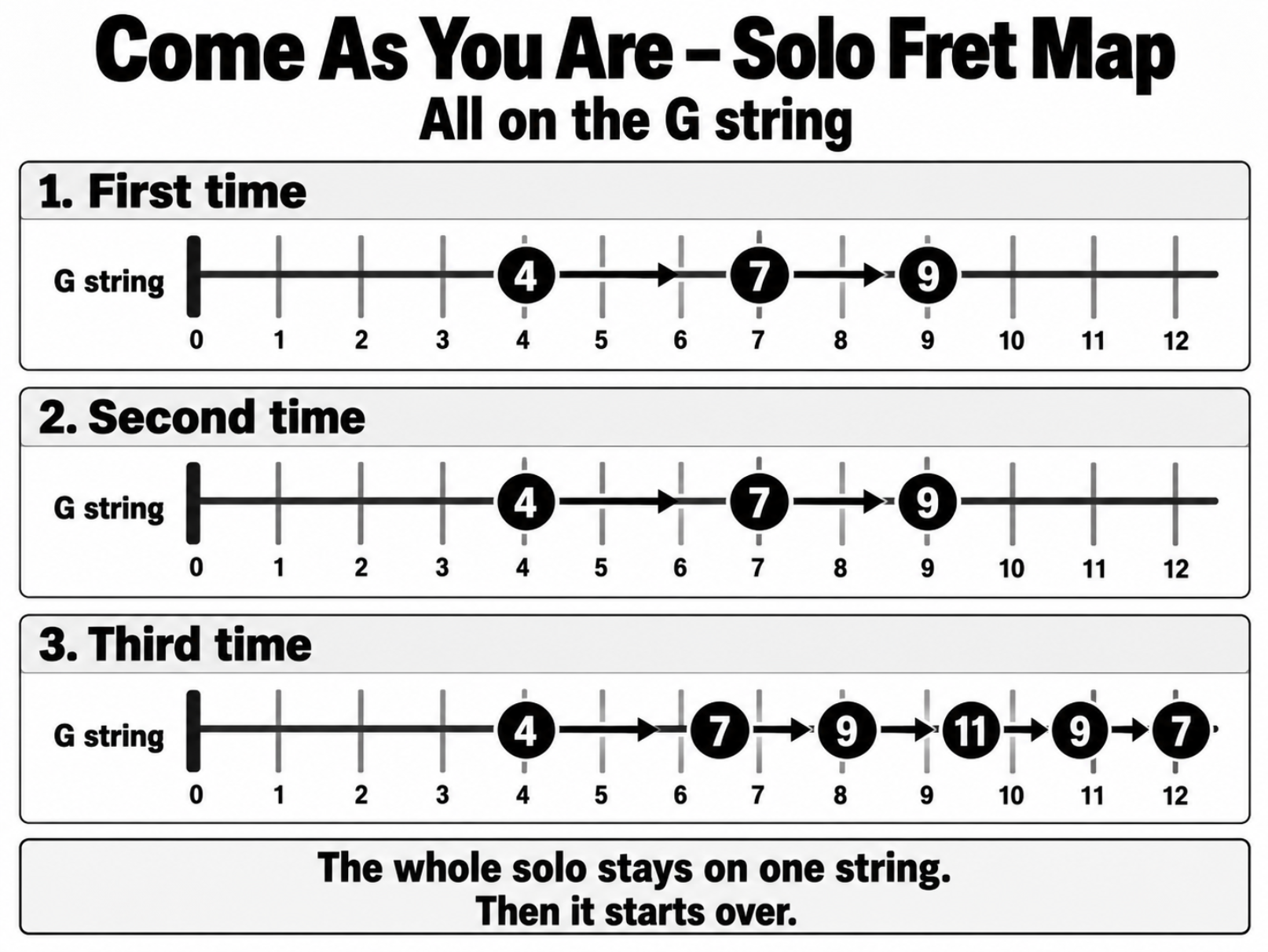
If you’ve never learned a solo before in your life, learn this one. It’s six notes on one string, and you’ll be able to play it today. There’s a real confidence jump that comes from finishing a solo, and this is the cheapest one available.
The ending
After the solo, the chorus goes six times.
The outro is the same as the intro, and the last chord to end the song on is that same F#.
The stripped down version
If you’re newer and the full arrangement is too much, here’s how to get a playable version of this song today.
Play the verse riff exactly as written. That part doesn’t get simplified, because it is the song, and it’s already about as easy as a famous riff gets.
For the bridge, forget the raised note and just play a standard F# power chord. Two fingers. It loses a little of the tension but nobody’s going to stop you.
For the chorus, play the B as a straight bar chord and the D as an open D. Both are easier than the versions above and both are in the right place harmonically.
Skip the solo the first week. Come back to it once the rest is comfortable, because it’s the most satisfying part to finish and you want to enjoy it rather than fight it.
That version is four shapes and a riff, and it’ll get you through the whole song.
Common mistakes
- Rushing the verse riff. It’s the most common one by a mile. This song sits back
- Cleaning up the bridge chord. Let that extra note ring, and don’t worry about the strings you’re catching by accident
- Playing the low E string on the D chord in the chorus. It muddies the whole thing
- Trying to play along with the record in standard tuning and wondering why it sounds wrong. The album is a whole step down
- Strumming the chorus too hard. The dynamic jump is in the band, not in your right hand
What to practice first
1. The verse riff, slowly, until it rolls without you thinking
2. The F# bridge chord on its own, getting that extra note to ring
3. The B and D chorus chords, switching between them
4. The solo. It’s six notes, you’ll have it in ten minutes
5. Then put the structure together
And that’s Come As You Are by Nirvana.
Give it a go this week, and if you’ve got questions, come find us in the community.