Why You’re Stuck in a Guitar Rut (And How To Break Through)
If you’ve been playing the same chords, in the same boxes, repeating the same patterns for longer than you’d like to admit.. this one’s for you.
Almost every guitar player hits the plateau. You’re not a beginner anymore, but you don’t feel like you’re getting any better either. Or at least not fast enough.
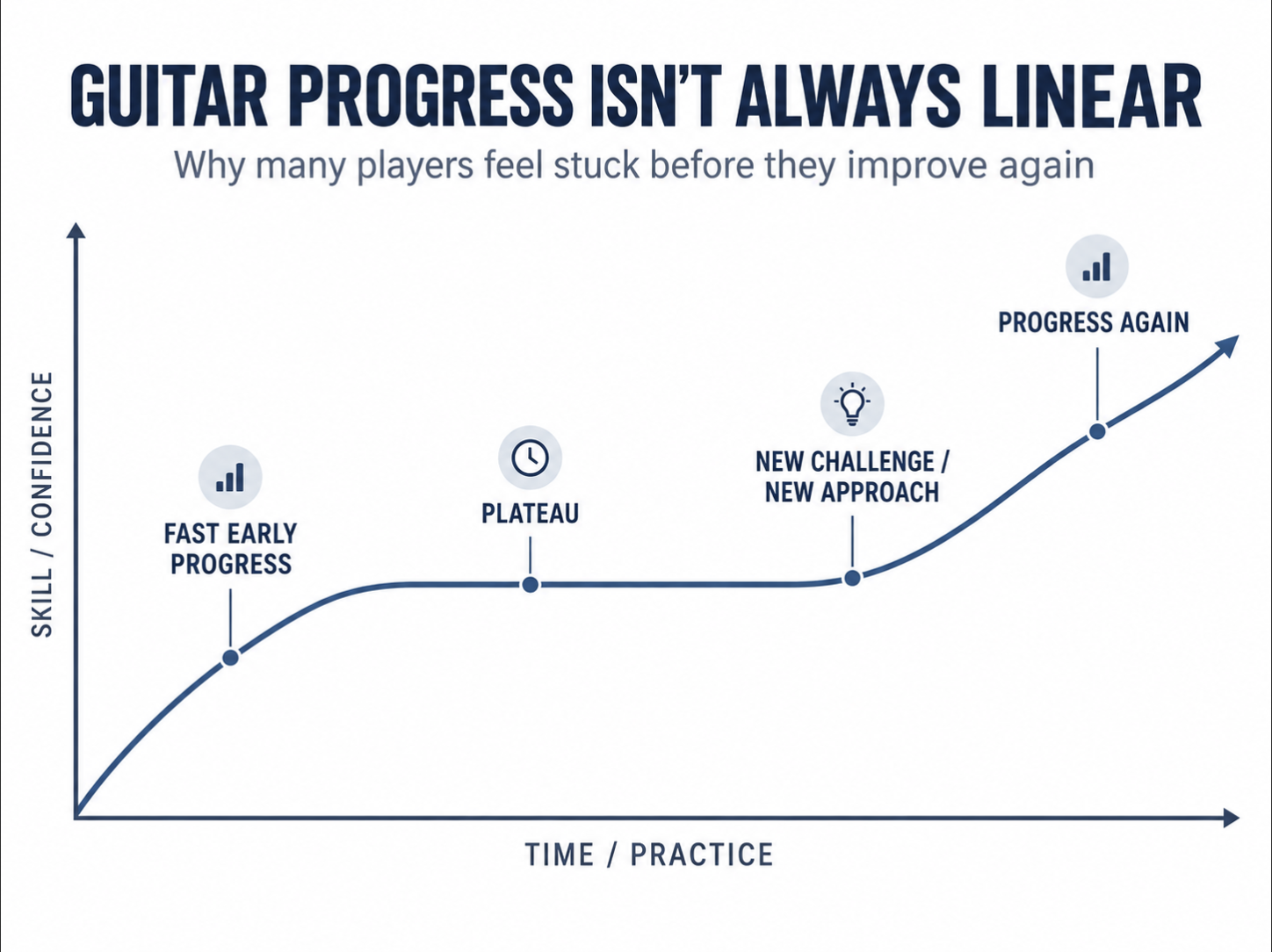
I’ve been teaching guitar for about 15 years and playing for almost 25. I’ve helped a LOT of players climb out of this exact rut. Here are the things that actually work.
Some of these will be quick fixes. Others will send you down a rabbit hole of new stuff to research and practice. Both are good.
1. You’re Stuck on the Same Chords
This is the big one.
Most of us come up the same way. We learn our open position chords: C, G, D, A, E. Then we ask, “okay, what’s next?”
For most players, the answer is barre chords. That’s usually your first big hurdle. If you haven’t gotten over it yet, no big deal. Keep working at it. You’ll get them.
But then a lot of players get stuck there too. You know your open chords, you know your barre chords, and then it becomes.. well, now what?
Part of the problem is that a lot of popular music really doesn’t use much beyond those. It’s not until you dig into more sophisticated music that you start running into major 7s, minor 7s, and dominant 7s.
A couple of my personal favorites you should look into: major 9s and minor 9s. Beautiful jazz chords. Big fan.
Stop memorizing, start building
When I was coming up, I had a giant chord chart on my wall with about 150 chords on it. I remember looking at it thinking, “How am I EVER going to learn all of these?”
So I started trying to memorize them. All of them.
Then I did some research and realized I didn’t need to learn all of those chords. I needed to learn how to BUILD a chord. That’s what we call chord construction theory.
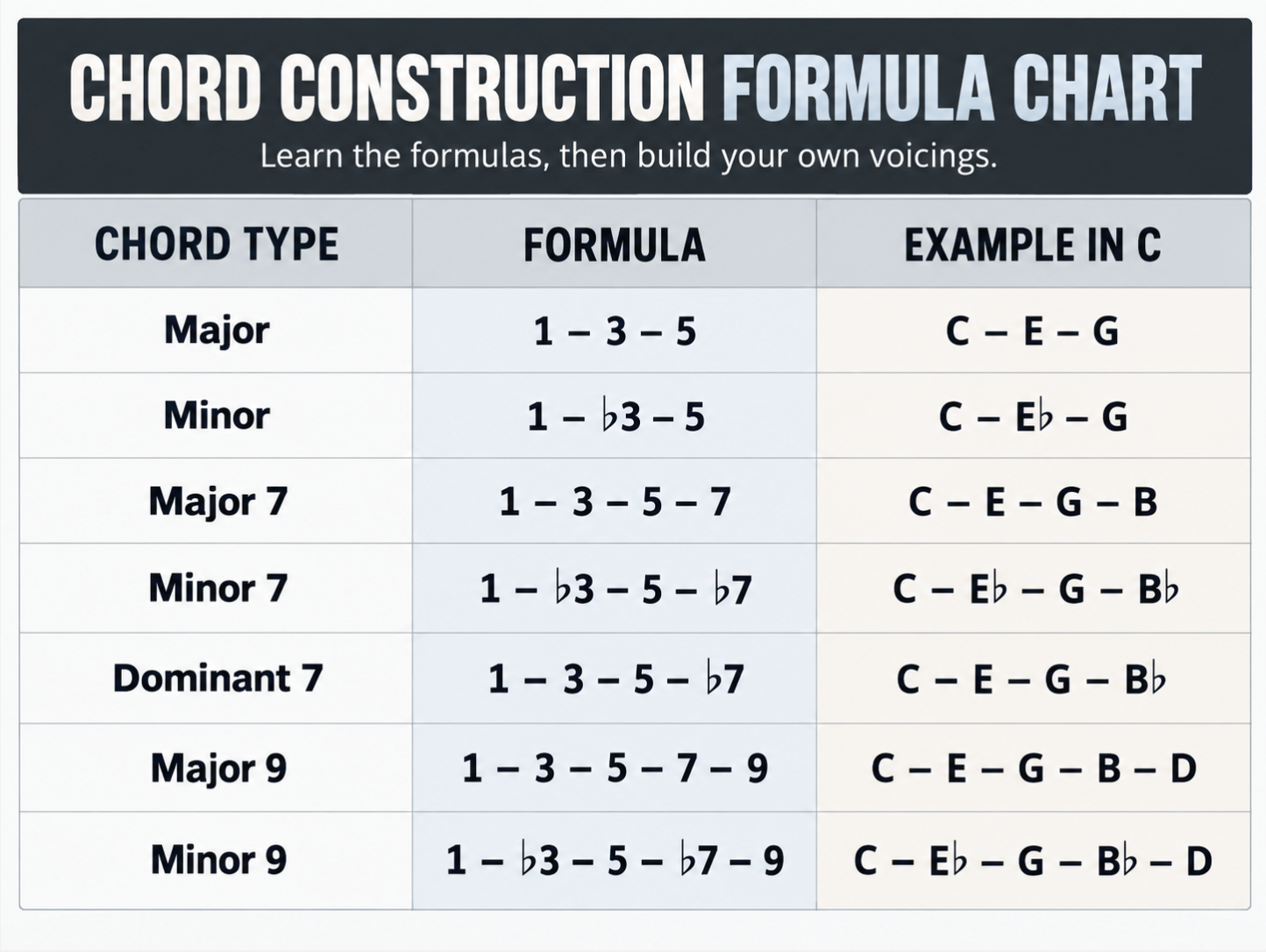
Once you dip your toes into those waters, you can start crafting your own chords. Maybe you don’t want to play a major 9 in the standard shape. Maybe you want a voicing that sounds a little different. That just comes down to knowing which notes from the scale make a chord major or minor, and which embellishments you want to throw over the top.
A lot of those really pretty chords have a leading, melodic tone built right in. It helps drive the melody forward.
Chord construction theory will get you out of a rut really quickly.
2. You Don’t Know Your Diatonic Chords
“Diatonic” is just a fancy way of saying “the chords that belong in the key you’re playing in.”
When I first started writing songs, it was a lot of guesswork. Maybe that chord works? Maybe that one?
And honestly, that’ll get you pretty far. But eventually you land in the rut of “I’ve learned a couple of chord patterns I really like, and that’s about all I can do.” Then you’re just mixing and matching and hoping it sounds good.
Diatonic chords take the guessing out of it.
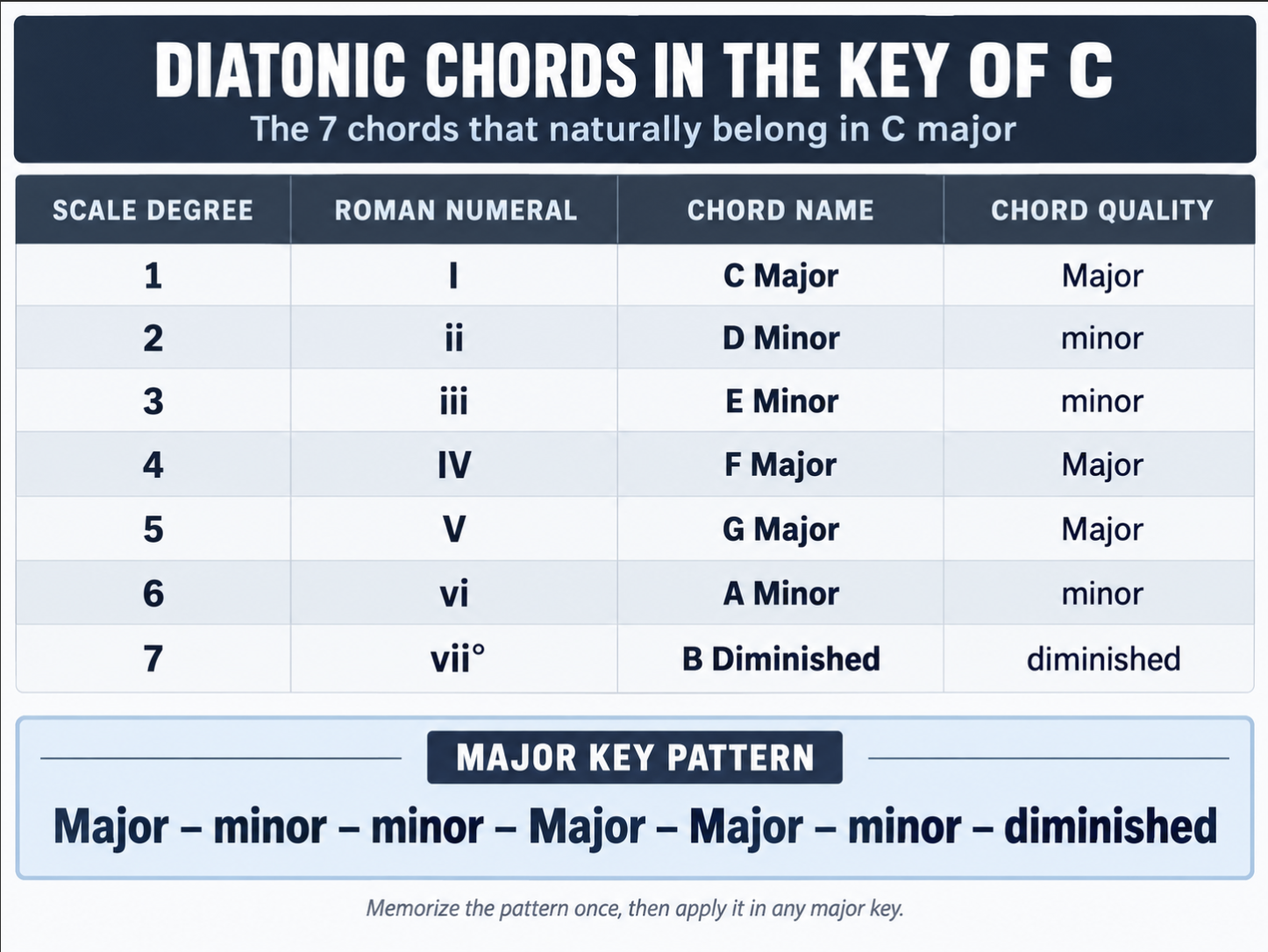
In the key of C, here’s what you’ve got to work with:
- 1: C major
- 2: D minor
- 3: E minor
- 4: F major
- 5: G major
- 6: A minor
- 7: B diminished
Any combination of those is going to sound like it belongs.
If you’ve ever heard someone talk about the Nashville Number System (or just numbers in general), this is what they mean. “It’s a 1-4-5 in C.” “It’s a 2-6-1-5 in D.” They’re using diatonic chords.
A few progressions to try in C
- 1-4-5: C, F, G. About as classic as it gets.
- 1-6-4-5: C, A minor, F, G. This sounds like a thousand pop songs, because it basically IS a thousand pop songs.
- 1-6-2-5: C, A minor, D minor, G. Play these in open position. Really pretty.
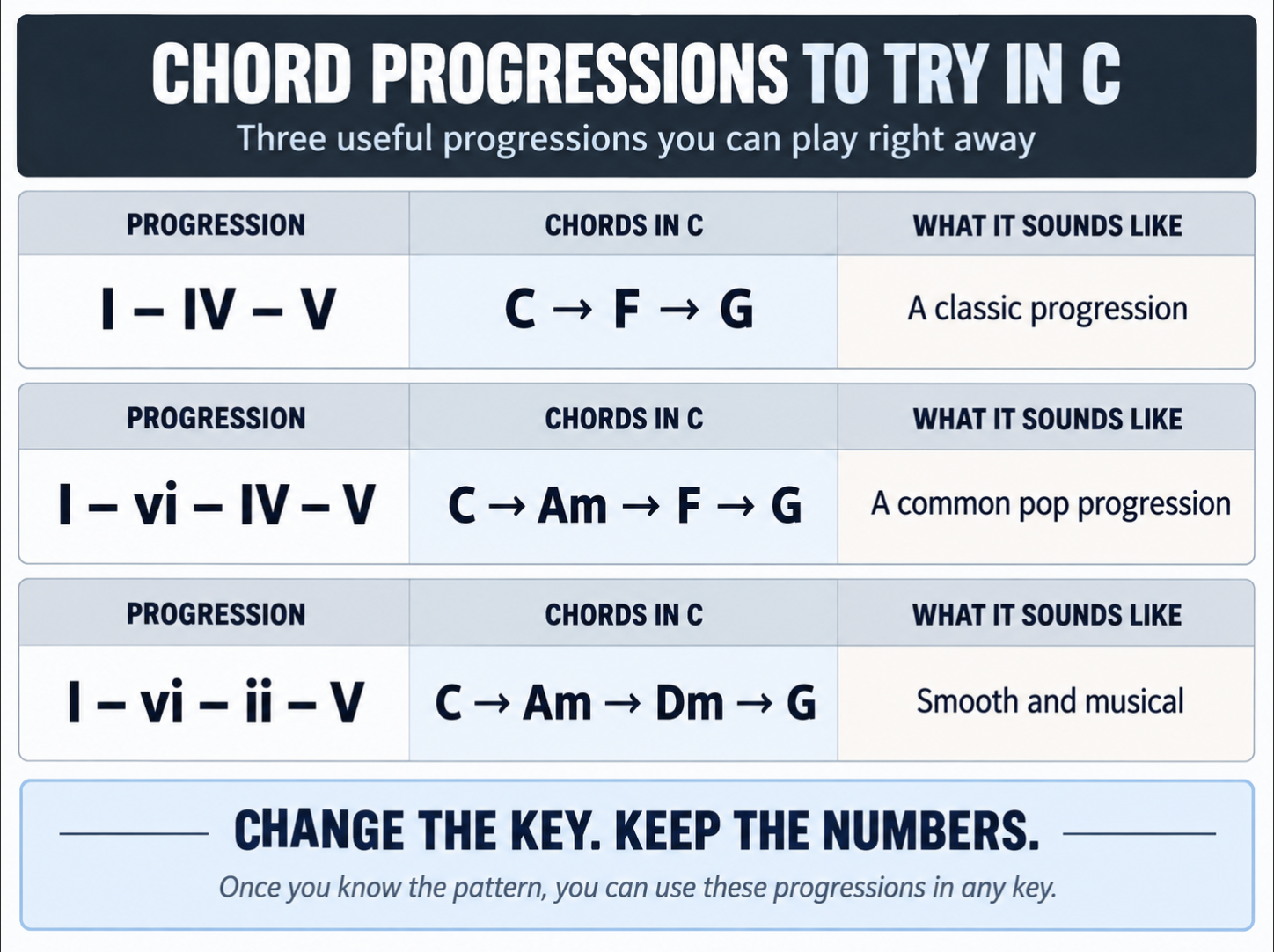
The best part? Once you know the numbers, you can play any of these in any key. Lickety split.
3. You’re Stuck in the Same Scales
This one’s geared a little more toward intermediate players.
Most of us learn the A minor pentatonic scale. Everybody learns that one. Some people learn the major pentatonic too.
Those are great scales. But they’re also exactly where we get stuck. I probably played those two back to back to back for the first two years I played guitar.
The result? Playing starts to feel stale. You’re stuck in “the box.” I’m sure you’ve heard that one before.
Get into modes
Modes are a really great way to add some sophistication to your playing and pull out sounds you might not be used to hearing.
Mixolydian is a good place to start. Try vamping between E major and D major and playing E Mixolydian over it. It’s got a little more spice going on than a straight major scale.
Dorian is one of my personal favorites. Try an A minor 9 moving to a D and play A Dorian over the top. It’s a little more jazz-inspired, with that Carlos Santana kind of sound. It just sounds more sophisticated.
Go check out your modes.
4. Your Practice Routine Is Holding You Back
A lot of times we sit down to “practice” and just run through the same things we always do.
Going back to that minor pentatonic, a lot of players will tell me they practiced, and what they actually did was run the scale straight up and down the whole time.
Here’s what happens when you do that: that straight up-and-down pattern starts coming out in your playing. There’s no melody to it. It just sounds like practice.
Practice musically instead
Try running your scales in note groupings. Take groups of four (1-2-3-4, 1-2-3-4) as you move through the scale. All of a sudden it starts sounding more musical. More like a lick. Like you’re actually doing something.
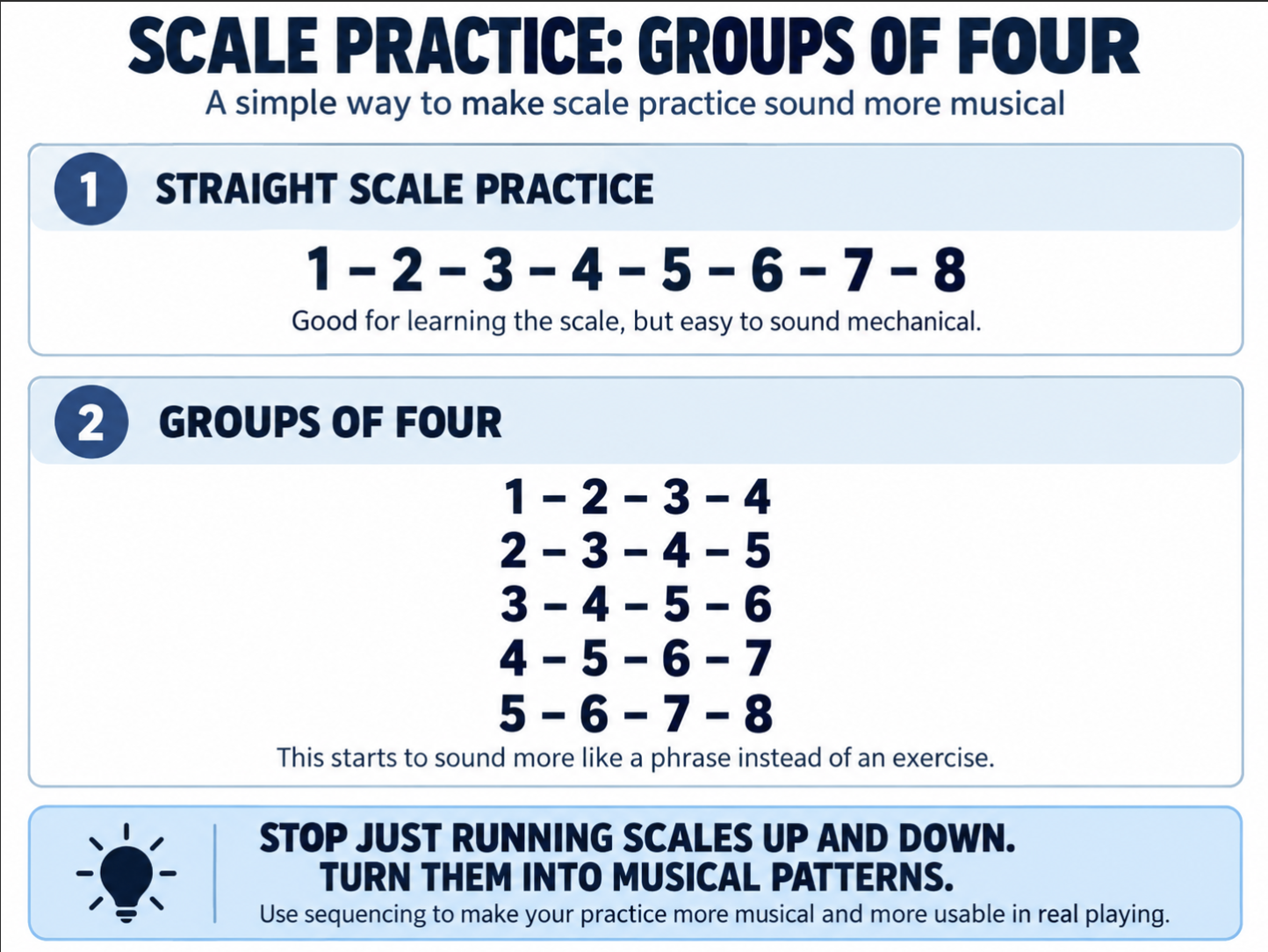
You can also try moving in 4ths. It’s always a goofy one, but it works.
These aren’t just exercises. They’re things you’ll actually USE when you solo.
5. You’re Not Using Your Practice Time Well
I’ve always been a big believer in working on the stuff you’re uncomfortable with, and doing it for about 15 to 20 minutes.
You hear about guys who practice eight hours a day. I’ll admit it, when I was in college, I did that too. I thought it would make me a better guitar player.
It doesn’t. It shreds your fingers, wears you out, and then you can’t play as much the next day. There’s no reason for it.
Here’s what I’d recommend instead:
- About 20 minutes of the nitty-gritty. Technique, theory, the stuff that’s hard.
- The rest of your time, play something you enjoy. Play songs. Play to backing tracks. Grab a loop pedal and jam over that. Go have fun.
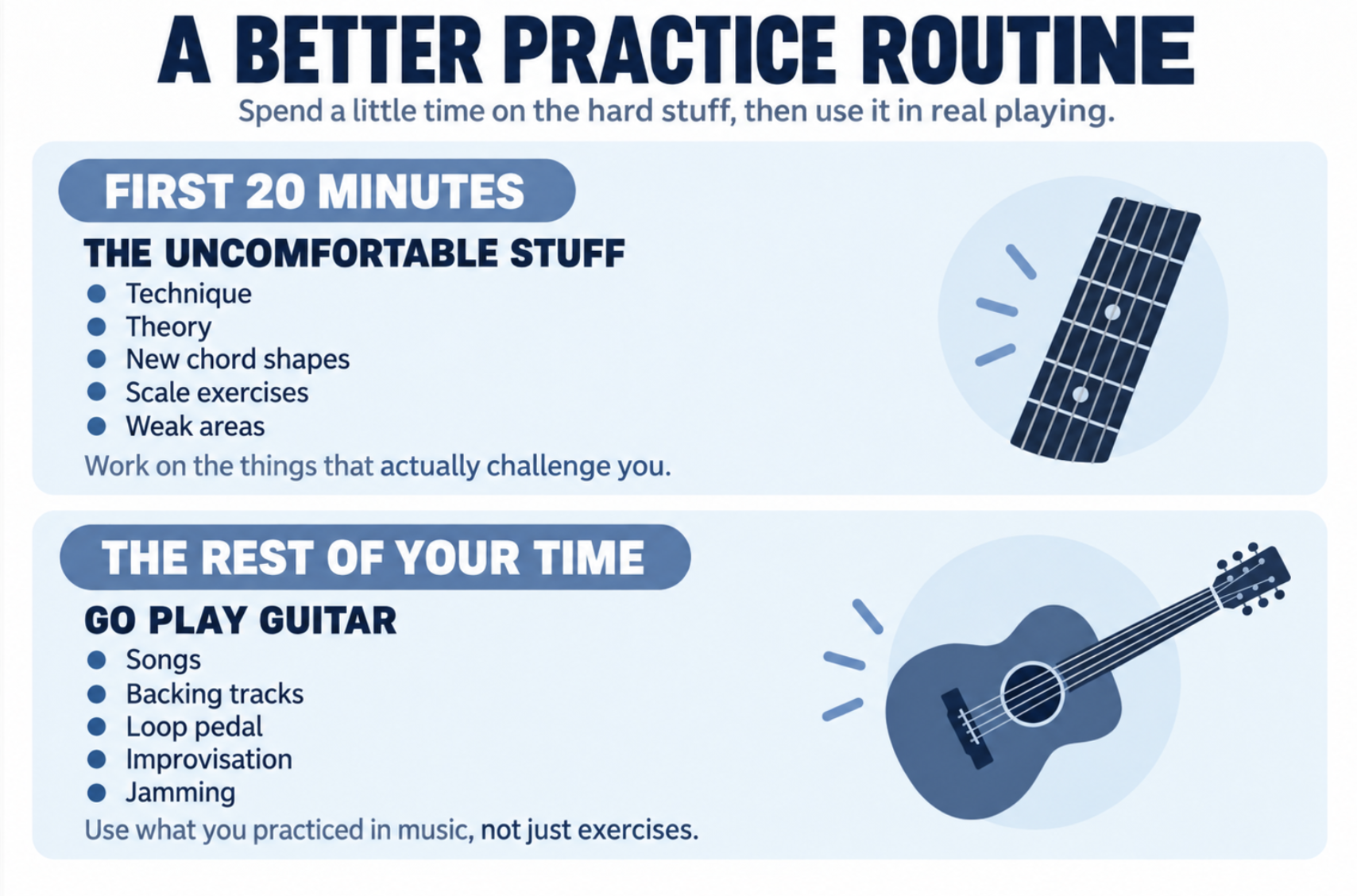
When you do the hard stuff first and THEN go have fun, you’ll notice the things you just practiced start sneaking into your playing. That’s when you really start digesting it and making it part of how you play.
6. You’re Not Getting Out and Playing
Guitar is something you love. So get out there and do it.
Find people to play with. Go to an open mic night. I know that’s a big ask, but it forces you to think like a performer. Made a mistake? You don’t stop and start over. You push through and carry on. The show must go on, right?
Playing with other people is huge for new ideas. Maybe you’re both working on the same thing, but you’re coming at it from two different directions with two different mindsets. That changes how you see the instrument.
Having someone to bounce ideas off of is always fantastic. You’ll both grow way faster together.
Play outside your comfort zone
Something else I like to do is practice in styles I’m NOT comfortable with.
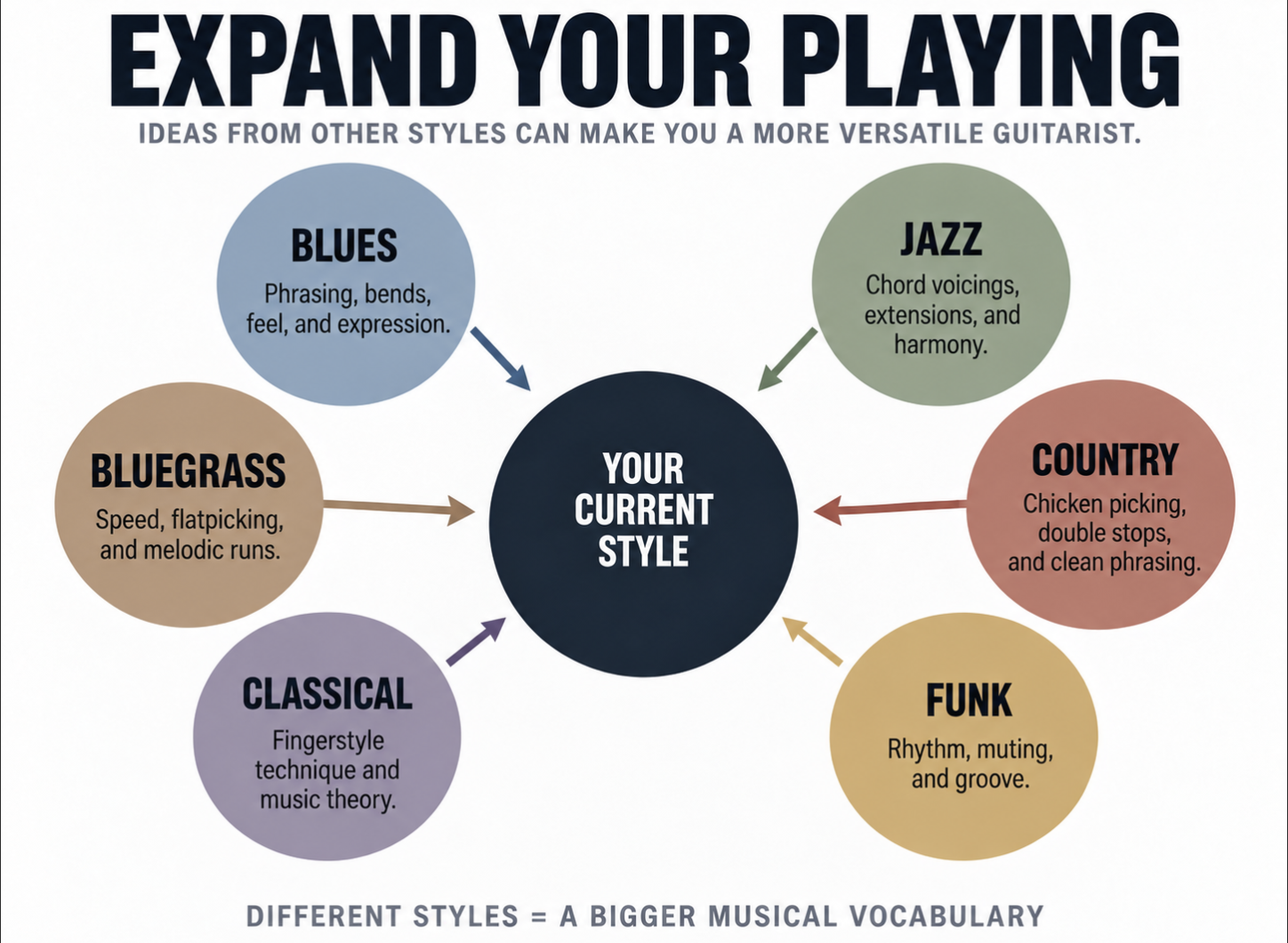
For me, that’s country and bluegrass licks. So that’s exactly what I work on. That way I can pull some of it into the styles I do love.
The more versatile you are, the bigger your musical vocabulary gets. And the bigger your vocabulary, the more complete (and better) guitar player you are.
7. You’re Not Picking It Up Enough
Think about the guitar players you idolize.
They play. And they play. And they play. And they play.
If you want to be good, you should too.
Like I said, you don’t need to sit down for eight hours a day. But when the mood strikes, pick that sucker up for five or ten minutes.
I like to hang my guitars on the wall or keep them on racks where I can see them. Sometimes I’ll walk by, grab one, blow through something real quick, and go “okay, got it.” Then I set it down and go back to whatever I was doing.
Even little things like that keep you tactile. They keep guitar at the front of your mind.
8. You’re Not Playing Through the Plateau
When you do hit that wall, play through it.
I know. That’s a tough ask. Getting stuck in a rut is about one of the most frustrating things that can happen as a guitar player. You’re sitting there going, “Oh my gosh, what do I do?”
Go find a new song to learn. Go find a new scale. Find something you’ve never done before.
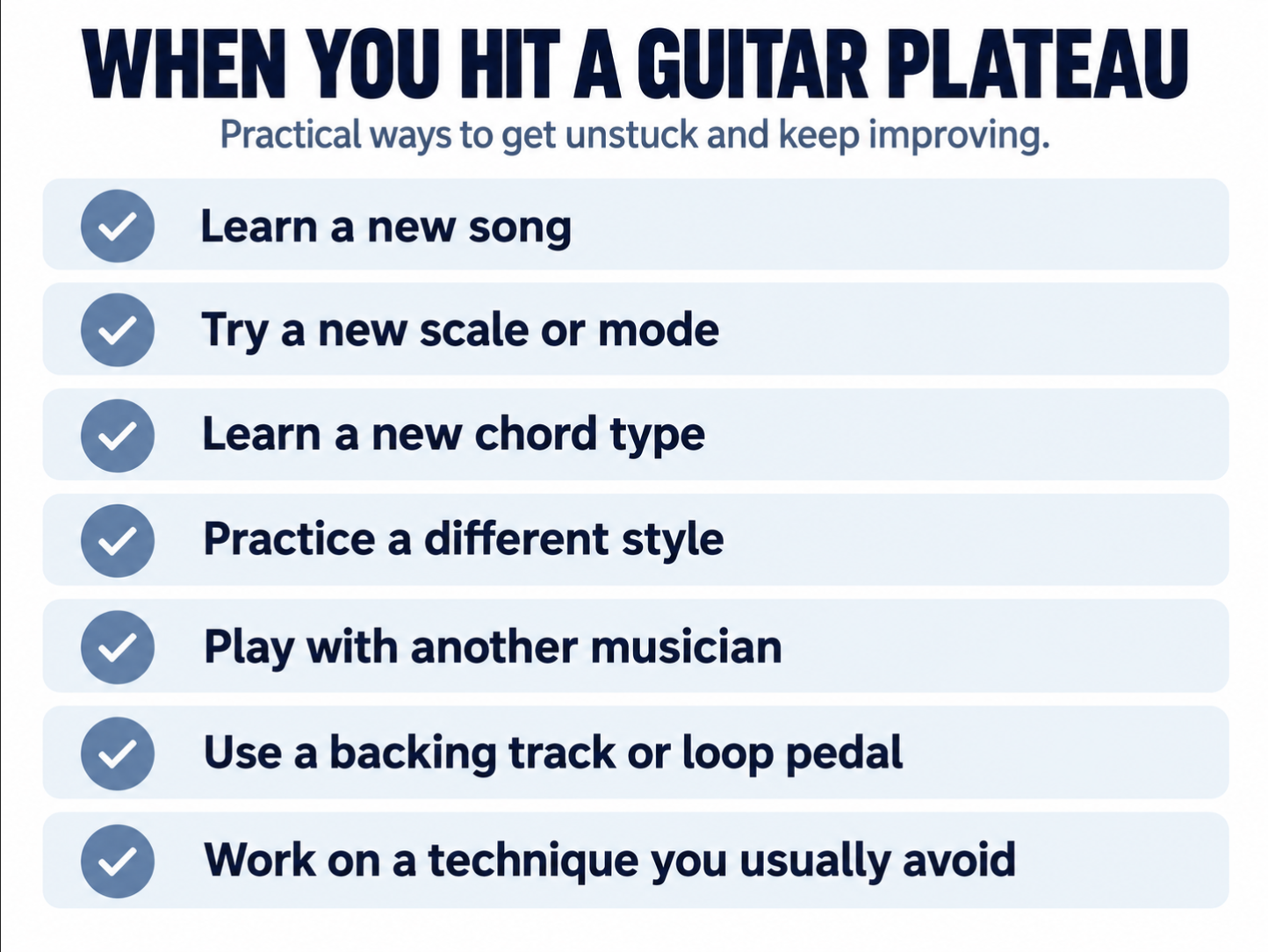
Sometimes that’s all it takes to blow the doors right off the plateau and pull yourself through.
Keep Moving Forward
Hopefully this gives you some new ideas to think about, and maybe a few new things to research and practice this week.