How to Play Seven Nation Army on Guitar (Easy Riff, Step by Step)
Today we’re taking a look at Seven Nation Army, off the White Stripes’ 2003 album Elephant.
Everybody knows the riff. It gets chanted at football stadiums by people who’ve never heard the record. But almost nobody who plays it at a jam knows the rest of the song, and the rest of the song is where the good stuff is.
We’re going to do all of it: the riff, the pre-chorus, the second guitar part that makes the chorus sound enormous, and the solo.
One thing to get out of the way first
Jack White uses a lot of different pedals: octave pedals, whammy pedals, all kinds of pedals to create wacky and wild sounds.
Most of us don’t have those, so we’ll just work with what we’ve got. You’ll get 90% of the way there on a plain guitar and a bit of dirt.
Also worth knowing.. that intro riff sounds like a bass, but it might not actually be a bass. It definitely isn’t a bass when they play it live. He’s running a guitar through an octave pedal to fake one, which is why it sounds like that and why yours won’t sound identical.
We’re in standard tuning for all of this. E A D G B E.
The main riff
Most of the intro and that recurring theme happens on your A string. One string, seven notes.
Start on the 7th fret of the A string. Play it twice, then reach your pinky up to the 10th fret.
From there:
- Back to the 7th fret
- Down to the 5th fret
- Down to the 3rd fret
- Down to the 2nd fret
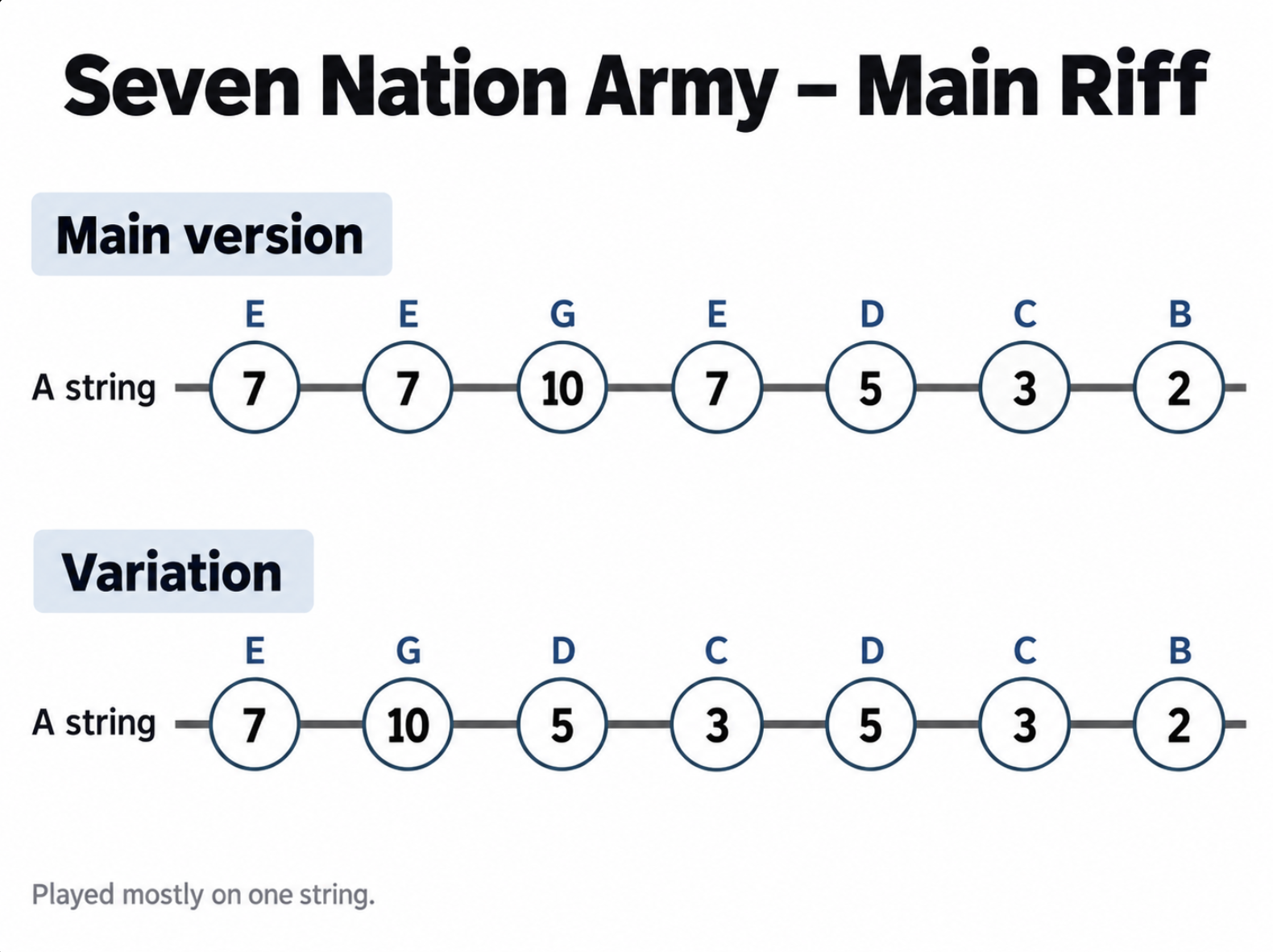
Sometimes throughout the song he does a variation instead:
7th fret, up to the 10th, then 5th, 3rd, back to the 5th, then down to the 3rd and the 2nd.
Learn both. He moves between them, and if you only know the first one it starts sounding mechanical after two minutes.
Why that riff got stuck in everyone’s head
Worth knowing what you’re actually playing here.
Those notes are E, G, E, D, C, B. All of them come straight out of E minor, and the line does one simple thing: it climbs once, then walks all the way back down and keeps going past where it started.
That’s it. A single rise, then a long descent that lands lower than home.
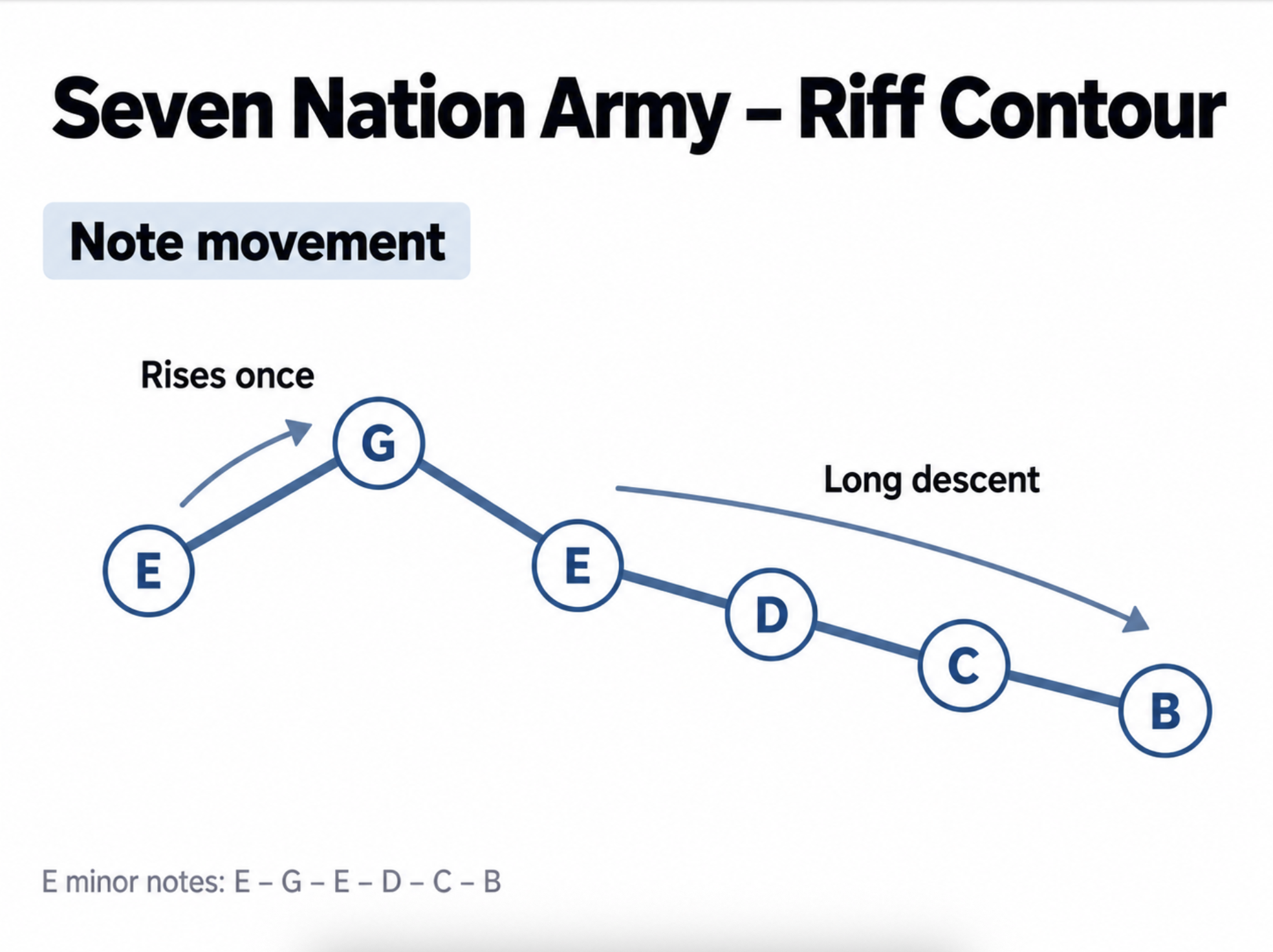
Riffs that stadiums chant tend to have that shape, because you can sing it after hearing it once. There’s no leap you have to nail and no rhythm you have to think about. Your ear knows where it’s going before it gets there.
It’s also entirely on one string, which is why it’s the first riff a lot of people ever learn and why it survives being played badly.
Getting the tone
Let’s deal with the octave question, because it’s the thing people fixate on.
The reason that riff sounds like a bass is a pitch shifter. Jack White ran his guitar through a Whammy pedal set to drop an octave, playing a hollowbody through it. That’s the sound. It is not a bass guitar and it is not a bass amp.
If you’ve got a pitch shifter or an octave pedal, set it one octave down and blend it under your dry signal.
If you don’t, play it on your bridge pickup with some dirt and move on with your life. It still reads as the riff, because the riff is the notes, not the pedal. Anybody at a jam will know what you’re playing within two seconds.
For the chorus bar chords, more dirt. That section is supposed to be loud and blunt.
Playing it on your own
If you don’t have a second guitarist, you’ve got two options.
The honest one is to just play the riff, and let people fill in the chorus part in their heads. It works. That’s what most people do.
The better one, if you’re comfortable, is to play the riff through the verses and then switch to the bar chord run for the chorus. You lose the riff underneath, but you gain the lift, and the lift is what the chorus is for. A loop pedal solves it completely if you’ve got one.
The song structure
Here’s the map:
- Intro, riff alone
- Verse, riff with drums
- Pre-chorus, the power chords, eight and eight
- Chorus, riff plus the bar chord guitar
- Verse
- Pre-chorus
- Chorus
- Solo, the slide section
- Final chorus, biggest one
- Outro on the riff
The pre-chorus
The little pre-chorus is a power chord on the 3rd and 5th frets. That’s the 3rd fret of your low E string and the 5th fret of your A string.
He plays the first one eight times. Count them out: 1, 2, 3, 4, 5, 6, 7, 8.
Then move up to the 5th and 7th frets. That’s the 5th fret on the low E and the 7th fret on the A. Another eight times.
Then straight back to the theme.
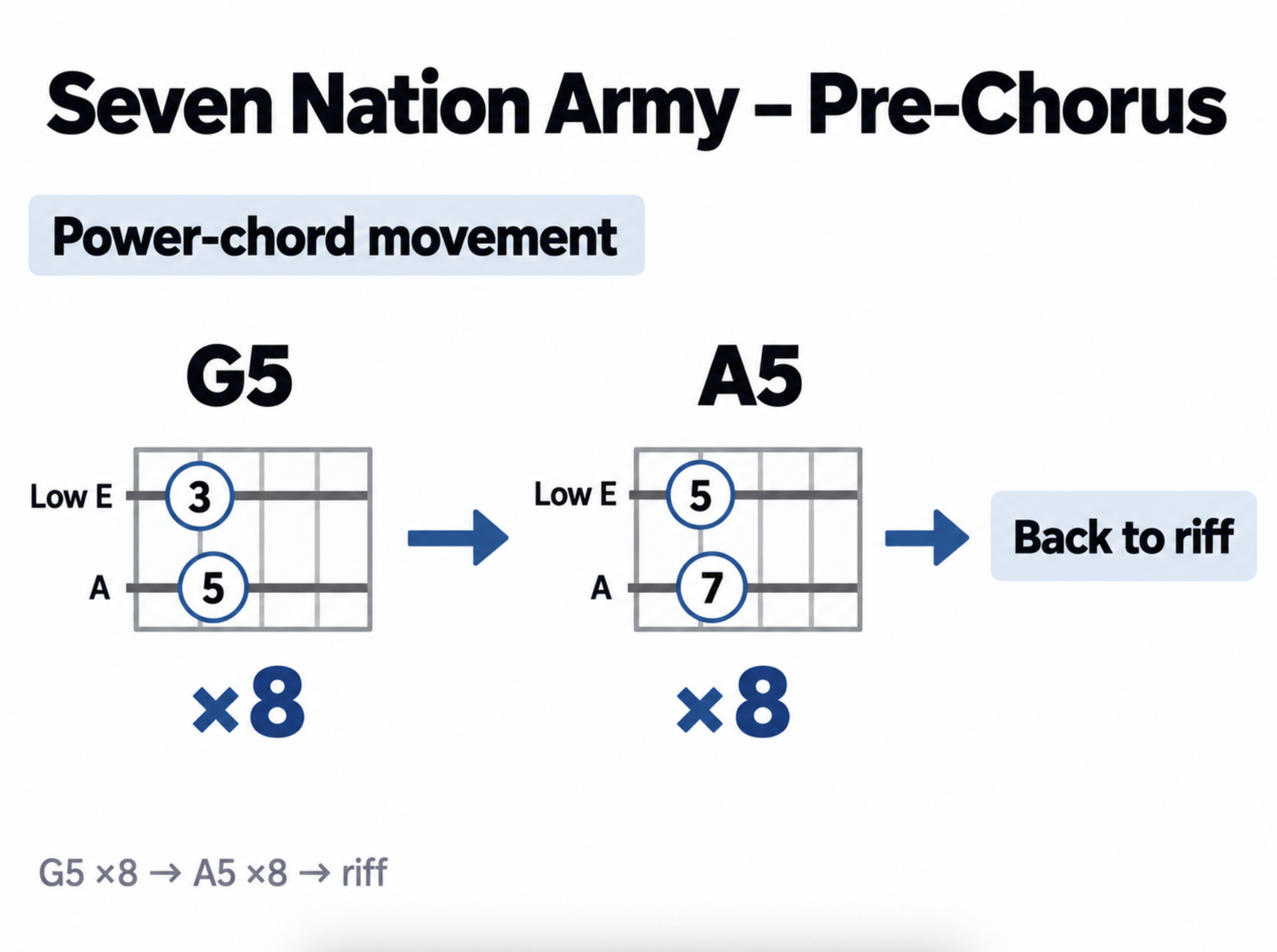
Eight is the number. Count it, because it’s easy to bail out at six when you’re playing along and the whole thing falls apart.
The chorus, and the part nobody learns
There are two guitars in this.
While one guitar is playing the main riff, the other one is playing bar chords. This is the part most people never learn, and it’s what makes the chorus sound huge.
The shape is the same every single time. Index finger barring, ring finger on the D, G and B strings two frets up.
Here’s the run:
- Bar the 7th fret, ring finger on the 9th. That’s an E
- Slide up to the 10th and 12th. That’s a G
- Back to the E
- Down to the 5th and 7th. That’s a D
- Down a whole step, barring the 3rd with the D, G and B strings on the 5th. That’s a C
- Down a half step, barring the 2nd with the D, G and B strings on the 4th. That’s a B
Same shape the entire way, you’re just moving it.
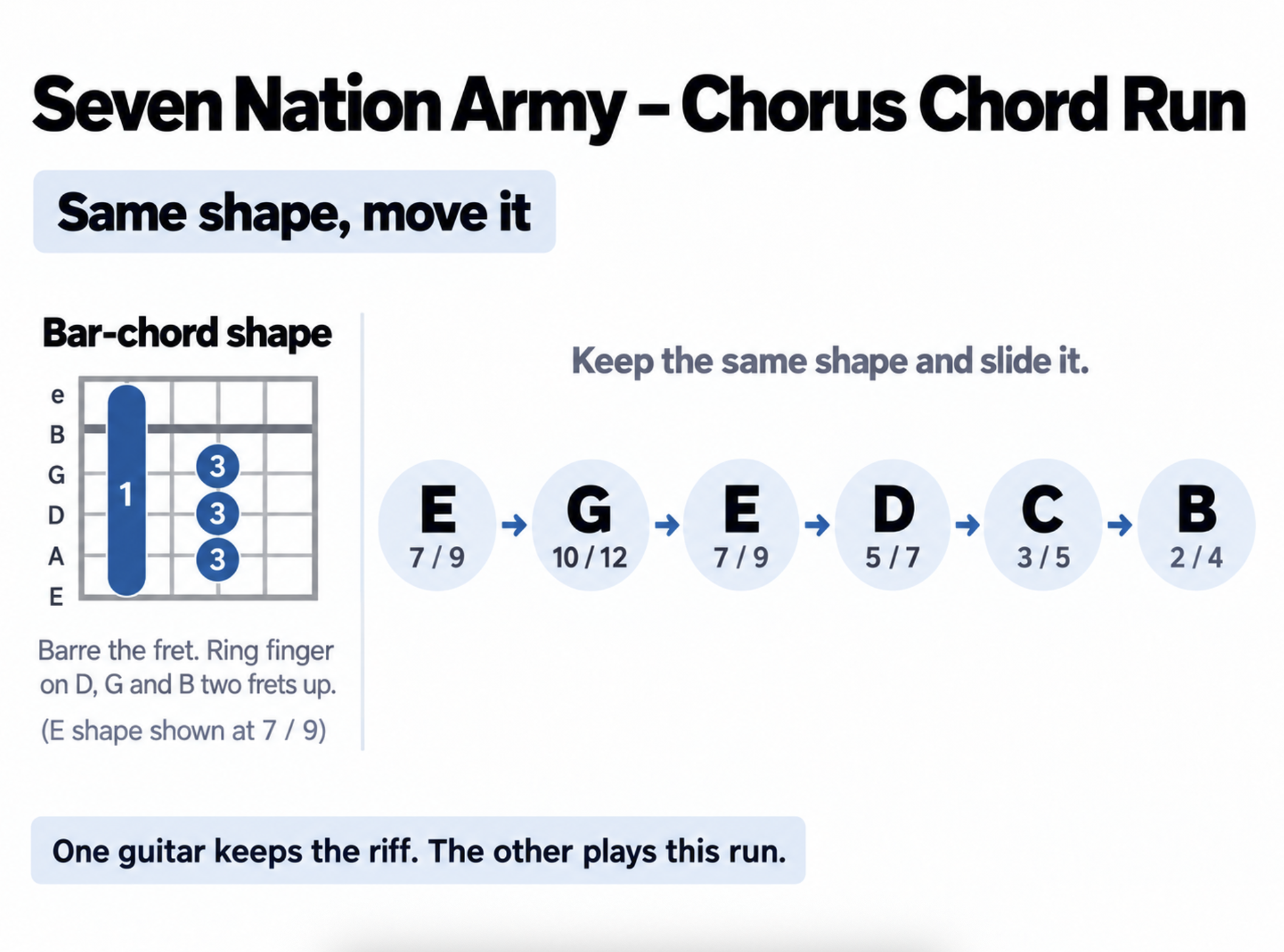
If you’ve got a friend who plays, this is the one to hand them. One of you takes the riff, one takes these, and suddenly it sounds like the record instead of like one guy playing a bass line.
The solo, and what to use instead of a slide
The solo is really interesting, because he uses a slide to get those wacky, slippery sounding notes.
Most of us don’t have a slide sitting around. You can use anything smooth. A pen, a bottle, a lighter. I’m going to use something we all have, which is a patch cable.
It sounds much better with a real slide, but this will work for our purposes.
Take your patch cable and lightly press it against the strings. Do not push all the way down. Just let it rest on the string and let it make the slide noises.
That light touch is the whole technique. Press down and you get a dead thud, because you’re fretting the note instead of letting it ring against the metal.
From there, we’re just above the 12th fret. Slide up to the 15th, back down to the 12th, then the 10th, the 8th, and the 7th.
Coming back down, he also goes from the 8th fret back up to the 10th.
One other thing he does in this solo:
12th fret to the 15th, back down to the 12th, up to the 17th, then the 14th.
If the slide part is fighting you
The slide section is the one place people give up on this song, so a few things that help.
Keep the slide, or whatever you’re using, parallel to the fret. If it’s at an angle you’ll get two strings at two different pitches and it sounds like a cat.
Mute behind it. Rest a spare finger on the string between the slide and the nut. Without that you get a second note ringing on the wrong side and everything turns to noise.
Aim on top of the fret wire, not behind it. Fretted notes go behind the fret, slide notes go directly over it. That’s the single most common reason a slide sounds out of tune.
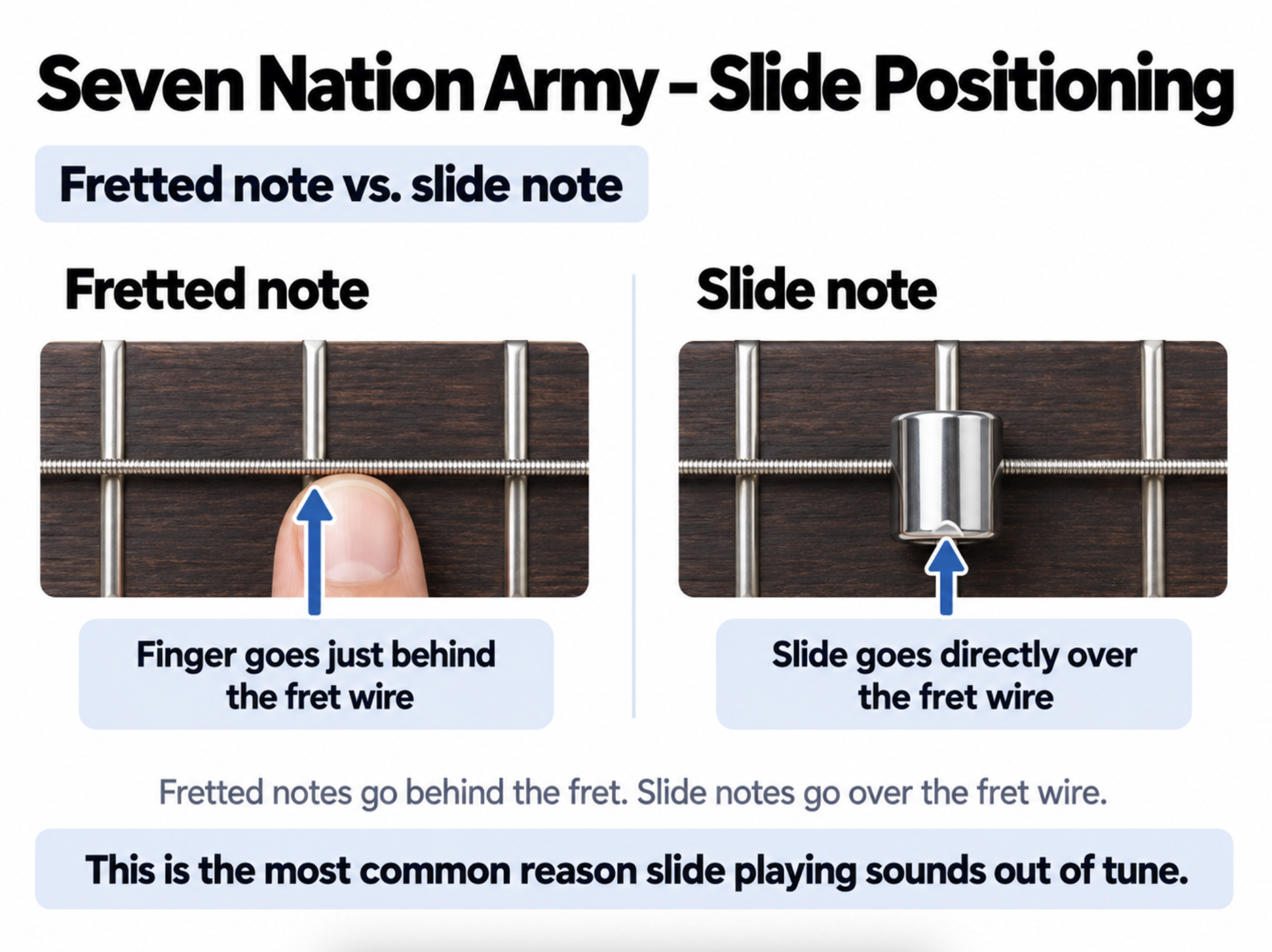
And if it’s genuinely not happening this week, play those notes fretted instead. You lose the swoop, but the line still works and you can add the slide later.
Common mistakes
- Only learning the first version of the riff. He alternates. It’s the difference between playing the song and playing the stadium chant
- Pressing too hard with your slide. Let it rest
- Skipping the second guitar part. It’s the whole chorus
- Losing count in the pre-chorus. Eight, then eight
- Trying to match his tone. You can’t without the octave pedal, and it doesn’t matter
What to practice first
1. The main riff, both versions
2. The pre-chorus, counting out loud
3. The bar chord run. One shape, five places
4. The slide part, last, once you’ve found something smooth to use
Piece it all together and you’re playing Seven Nation Army by the White Stripes.
Give it a go this week, and if you’ve got questions, come find us in the community.